Sunday, 26 May 2013

A trip to Dolnośląskie

All the good things have to come to an end… Taking a long-awaited and well-deserved holiday break helped me recharge batteries and forget about most of everyday worries. All the plans, social and sight-seeing-related have been followed out, so with no regrets tomorrow I’m bound to submerge into corpo-world. However, before I brace myself for a head-on collision with the recently upsetting murky corporate reality, let’s share some uncanny pictures and thoughts from the days off…

The Sky Tower in Wroclove, to the right shot from the street level, on its south-west edge. The tallest building in Wrocław was under construction in late summer 2011 when I last visited the city. Construction works were finished in 2012. The edifice built by Mr Leszek Czarnecki, one of the richest Poles, comprises of shopping mall, offices and apartments and there have been ample controversies surrounding the building, its design and whether its fits the rest of Wrocław in terms of architecture.

You may like its design or not, but you can’t fail to discern it. It’s visible from all main roads running to Wrocław from the distance of some 50 kilometres and right away it should strike you that the structure stands out in terms of height – the second tallest building in Wrocław is two times smaller… Its shape – looks like a tube sliced aslant – is a distinguishing mark. Whatever the owner and architects wanted to achieve has been achieved – no matter whether the building’s design falls in with your taste, pretty nobody passes it by indifferently.

To the right – north-eastern entrance to the shopping mall. Lipstick on a big, as I called this peculiar composition – the sculpture “Profile of time” by Salvador Dali was put up outside the building in April 2012 and has sat there since then. To make it clear – I have nothing against placing the piece of craftwork there and find it one of more attention-deserving examples of contemporary art (bringing to mind the timeless picture by Salvador Dali), but who the hell has come up with the ridiculous idea to mar the sculpture with the advertising screen put up just next to it? Does this stand for due respect for art? Or is the craftwork meant to serve the consumerism?

Sky Tower overlooks Wrocław and the further from it you move, the more likely you are to discern the characteristic tube in the distance. To the right, a photo taken from the southern fringes of Wrocław, where Al. Wyścigowa (former national road no. 8) and Al. Karkonoska  (National road no. 5) converge and then run towards A4 motorway. Before motorway bypass of Wrocław was opened this was a place where all the southbound transit traffic would meet…

Between the afore- mentioned streets one can find a cemetery of Soviet Soldiers. Cannons and tanks have been giving a warm welcome to all visitors coming to Wrocław since late 1940s when the necropolis was laid. This is one of many similar places in Poland (including the cemetery in Warsaw by ul. Żwirki i Wigury) commemorating the Soviet soldiers who “sacrificed their lives to liberate Poland”. The inscription to the right literally says: “HERE REST THE SOVIET ARMY SOLDIERS, PARTICIPANTS OF WROCLAW BATTLES WHO HAVE LAID DOWN THEIR LIVES FOR LIBERTY AND INDEPENDENCE OF NATIONS OF POLAND AND THE SOVIET UNION”. Unless you are a hard-line commie, you should at least bridle at this pack of lies. What liberty? What independence? Many lunatics would probably be in cloud nine, if only they could obliterate such places of commemoration and go unpunished. I in turn hold the view such places should be taken care of and stay unharmed to bear testimony for next generations, also to bear testimony of omnipresent lies on which the totalitarian system was founded. Besides, those soldiers who rest there, were also victims of communism, cogs in a machine who were meant to die in order to let the Soviet empire expand westwards… They, as all humans, deserve a place of peaceful rest…

Coming to down-to-earth issues:

The weather was clement until Wednesday afternoon when temperature unexpectedly plunged and fell to mere +5C on Thursday morning. Given that spring came later than usual this year, some northern slopes in Karkonosze were still covered with snow (to the right, view from Kowary).

And two shots from Jelenia Góra – to the right, a pebble from Jelenia Góra, encased in cobblestone in the market square. Long story why it’s been here, every why has a wherefore. If any of the readers bothers to tell the anecdote, I’d be more than grateful…

To the right, again Jelenia Góra – every city must have its focal point, but few have it marked so distinctly. Interestingly, this is an element of a Church property. I won’t dare to speculate whether this is just a coincidence, or if it proves dominance of one specific institution in the Polish secular state ;-)

The trip was eventually in some 70% sponsored by a carefree driver who rear-ended me in Jelenia Góra. The speed at which the rear of my car was hit was low (again, inattention and centimetres lacking to make it a near-miss) and I was lucky not to sustain any neck injury (cervical spine is very sensitive to such accidents) and the damage done to my car was negligible. Upon checking the exhaust system and boot door lock remained intact, the culprit and I agreed on a few hundred PLN compensation for visibly scratched paintwork on the rear bumper. The damage doesn’t diminished the car’s utility value and it earned me some dough…

A propos motoring. After the period of run-up to Euro 2012 when several kilometres of roads were being modernised and built and ordeal drivers had to go through, now we can enjoy much higher standard of expressways and motorways – the wait was worthwhile! This was the first time I drove the newly built almost 100-kilometre long section of S8 (I last was there in September 2012, a month before opening) between Mszczonów and Piotrków Trybunaski and for the first time drove without even having to downshift to 4th gear 102 kilometres from Kostomłoty (junction on A4 motorway west of Wrocław) to Syców, where S8 expressway ends and turns into National Road no. 8, full of big trucks, small towns and numerous speed cameras… The missing section between Piotrków and Syców is under construction, due to be opened in 2015. Fills with hope. Actually driving the decent roads is faster and safer, but not necessarily cheaper. Unless you hold your horses and move excruciatingly slowly (100 kmph in my car is the speed above which fuel consumption begins to soar, from 6 litres of petrol per 100 km when the car does 100 kmph, to 8 litres when speed rises to 130 kmph and some 10 litres if I reach 150 kmph), the journey will set you back more (even more if you go via toll motorways, not the case this time) – but at the end of the day, comfort has its price…

Sunday, 12 May 2013

Poles aged 30 – portrayed, but accurately?


From time to time journalists of Gazeta.pl (online flank of Agora S.A., one of the most influential, leftist-liberal, media holdings in Poland) come up with series of articles dwelling on social problems. Quite recently two of them encouraged readers of the portal, aged near 30, to share with wider audience how their dwellings looked and what their material status in terms of housing conditions was. I usually keep track of such series with some does of curiosity, but that time I impatiently waited for each consecutive article, then read each of them with bated breath and avidly followed record-long comment threads…

The larger project run in attempt to paint a collective portrait of generation of 30-year-old Poles began by posing a question why people born in early 1980s are reluctant to have children. In the next step journalists resolved to find out where and how those people live and how the finance their housing needs.

The first article is a string of brief stories which paint a bitter-sweet picture…

Kaśka, aged 32, and her husband co-rent a room in a bigger flat. It’s cheaper and more practical, yet at times inconvenient. Their salaries would suffice to rent a tiny flat in a shanty town, but they prefer a 20-metre room in a flat shared with other people. Tensions sometimes appear, but when they are in need, they may count on their flatmates. In the meantime they put aside money to have equity and get mortgage on more favourable conditions. As for now, no bank finds them creditworthy. Purchase of property with cash – out of reach.

Błażej, aged 30, lives with his girlfriend in her 42 sqm flat (probably inherited or bought by her parents, photo suggests it’s located in Służew, part of Mokotów district, Warsaw). Given his girlfriend’s and his earnings, they wouldn’t be capable to service any mortgage debt, nor to rent any flat. Their aspirations have been fulfilled. Probably hadn’t it been for the windfall (his girlfriend’s own flat), they would live with parents…

Agata, aged 31, and her husband live in a mortgaged flat. Shortly after getting married they lived in a rented flat, then when a child’s birth was imminent, they took out a loan. Month by month, they move closer towards “full ownership” of their flat.

Piotrek, aged 30, and his wife, with some support of their parents and bank financing, bought a 70 sqm on city fringes. In his view this was a fair trade-off between location and size. Debt burden is not excessive and the flat would be spacious enough when children are born.

Anka, aged 29, is also one of those better-off. Since she was 20 she lived in flats inherited after family, currently she and her husband live in a house built on a plot donated to them by husband’s parents. She’d be damned if she dared to complain about her housing conditions.

The stories above bring a moderate dose of optimism. All character manage, some better, some worse, but are satisfied with what the have and keep cheerful. When you begin to read next sent in pieces, smile is immediately wiped off you face…

Sferyczna, single woman, aged 30. Lives in Warsaw, but hails from provincial Poland. Worked for a while abroad, but has not managed to save any money. Currently rents a tiny room in a tiny flat and estimates is 5 years will be eligible for a mortgage. Interestingly, she claims to earn more than peanuts and still she declares she can afford very little…

Karolina, aged 31, and Marcin, aged 36, have one child and live in an old flat that could do with a comprehensive refurbishment. Mortgage is a huge burden for them, each unplanned expenditure or a second child would blow over their budget. Loan instalments make up more than half of their income – this speaks for itself…

Next piece contains two contrary opinions. Rafał, aged 31, and his wife wonder whether only grumblers are around. He wants his voice to be audible. Instead of grumbling his wife and he toil away up to 60 hours per week, have built a house and bring up two daughters. Not a word about any mortgage, but he mentions his father who runs a prosperous company. Despite having little spare time, he claims he is happy and encourages to sheer hard work, which, as he believes is a key to the door of financial and personal success.

Marek, aged 27, has co-rented a flat since coming to Warsaw 5 years ago. With his earnings, little more than 2,000 PLN after tax, he can only afford to rent a small flat and pay maintenance charges, this all sets him back some 1,500 PLN – after this he has 600 PLN to spend on food, travels, clothes, entertainment??? He sees future in anything, but bright colours – with his earnings he stands no chance to get a mortgage and own any property…

Need something upbeat, don’t continue reading… A 30-year-old single woman has just bought her own flat. The mortgage and refurbishment loans have both 23-year repayment schedules, but her own flat is a step forward after years of renting and sinking money to landlord’s pocket. Living conditions are pretty dire, but glimmers of hope bring about smile on her face. In a few months the flat will be finished. As for now, she saves on everything, including food and scrapes along, to service debt timely…

Another confession, written by a 29-year-old man. He works in a public sector, is employed for a finite period and earns minimum wage. No chance to move out of parents’ house, even to rent anything. No prospects of becoming self-supporting, of raising family, no feeling of stability. He’s angry with those who stigmatise his peers who keep living with parents. In fact many of them do this not out of fear of taking responsibility for their lives, of facing adulthood, etc., but they stick to their parents for purely financial reasons. When earning 1,500 PLN after tax, attempt to taste independence is like being thrown at the deep end… Hopes for future… None… just prospects of barely getting by…

Not yet miserable? Carry on! A 31-year-old single woman has a single-bedroom mortgaged flat, but she and her daughter live with her parents. The graduate of Polish studies and Journalism, since finishing school changed jobs many times. Each was supposed to have been temporary, before she found something more desirable. In 2010, with support of her parents and a bank she bought a flat. Soon after she was offered a new job, left the previous, well-paid one, and eventually was left out in the cold, because the new employer changed its mind. Never jobless, she had next temporary, poorly-paid jobs which allowed her to pay bills and mortgage instalments. A year after it turned out she was pregnant with a man who turned out to be too irresponsible to fulfil role of a father. To make ends meet, she moved to her parents and lets her flat to repay the mortgage… She wipes every night and slowly is losing hope for a better tomorrow…

Let’s face it – those letters have been picked out of several sent in to Gazeta.pl’s editorial room. The picture of the generation which emerges is a matter of who and on the basis of what criteria chooses which letters to publish.

More interesting are plentiful comment threads under the articles, counting several hundred entries. Comments can be divided into a few categories…

Predictably, quite a few commentators trot out the “young, educated, from big cities” myth – they argue the depicted misery bears a truthful testimony how in fact the “Green Island” looks like and what the youngsters got from the party they had voted for. How long before people realise politicians’ influence on people’s everyday is much smaller than they claim? Misery of many young people can’t be put down to “feckless rule of losers and traitors”, while if the biggest oppositional party came to power, it wouldn’t turn Poland into a land of milk and honey. Society and economy are driven by actions of millions of individuals, not by decisions and deeds of few politicians. They don’t have power to heal the country and, on the other side, have little power to screw things up. If I were to be malicious, I could say between 2005 and 2007 property prices in Poland soared by almost 100%, hence becoming less affordable.

Some commentators point out those stories do not hold water – why somebody takes out a loan and than changes a job, for a worse-paid one, how some of mortgage instalments calculations match with what somebody has left at their discretion, etc.? Some even claim the stories sound so incredulously that they appear concocted.

The more ruthless advise authors of the letter who take pity on themselves to blame themselves, not the rest of the world. Who made them choose dead-end studies? Who precluded them from working harder? Who told them to change jobs several times?

Other group indicate young Poles have over-inflated expectations regarding consumption and earnings, while it takes time to grow into wealth. The only way to consume more than you can afford to is living beyond means, which means living with a ball and chain in form of debts and praying luck streak doesn’t cease, as then the frail wealth collapses.

For my part – I have no right to complain… I’m better of in comparison to some 99% of my peers. I don’t live in my own flat, but this is only my choice – I can afford to rent or take out a mortgage, but since there’s no pressure to move out I keep living in my parents’ house (and give them little money each month) and put aside some 70% of my salary. I earn very decently and have prospects of even higher earnings, but on the other hand at the back of my hand there’s a seed of uncertainty – my employer knows how to send adrenaline rising and having seen people being fired (with 1-day notice and generous severance packages) I realise no matter how committed I am, one I day I can have an inadvertent slip-up or my employer may change strategy and back out of business segment I work at, resulting in my job contract being terminated. I have job contract for indefinite period and well-above national average salary, but in return am offered no stability. I don’t go mad with the awareness each day might be the last day of my work only because I don’t have to provide for a family and have no debts to settle.

I’m also far from sharing opinions of those telling those unhappy people to blame only themselves. Success, not only financial, is a combination of many factors, including parentage (if your parents are wealthy, you’re better off at the start), skills (many are inborn I believe, you may develop them or not, but if you really lack a specific skill, developing it won’t get you far), hard work (inborn skills without hard work are useless) and luck… Every day I happen to realise where I am now and what I do is just a stroke of fate… Of course I can’t pronounce it’s prudent to take dead-end studies in political sciences, change jobs frequently, or get pregnant with an immature man, but in some cases people are inarguably out of luck and telling them to blame themselves proves only lack of empathy. Not everyone has a chance to be born in the capital city, in well-off family, to have educated parents. Most people have it up-hill and in Poland I can’t honestly say others have it downhill.

I recently calculated, with my above-average earnings and possibility to put aside most of my salary, if I was to start saving from scratch now, I’d have to save for 6 years to buy an average 50 sqm flat in Warsaw, assuming property prices stayed unchanged. Some time ago I read an average Pole would have to save for 11 years their whole salary to buy such flat. Imagine this – live with your parents for 11 years, let them feed you, don’t buy clothes, cosmetics, don’t go out, don’t travel and after 11 years you can buy a flat for cash. If your parents can’t support you financially you can only take out a huge burden on your back and pray nothing goes wrong along the way. How young Poles live is an aftermath of still steep, in comparison to earnings, property prices in Poland. As many market specialist claim, only increased supply of dwellings could help solve this problem – this can be achieved in form of public-private partnerships – local governments building in partnership with property developers council flats for rent. But for this you need a proper legal framework and wise and honest people to run such schemes. Out of reach, just like own flat for an average Pole turning 30…

Apologies in advance for taking a break from blogging next week. I’m holidaying… At last :-)

Sunday, 5 May 2013

Early May long weekend – from sociological standpoint

1 May (Labour Day) and 3 May (Constitution Day) are bank holidays in Poland. This favourable alignment of non-working days almost each year gives an opportunity to extend a weekend preceding or following those days and take longer holidays. The majówka has already become a well-established annual tradition since the Constitution Day was reinstated over 20 years ago, while Labour Day, the paramount festival of the working class in PRL, remained intact as a public holiday.

Customarily, most schools and universities do not hold classes, many offices close, public transport vehicles run according to weekend timetables. In a word, in the first days of May Poland runs into a standstill, or at least is ticking over.

Many people decide to go on holiday at this time, as by taking a few days off they may extend their time off-work for up to 9 days. Many do this because they have no choice, either because they need to look after their children, or because their employer forces them not to come to work. Lucky are those who may voluntarily come to work on working days in the middle of the long weekend. The customary daily routine is that you come slightly later, go for a longer lunch and knock off earlier. Little is going on in the office, nobody pesters you with e-mails, phone calls and at the end of the day it turns out your efficiency rises and within 5 hours your output is equivalent to what you manage to do on a normal 9-hours working day – you can sit back and catch up with overdue tasks. For this reason I hardly ever take days off during long weekends. It simply doesn’t pay off, I even draw a lot of pleasure from going to work on such days. The atmosphere is quite specific and I must say everyone likes this feeling of being laid-back.

If you aren’t at work, there are several popular ways of spending the early May long weekend: going to holiday resorts (seaside, lake district, mountains), spending it in own or friends’ allotments, or on outdoor activities near your dwelling. This year I feel sorry for those who decided to holiday away from home, as the weather, unlike last year, is awful. Temperature below 20C, sparse moments of sunshine, yet rainfalls in abundance. Only today sunshine fought away clouds and Poland was basking in spring pre-heat.

The key outdoor form of entertainment in the last 20 years in Poland is making a barbecue. People from all walks of life keenly indulge in this form of leisure. No matter if you have a big garden, an allotment, a balcony or go to a park, no matter where you live, how much money you have, how old you are, preparing grilled staff and consuming it gives pleasure to almost everyone, except for some neighbours, sick of inhaling accompanying smoke. This year weather has not been conducive, as it settled clement at the end of the weekend, but today I finally bothered to inaugurate the barbecue season…

From what I observed over those days:

1 May 2013 – lots of people working around their houses – painting fences, cleaning cars, tidying up garages, mowing lawns. This is not a Church holiday so nothing holds them back from physical work which is considered inappropriate on Church holidays. Trains run half-empty (I boarded one in Warsaw, after getting sweat during a bike ride – air was very humid and I decided to take a rest and let the train carry myself closer to home). On my way I noticed few people on bikes, those I ran across were usually fathers with children.

On 1 May few people take part in marches staged by leftist organisations. Instead of claiming the rights of the working class, Poles prefer to relax. But if, for ideological reasons, someone would attempt to scrap the Labour Day, they would all in unison stand up for this bank holiday, for their right to have a long spring weekend.

2 May 2013 – traffic is sparse – on my way to work I get fed up with unhurried drivers and… am in a luck not to be caught by a police patrol, or by a speed camera. Having got off the underground I stroll past desolated streets to my office. At half past three I knock off and cadge a lift from my workmate who lives in Ursynów. Thanks to her favour I get to my car within 20 minutes – the traffic is blissfully sparse, although not as sparse as on bank holiday – this indicates shopping generates much of the traffic volume... Then I head for Konstancin and while I’m driving, heavens open. I feel sorry for numerous bedraggled cyclists I spot there.

3 May 2013 – rainfalls cease around midday. In the afternoon I set off to Piaseczno. I pass by few people as I walk to my hometown; traffic on the roads is anything but dense. The humans I come across come basically from two groups – either parents taking their children for a walk, or alcohol addicts on the lookout for a liquid which would quench their thirst. On the market square I observe a patriotic celebration taking place. Runners are getting ready to a Piaseczno – mile race. Most people sticking around are again parents with children. Credit to them – at least they want to familiarise their offspring with the history (40% of Poles don’t know what event we commemorate on 3 May, is unaware of circumstances in which the constitution was passed, or mistakes it for independence day…). The upbeat observation is that almost all cafes and bars are open – if you want to eat out on a national holiday, you won’t have troubles finding an eatery. The downbeat (or, why?) observation is that all off-licence shops are opened and in front of each you can see a gathering of drunkards (I was accosted by one of them, insisting I lent him 2 PLN). Besides – humans almost disappeared, Piaseczno again appears abandoned.

Swimming pool, which I visited three times during the weekend was anything, but full. The better for me, on Saturday morning half of the time of swimming I could enjoy the whole track at my disposal.

Today, while cycling from 10 a.m. until midday, I spotted no more than 20 other bike-riders, including an admirably fit “grandpa”. The man, I estimate no younger than 70, while overtaking me (I cycled some 20 kmph) asked how to get to the [brand] shop with sports stuff and having received instructions accelerated and rushed forward. The chap’s fitness was enviable.

Crowds were somewhere else… The picture which emerges from the jumble of observations above is gloomy. Given that
- an average Pole can’t afford to spend the long weekend away from home, unless at their family’s,
- number of cars parked outside houses and living blocks was no lower than on ordinary weekend,
- few people were out to the streets and traffic was sparse,
- on 1 May and 3 May shops were closed (unless their owners, their families or employees with contracts not governed by the labour code stood behind the counter),
- no crowds could be spotted in the places of leisure,
- half of Poles do not read a single book in a year,
the facts above lead me to a dejecting conclusion that an average Pole spends the long weekend sitting or lying in front of TV (or computer) screen and this gets me down. I’d prefer my nation to be more open-minded and this can be achieved by spending more time outdoors and in places other than supermarkets and shopping malls. I’d prefer my nation to be fitter and without walking, swimming, cycling or working out this can’t be achieved.

Or maybe I’m just picking on. Everyone should rest and relax the way the feel is best for them. Doctors advise people whose lifestyle is sedentary should choose pastime activities involving physical exercises. After spending most of the week behind my desk at work I can’t imagine myself sitting more than I need before my laptop or lying in bed and watching TV (I hardly ever do this). Spring beckons and young body cannot resist it!

Sunday, 28 April 2013

Pension system in Poland – pending overhaul…

The topic of private-run pension funds in Poland (the biggest scam in the history of Poland after 1989 IMHO) has been shelved on this blog over two years ago. Back then I outlined a relatively decent (how modest of me) summary of its workings and the government’s plans at that time. As I see no point in flogging the dead horse, if you need to catch up, please revert to ample previous posts where you can find both my private opinion on the workings (and pathologies) of second pillar of Polish social security system, as well as an unbiased description of it.

By the end of first half of 2013 the government plans to carry out a long-awaited comprehensive review of the whole pension system in Poland, the review is bound to cover not only the private-run pension funds, but also other contemptible features of it, such as privileges for many groups of professionals that need to be funded from taxpayers’ purse.

As the results of the review have not come to the light, there have been speculations regarding what the government might do to enhance workings of the private-run pension funds. As some of the government-liked economists claimed, any outcome was conceivable, including fully scrapping the pension funds and moving assets from there to state-run social security fund (running deficit for years), if their existence was deemed detrimental to future pensioners and public finances. This most abject plan has been given up, as one of three main rating agencies threatened to downgrade the rating of Poland if the government seized assets accumulated there. The Polish government is aware that you shouldn’t mess with ruthless financial markets and it quickly backed out of such option, declaring it had never come into play. I’m in two minds about such stance, but it’s hard to deny the government the foresight in this respect. Lucky streak of low debt service costs will not last forever…

Now to the point. Pension system is an element of public discourse; several economists, politicians and, let’s speak it out, lobbyists make several statements to shape Poles’ opinions on it. The problem is some of them are not home truths. I will confine to pointing at just three most blatant… Distortions? Misleading statements? Departures from truths? Misrepresentations?

Misrepresentation 1: Money amassed in pension funds are Poles’ private savings.

The sentence above could be a nice illustration of the English idiom “pack of lies” – let’s count how many lies can you pack into one sentence.

“Money” – what money? Pension funds are a pool of assets, including two key types: government bonds – ca. 55% and shares of publicly traded in Poland companies – ca. 40% (the rest are miscellaneous assets, also cash and bank deposits). These assets are hence securities which represent either a government obligation to redeem its bonds, or ownership stakes in companies.

“Private” – further on, pension funds keep records of their participants in relevant registries, thus each participant is allocated a share in the pool of assets (recorded as number of “settlement units” allocated to them), each share has the same composition of assets. Now how come it is “private”? How come many claim those “money” belong to future pensioners, or is even owned by them? Let’s look at some facts? On 4 June 2008 the Supreme Court of Poland handed down a ruling (quoted and linked in one of previous posts) which clearly stated assets in pension funds are a part of public social security system, hence contributions to pension funds are obligatory. This should dispel all doubts – whatever assets are allocated to the account assigned to you in a pension fund, they are owned by the state. If however, just like many other people, including dr hab. Leszek Balcerowicz (interesting why everyone titles him “professor”, if Mr. Balcerowicz does not hold this academic title, it is only his position at the university I graduated from), claim this is your money, ask yourself a few fundamental questions:
If it is your money – why can’t you withdraw it and spend it the way you want?
If it is your money – why can’t you have influence on how it is invested?
If it is your money – why can’t you use this assets as a collateral for a loan you wish to take out?
If it is your private money – why are you forced to pay huge load fees to private companies managing it?
The only advantage of it “savings” in pension funds is that they are inheritable. There are of course some restrictions aimed to keep “money” in the system, but indeed there are case when contributions, depleted by fees charged by management companies, can come out of system in real cash. Unfortunately the only such circumstance is death…

“Savings” – peculiar are savings funded by debts run up by the Polish state of the taxpayers… With some “little” help of 14 useless, yet expensive intermediaries. No comments…

Misrepresentation 2: Pension funds fetch high profits.

Remember the adage there are “lies, damned lies and statistics”? You could add financial reporting tricks to that list. Here the trick is simple and only recently somebody bothered to analyse its impact on returns brought by pension funds.

The mechanism is very simple – what in all statistics is presented as rate of return is a growth in value of “settlement unit” – a book record representing market value of some portion of assets in a fund. Example: let’s assume now your contribution to a pension fund is 100 PLN. The moment you make a payment one settlement unit is value at 10 PLN. 100 divided by 10 is 10, so you should have allocated 10 settlement units to your account. And here’s the catch! Because load fee for each contribution is 3.5%, only 96.50 PLN out of 100 PLN is invested in assets in the pension fund, the rest goes to oil the wheels of the pension system, majority of which to private management companies. Now let’s assume the value of funds’ assets rose by 4% over the reporting period, so the end-of-period value of one settlement unit is 10.40 PLN. Now recall you bought 9.65 settlement units. Value of assets allocated to you is 9.65 times 10.40 = 100.36 PLN. Your rate of return is 0.36%! Surprised? Now let’s face some other facts: I omit management fees, as they are included in valuation of settlement units, at the reform inception load fee was 10%, then 7% and some 3 years ago it went down to 3.5%. Imagine then break-even rates of return, i.e. by how much market value of funds’ assets had to increase to let their participants earn at least a nominal return (answer: they are respectively: 11.11% and 7.53%), let alone above-inflation one. To recap, given that yields on government bonds run near inflation rate and returns on stocks are very volatile, this system cannot (has a built-in inability to) generate profits to future pensioners. The only beneficiaries are private companies administering it.

Misrepresentation 3: Obligation of the state in form of issued bonds, purchased by pension funds, better secures future pensioners’ interests than promise in form of book record in state social security fund.

Giving lie to this statement takes very little. Let’s look at the example of Greece on the verge of bankruptcy. Bondholders had to accept 53.5% face value haircut, which means out of each single Euro they recover 46.5 Euro cents. Most pensioners have not seen their benefits declining by such percentage, usually in nominal terms their benefits fell by 30%. Media reported single cuts by 60% or 70%, however these hit most privileged Greek pensioners. Moreover in November 2012 Greek Supreme Court declared pension cuts unconstitutional. The same, under the current legal framework, would probably happen in Poland, if it, heaven forbid, was nearing default. Get real! Promise on form of bonds has no higher value than constitutionally protected right to participate in the social security system!

One more misrepresentation is in the calculation of state’s liabilities towards future pensioners. Pension funds advocates claim thanks to existence of pension funds, they become explicit, while in the state-run social security fund they are hidden. They also calculate book record of sum of liabilities on technical accounts with social security fund. They only forget about one detail – these are all contingent liabilities – the state does owe that much to people, as this worst-case scenario comes to a pass only if all people reach pension age. Once somebody dies before retirement, liability towards them is erased. There is no indecency in it, as social security system in Poland functions as insurance – if you pay contributions, you may, bit not have to get the benefit.

Hope it has given you some food for thought, and not for the last time.

Sunday, 21 April 2013

"It depends"

Is probably the best answer to (most of) the questions below…

How can you define love? *

How many kinds of love can you distinguish?

Should love be unconditional? **

What can love be mistaken for? Desire? Passion? Fascination? Infatuation? Craving? Obsession? Affection? Care? Friendship? Dedication? Sacrifice? Something else?

Why do people pair off? Just driven by the feelings (?) named above? Not to be alone when they grow old? To have a shoulder to cry on? For practical / economic reasons? To bring offspring to the world? Out of primeval instinct of preserving the mankind? Because it’s socially acceptable? Because others do it?

Why do people decide to formalise their relationships by getting married? Does the institution of marriage reinforce the bond between them? Do they think due to formalised procedure of breaking up (divorce) they can make the other one stay by their side? Does the ring on the finger change the way of thinking of the opposite sex? For same reasons as in the paragraph above?

What keeps people together for decades? *** What does it take to put up with each other for such long period of time? Patience? Tolerance? Friendship? Something else?

What put relationship to a test? Parting for a longer period of time? Extraordinary hardships (incurable disease, accident, disability) or the down-to-earth problems (she spends too much money on clothes, he scatters his dirty socks around the flat)? ****

Does a relationship between two people, casually called “love”, has to go through specific stages? If psychology attempts to define such stages, is its approach universal? Does every relationship have to go through the same path? How about the concept of “love at first sight”? *****

Why do mating rituals differ with age? A silly question, but… Why a teenager who wants to go out with a girl acts differently than his ten years old counterpart?

How much freedom should there be in a relationship? To what extent can we influence, and to what extent tolerate our partners choices?

Is there such thing as destination? If somebody says two people were meant for each other, is it just a metaphor? ******

How quickly can a relationship between two people turn sour? How short can be the distance between love and hatred? If it can turn into hatred, or any other negative feeling, has it ever been a true love?

How is it easy to break a promise*******? If a promise is given before the countenance of God (church marriage), is it harder to break it, compared to the pledge made in a registry office? Is the time factor important – i.e. the more time goes by from making the promise, the more brittle the value of it is? If the other party breaks the promise, are we still bound by the promise we’ve given?

How come people hurt people they love? Do they do it deliberately or inadvertently? If the former, is it, again, genuine love? Should a “normal” human being feel guilty after hurting a fellow human? Is it inhuman to take pleasure in causing pain to other people?

Why sometimes it takes so little to fall out of love? Does it prove fragility of human feelings?

Why sometimes it’s the opposite – why is it so hard to let go? Does being unable to break away from a dead-end affection bear any testimony?

Is there a return from the point of no return? If so, it is true some wrongdoing can be forgiven, but never forgotten? Why some people after breaking up can still be friends and some hate each other guts?

The list could have been longer, yet extending it will get me nowhere nearer to the revelation, so I choose to take a bike from the garage and have a shake-down ride :-)

* Don’t just think of love as a feeling between two people of (usually) different sex.
** Consider manifold facets of love, including the concept of divine love, a deity giving its love to mankind.
*** Good timing for such question – five days after my parents celebrated 30th anniversary of their wedding and half a year before my paternal grandparents celebrate their 65th anniversary.
**** From what I’ve observed, living together is the best test. From the phase when you spend together only the best moments, you go to another one, when you have to get accustomed to your partner’s habits, share mundane household chores, begin to have a common budget, you get up the bed of roses and walk into the thorns…
***** I’ll dare to answer this question right away – it’s simplification / misnomer – there might be a fascination, affection, desire at first sight, but it can become love later.
****** My own take on this problem is that there is more than one “second half” to every one of us, hence odds of meeting at least one of them are much higher.
******* Having lived long enough to see people tying the knot before God and then watching their relationship falling into pieces I find this question immensely justified.

In fact, these are all questions to which there is no one clear answer. The realm of humans’ emotions is governed by an indefinite set of vague rules. It’s where its beauty consists in…

Sunday, 14 April 2013

Winter timeline 2012/13

It all started in late October. Snow showers began on Saturday, 27 October 2012 around 7 a.m. and continued until next day’s morning. Over that time ground has been covered with some 10 centimetres of heavy wet snow, while roads got covered with slush. Most drivers were caught naked by the winter with summer tyres on. Those who proved their foresight and changed tyres in time should not have sat behind wheels of other cars unprepared for the winter incident lasted five days. The lowest temperature (-7C) was recorded on 29 October 2012. Snows fully melted on the first day of November when temperature topped +7C.

November 2012 was another one in a row of warm Novembers in recent years (2006: +5.9C, 2008: +5.2C, 2009: +5.7C, 2010: +6.0C). Average temperature in Warsaw was +5.8C (vs. long-term average of +3.1C). After October snows melted in the first two days of the month, no sign of winter was in sight.

1 December 2012 – 5 December 2012
Winter creeping in. Temperature stays below 0C even over the day, snowfalls are meagre – less than one centimetre on 3 December

6 December 2012
A beautiful sunny, uplifting day is followed by frosty evening. On my way home around 7 p.m. car thermometer reads –6C. Forecasters warn of first heavy snowfalls, but I’m sceptical about this…

7 December 2012
It begins to snow around 3 a.m. and goes on for 12 hours. In the afternoon some 4 centimetres of white powder linger on the ground. Road clearance services have risen to the task – this year winter has not taken them aback and roads are clear, what cannot be said about slippery pavements. Around –4C over the whole day.

8 December 2012
Forecasters missed it by a long shot, not –6C at night, not –3C over the day. The temperature in the morning is –8C and refuses to go up over the day. A single sunbeam cannot break through thick fog. Long-term forecasts show snow showers next weekend and a big frost wave starting around the middle of the month and lasting until Christmas…

9 December 2012
Frosty, but beautiful morning. –12C at sunrise and the sun does illuminate swathes of land adorned by hoar frost. By midday it clouds over and beauty of the winter loses it charm. Chilly.

10 December 2012 – 12 December 2012
Three moderately frosty (single-digit below zero) and snow-shower-free days. Bearable winter gloom

13 December 2012
In afternoon sun breaks through the clouds for an hour before sunset. As the skies have cleared up, temperature plummets. Around 7 p.m. it’s –9C. Cold night ahead.

14 December 2012
Right on! –12C in the morning, clear sky. A beautiful scenery to try out a new camera. Only chilly wind takes the gloss off delighting in gorgeousness of the winter. Wind chill of –20C

15 December 2012
Light frost and icy rain mean everything is slippery. Good it’s Saturday and after morning to the shops I can stay at home and focus on pre-Christmas household chores. In the evening it begins to snow

16 December 2012
Temperature above 0C all day long, fallen rain has frozen on the ground and at least by midday most trails for pedestrians and vehicles are treacherously slippery. Besides, we have a mild, short-lasting thaw. Long-term forecasts show a frosty and snowy period before Christmas, followed by annual tradition of Christmas thaw…

17 December 2012
Little frost (range of –5C to –3C), some freezing sleet and in the evening I can indulge in one of my two favourite winter sports – defrosting the car. I’m in a luck – unlike many other vehicles my car does not resist to open.

I don’t know whether anyone predicted it, but I wake up to the sight of over ten centimetres of fresh snow. Half an hour in the morning to clear the drive out of snow and off I go to work. Both ways not that bad on the roads – I must say this time road clearance (on main routes) services are up to the mark again. In the evening I experience a freezing drizzle (rain falling at –5C) – icy.

19 December 2012
No snow today, it’s still icy. First truly white Christmas since 2002 ahead! To the right – unacceptable example of clearing only a small part of windscreen before setting off…

20 December 2012
Kind of frosty morning, -10C, followed by a bright, sunny day

21 December 2012
The world doesn’t end, but it’s –14C in the morning and again we enjoy beautiful clear skies. High pressure system doesn’t let off and temperature doesn’t climb to single digits over the whole day. In the evening –13C

22 December 2012 – 23 December 2012
A lovely weekend, weather is ideal for Christmas – frosty and sunny. Unfortunately I cannot lap it up as I’m down with flu in bed. Chilly, -16C on Sunday morning is this winter’s low so far. (with hindsight – it’s been)

24 December 2012
Morning, -6C and freezing rain. Ghastly weather for drivers. First nuisance is clearing your vehicle off ice, but even if you keep it in a garage, you’re not much better off, as roads are very slippery. Over the day temperature soars, breaks 0C shortly before 11:00 a.m. and hits +4C in late afternoon. Annual Christmas thaw begins! Weather never breaks tradition…

25 December 2012
Gloomy Christmas Day. Day-time high of +5C. Snows are melting rapidly… Long-term forecasts say true winter is not expected to return within a fortnight…

26 December 2012 – 28 December 2012
Let it thaw, let it thaw, let it thaw…

29 December 2012
Ooops, -8C in the morning and everything is covered with a thick layer of hoar frost. Nature again shows its beauty. Sunny most of the day, but temperature stays below zero.

30 December 2012 – 2 January 2013
Let it thaw, let it thaw, let it thaw. Above zero almost all the time, and sunny on most days in this period.

December 2012 was cool. Average temperature in Warsaw was –3.1C (vs. long-term average of –0.7C). Much colder than a year ago… Stats:
- month-time high: +8.2C on 26 December 2012 (unsurprisingly, around Christmas)
- month-time low: –16.1C on 23 December 2012 (hey, it’s also around Christmas, how temperature soared)
- the warmest day: 26 December 2012 (daily average of +5.6C)
- the coldest day: 21 December 2012 (daily average of –12.5C)

3 January 2013
Still balmy (+4C both in the morning and in the evening), but rain pours down and chilly wind takes the gloss off the warmth. Frosty winter expected to come in mid-January.

4 January 2013 – 6 January 2013
Hideous, chilly thaw. Barely above zero, windy, with no sunshine. Weather could after all settle for something – either a proper winter with snow and frost, or proper thaw as it was a week earlier.

7 January 2013 – 8 January 2013
Temperature below zero all the time, but weather not typical for winter, ground is free of snow precipitation.

9 January 2013
Little overnight snow plays havoc with traffic. Winter is back for more than a week.

10 January 2013
Heavy, wet overnight snow is much worse than yesterday. It’s much warmer (about –1C in the morning, day-time high of +3C), but driving conditions are dreadful. Slippery roads are not that scary; poor visibility is a more serious problem, the worst thing is when you can’t discern lines marking out lanes.

11 January 2013
Light winter, little snow, more snow showers expected over the weekend.

12 January 2013
Woke up to behold new supplies of fresh snow. This time flurry is beautiful, fluffy and crisp, but falls over the whole day. Instead of forecast –3C some –7C in the early afternoon. Abundant snowfall is much better on weekend than on a business day. I hope snow showers cease by Monday morning…

13 January 2013
Snow showers ceased at night. Morning is frosty (-10C), but sunny and so is the day. To the right – plants in the garden shrouded in white powder.


14 January 2013
The coldest morning in January so far (-12C), another bright and sunny day

15 January 2013 – 16 January 2013
Getting warmer (between –4C and –1C), in return – another portion of nagging flurry, and accompanying nuisances – slush, slippery pavements, etc.

17 January 2013 – 18 January 2013
No snow falling, enough is on the ground, temperatures plunge to range of –10C to –6C. Not very chilly, even despite howling wind.

19 January 2013
TGIS – Thank God it’s Saturday. Snowing begins shortly before dawn and continues for the whole day. –10C when the day is breaking and no warmer than –8C in the afternoon. Snow is crisp and flakes are tiny so clearing it with a shovel is easy, but road clearance services find it hard to keep streets clear of snow. The lower the temperature, the less effective putting down salt and grit is.

20 January 2013
A day of respite from snow, sky stays overcast and it’s chilly – no warmer than –7C.

21 January 2013
Snow showers begin around 6 a.m. During rush hours, morning and evening ones, city road clearance services bugger up all the way, for the first time this winter. –10C in the morning, -10C in the evening, wind chill makes it below –15C. And around 6 p.m. there’s a mini-blizzard that brings traffic almost to a standstill

22 January 2013
After overnight snow main roads are clear. –9C in the morning and not much warmer over the day, wind chill of –18C persists. Snowflakes launch an assault around 10 a.m., here we go again.

23 January 2013 – 24 January 2013
Snows keep plaguing. Road clearances have given up for sure, pedestrians waddle in a slush. Weather station says snow cover reached 26 centimetres in Warsaw – still little compared to 53 centimetres on 16 February 2010, the thickest in my lifetime. Temperature between –10C and –6C. Enough is enough. Thaw on the horizon, but before it happens, a frosty weekend.

25 January 2013
Forecasters get it wrong. Was supposed to be a clear-sky night and temperature was supposed to go down to –11C. In the morning I wake up to find 2 centimetres of fresh white powder and it’s –7C. Over the day – no warmer. Snow cover reaches its peak of 27 centimetres. From now it will subside.

26 January 2013
Forecasters get it wrong. Was supposed to be a clear-sky night and temperature was supposed to go down to –15C. This time there’s little flurry in the morning and temperature dropped to mere –11C. In the afternoon a few hours of glorious sunshine make my day. To the right – big icicles hanging down from my roof Pink glow on the sky signifies a frosty night ahead.

Forecasters… Same old story. Was supposed to be –17C and beautiful sunshine by midday, actually it’s slightly warmer, -16C, 0.5 degrees warmer than on 23 December 2012. The coldest morning this year, but not this winter. In the afternoon it’s sunny, but temperature goes up to –11C, wind chill of –16C, unpleasant. Waiting for the big thaw, expected to commence tomorrow.

28 January 2013
From –11C in the morning, to –1C in the evening, weather walks towards the thaw. Its companions are snow (1 centimetre today) and fog swathing everything from 8 p.m. into the night.

29 January 2013
Temperature turns positive, its snows and then rains, but as the ground is frozen, precipitation freezes on pavements which turn into ice rinks. Beware.

30 January 2013
Big thaw & big melt in overdrive. Temperature tops +7C (at 8 p.m.!!!) and snows melt rapidly. Everything flows. Dull, but relief from snow and chill is pleasurable.

31 January 2013
Thaw continues and is unlikely to give in…

January 2013 was normal. Average temperature in Warsaw was –3.5C (vs. long-term average of –1.9C). Stats:
- month-time high: +7.7C on 4 January 2013
- month-time low: –15.6C on 27 January 2013
- the warmest day: 4 January 2013 (daily average of +5.9C)
- the coldest day: 27 January 2013 (daily average of –13.2C)

1 February 2013 – 5 February 2013
To put it briefly – no true winter, sometimes it feels like late autumn, sometimes like pre-spring. Temperatures slightly above zero, occasional showers, scarce moments of sunshine. May the weather take a turn in any direction…

6 February 2013
Light dusting of snow in the afternoon and –1C. Not a winter though…

7 February 2013
Has anyone predicted several centimetres of wet snow falling today? Day-time high above zero; snow shower begins after midday, an hour after sunset there are more than 5 centimetres on the ground.

8 February 2013
Snowfalls ceased at night and we have more than 10 centimetres of fresh snow. To the right, snow-covered P&R Stokłosy car park. Some of it melts over the day when temperature creeps above zero, in the evening it’s again –3C

9 February 2013
The coldest morning this morning so far –7C before midday and thick fog lingers. What a beautiful winter :)

10 February 2013
Kind of chilly, despite temperature creeping above freezing, yet without flurry. Forecasters envisage mild winter with occasional snow showers over the coming days, but no harsh winter.

11 February 2013 – 15 February 2013
Very busy week at work; from what I notice it’s around zero – slightly below at night, slightly above over the day. Plus it doesn’t snow – we’re on a verge of winter

16 February 2013
Just below freezing and some snow showers…

17 February 2013
Was supposed to be near zero and with sunny intervals, in fact it gently snows and –4C persists…

18 February 2013
Light winter continues, very light dusting of snow over the days and temperature gently below zero. Snow nightmare ahead!

19 February 2013
Not as disastrous as forecasters would scare. Even if those 10 centimetres of snow have fallen, some of it have melted in above zero temperature. Slush, peddles, slippery, grotty…

20 February 2013
Time to speak it out – enough is enough, everyone’s had enough of winter. In the morning again – slippery – what melted yesterday froze over. Over the day still below zero and some little snow into late evening…

21 February 2013 – 22 February 2013
A two-day respite from falling snow. Gloomy, except for one hour of sunshine on Friday morning. Waiting for the spring…

23 February 2013
A few centimetres of heavy, wet snow linger on the ground after the night. Before midday thaw shyly comes over and it all begins to melt. Sleet in the evening.

24 February 2013 – 25 February 2013
Pre-spring thaw in its filthiness… Not much above zero, overcast sky, chilly wind and some drizzle…

26 February 2013
The first whiff of spring is felt in the air. Temperature tops +5C, gusty wind has the scent of warm breeze. Around 3 p.m. skies clear up and Warsaw enjoys two hours of sunshine. Spirit-lifting weather.

27 February 2013 – 1 March 2013
Spring still in the air, gusts of chilly wind sometimes take the gloss off it. Not much sunshine though…

February 2013 was normal. Average temperature in Warsaw was –0.4C (vs. long-term average of –1.0C) And numbers below prove weather was far from going into extremes. Stats:
- month-time high: +6.4C on 5 February 2013
- month-time low: –8.9C on 22 February 2013
- the warmest day: 1 February 2013 (daily average of +4.0C)
- the coldest day: 9 February 2013 (daily average of –4.5C)

2 March 2013
Light frost in the morning is a prelude to a sunny, warm day… A great opportunity to take a longer walk

3 March 2013
Very windy today, so day-time high of +5C cannot be felt, unless you find a shelter from the wind. Forecasts of blast of spring have been revoked…

4 March 2013 – 5 March 2013
Two days of gorgeous weather – clear blue skies, about –3C at the crack of dawn, day-time highs of +5C on Monday and +11C on Tuesday

6 March 2013
Light frost (-1C) before sunrise, then temperature soars to +15C in the afternoon. Gorgeous weather – clear blue skies, gentle southerly wind. Probably the last day of such great weather. Weather forecast is mind-boggling. I’m basking in the sun (day off to wash cars after winter) while Pogodynka.pl tells me in five days (on 11 March) it will be –7C and snow…

7 March 2013
The last day of pre-spring episode. Temperature tops +10C, but sun is hidden behind clouds…

8 March 2013
Winter comes back. It begins to snow before midday; during first hours it melts, in the afternoon white powder begins to linger. Ghastly in the evening…

9 March 2013
After overnight snow shower everything is cloaked in over 5-centimetres-thick layer of snow. According to official readouts from W-wa Okęcie weather station temperature doesn’t rise above zero over the whole day, but snow melts… Puzzling…

10 March 2013
Flurry kicks off around 7 a.m., short before I wake up. I hatch the theory why the snow melts despite sub-zero temperature – it’s because the ground is still warmed up after the recent spring spell. No warmer than –2C and gloomy. End of winter on the horizon! (how premature it was…)

11 March 2013 – 12 March 2013
Ghastly, chilly, with light snow showers. Temperature actually hovers between –5C and 0C, but wind chill makes it feel as if it was below –10C. And this late winter spell grossly contrasts with length of day – it’s before in the evening, it’s not yet dark (though no longer light) and it snows. On Tuesday morning I take a walk to Ogród Saski… (to the right)

13 March 2013
New supplies of fresh, crisp snow are dropped overnight, in the morning it’s –7C, snow ceases to fall shortly before midday. Over the day – no warmer than –4C. Amount of salt on roads and pavements is horrifying…

14 March 2013
Really cold, -11C in Warsaw just before sunrise. In some parts of northern Poland temperature drops to –20C, which is atypical for mid-March. Clear blue skies over the whole day. Day-time high of –2C.

15 March 2013
Woken up by the howling… It’s just –5C, but feels like –13C, over the whole it doesn’t get much warmer. Warsaw is spared snow, while south-eastern swathes of Poland are fighting an assault of winter – 20 centimetres of snow & blizzards. Snow happens…

16 March 2013 – 17 March 2013
Large temperature variations are typical for late-winter high-pressure systems. The one which has come over Poland is bringing arctic masses of air. Outcomes: double-digit frost around sunrise and near 0C in the afternoon, cloudless skies, 12 hours of sunshine, chilly northerly wind. Funnily enough, temperature soars on Sunday. From –11C at 5 a.m. to +1C five hours later is a quick warm-up…

18 March 2013
Morning brings slightly higher temperature than yesterday, mere –8C. Clear skies lift spirits by midday, then sky gets overcast, but at least it doesn’t snow. Another winter assault is imminent and watch out, long-term forecasts don’t show spring on the horizon.

19 March 2013
Woke up at 3 a.m., looked outside the window, no snow – what a relief! I rolled out of bed at half past five and by that time snow shower kicked off and didn’t cease for the whole day. Not very frosty – above zero for a few hours over the day…

20 March 2013
Spring creeps up two minutes after midday (CET), greeted by temperature around zero and sleet. Temperature in the afternoon goes markedly above zero, shrinkage of snow cover is then noticeable.

21 March 2013
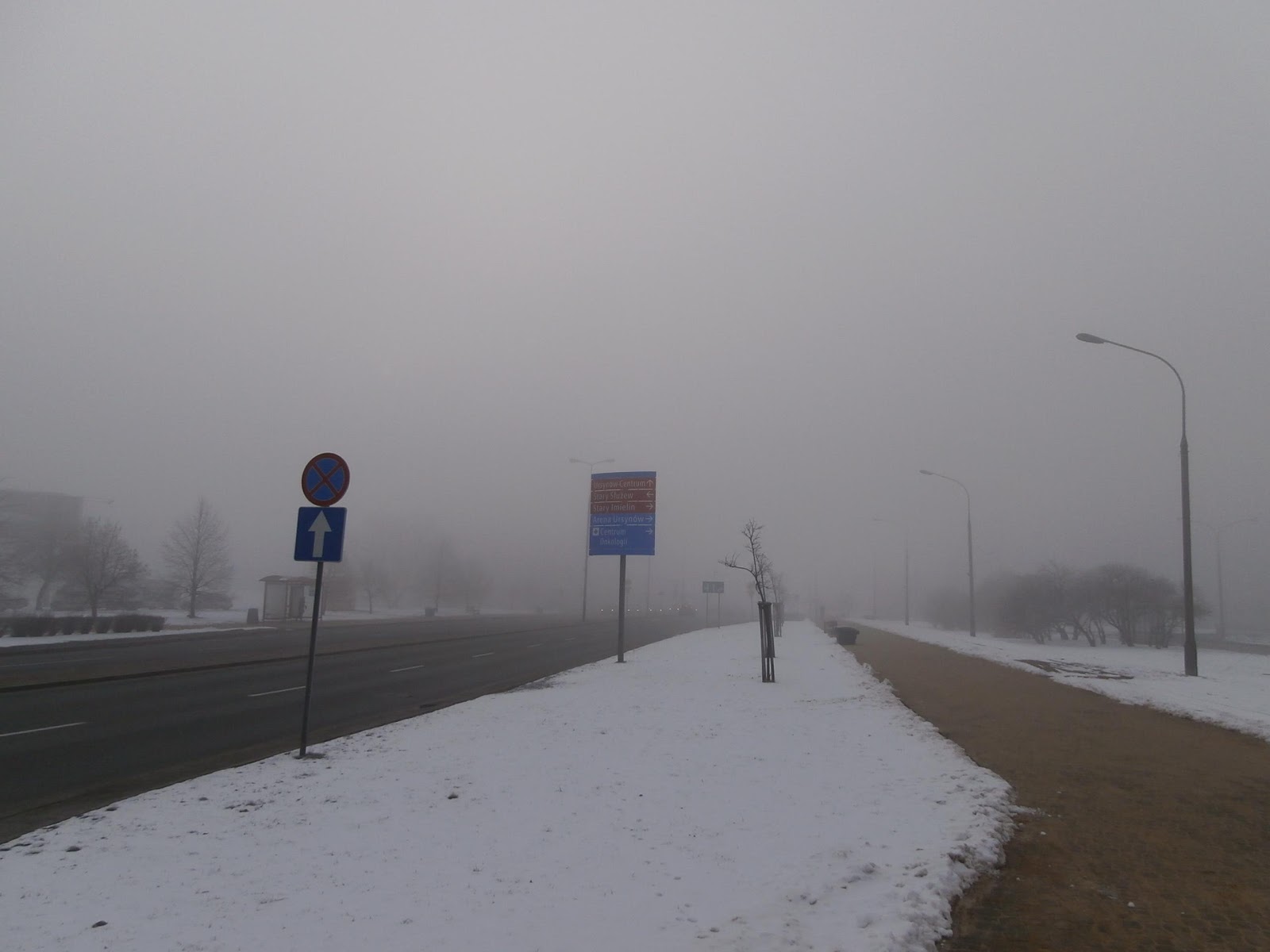
First day of spring doesn’t give a warm welcome – double digit frost at five in the morning. Some two hours later it’s –7C, but thick fog lingers and limits visibility to less than 50 metres. To the right – can you tell, from the distance of 50 metres, whether the traffic light is green, or red? Foggy spell last half an hour to give way to sunbeams. Around midday sleet takes over, then around 4 p.m. temperature drops below 0C from day-time high of +2C and it simply snows. It snows and won’t cease for hours to come…

Was supposed to snow all day, but forecasters got it wrong. Snow showers (over 5 centimetres of crisp, light snow overnight) give way to sunshine before midday. Cold, no warmer than –1C…

23 March 2013
As for late March, extremely chilly – sky is cloudless and when the day breaks temperature can drop as low as to –13C, over the day sunbeams quickly heat the air up, but just to some –4C. Glorious… but why not spring?

24 March 2013
This time –12C in the morning and the full range of winter moods of weather – moderate flurry which doesn’t linger, overcast skies and sunny intervals… -3C in the afternoon – winter doesn’t ease off.

25 March 2013 – 26 March 2013
Getting warmer – only single-digit frost in the morning, slightly above 0C in the afternoon and clear skies from sunrise to sunset. The last of the winter

27 March 2013
Spring is in the air. It sounds absurdly if you bear in mind morning brings again –7C, which is very cold as for late March and day-time high hits +3C. The sky slowly clouds over. Much of the snows melt.

28 March 2013
Instead of forecast sleet, day full of sunshine, no single raindrop nor snowflake, and on top of this a few hours of positive temperature.

29 March 2013
Blizzard kicks off before midday. It’s just one or two degrees below zero, so the snow is wet and heavy and continues to fall late into the night. Ghastly outside… It’s not just a spell of winter, it’s a proper winter. Only long daylight period signifies something is amiss… To the right – Ursynów, Al. Ken – late afternoon blizzard…

30 March 2013
After a light dusting of snow in the morning, thaw comes over. Gloomy, +2C and feels like late February…

31 March 2013
Clocks go forward overnight… When meteorologists warned of oncoming intense snowfalls I thought this would be harmless as temperature over the day was forecast to reach +2C. In fact temperature was just below zero and precipitation was one of most abundant this winter – some 10 centimetres of heavy, wet snow… To the right – on our way home from day spent celebrating Easter with family. Having dropped off my grandparents in Konstancin, we’re heading towards Piaseczno…

March 2013 was very frosty. Average temperature in Warsaw was –1.8C (vs. long-term average of +2.7C). This month will go down in the history of weather in Poland as extraordinarily chilly and snowy. This was also the coldest March in my lifetime (average temperature in second coldest March 1996 was –1.6C), but the second half of the 20th century saw colder ones in: 1987 (-2.5C), 1969 (-2.5C), 1963 (-3.0C), 1964 (-3.9C), 1958 (-3.9C), 1952 (-4.7C). Stats:
- month-time high: +14.7C on 6 March 2013
- month-time low: –13.1C) on 24 March 2013
- the warmest day: 6 March 2013 (daily average of +5.7C)
- the coldest day: 23 March 2013 (daily average of –8.8C)
Good I’ve cleared the drive yesterday around 5 p.m. Thanks to that prudent move in the morning I need to remove only some six centimetres of wet, heavy, white blanket. It snows all day and the only positive thing is temperature… To the right – the sight I woke up to on Easter Monday, not a laughing matter…

2 April 2013
Most of the day above 0C with some intermittent and harmless snow showers – white powder melts immediately…

3 April 2013 – 4 April 2013
At night – below zero and snow lingers and shovels come in useful in the morning. Over the day – above zero and snow melts instantly. Warsaw road maintenance service has run out of money for snow clearing. Can be felt in the morning rush hour… And this must be the last gasp of winter…

5 April 2013
Breakthrough – little snow at night, night-time low of –1C, proper thaw in the day. Foggy and gloomy…

6 April 2013
Out of line with weather forecasts, temperature doesn’t even reach +2C and no single sunbeam reaches snow-covered swathes of land…

Winter falls back. First sunny day after clocks went forward. After a frosty morning, day-time high of +6C. At last…

And then winter said a long-awaited farewell…