Sunday, 27 February 2022

Pandemic diary – weeks 101 & 102

Monday, 14 February 2022
Omicron now accounts for more than 90% of sequences. To make stats less boring, time to come up with the distinction between BA.1 (current prevalent) and BA.2 (less than 5% of sequences these days) – more infectious and probably more deadly subvariant which already prevails in Denmark.

Tuesday, 15 February 2022
After the post-contact quarantine was lifted and less than a week before pupils return to classrooms, headmaster still do not know how to handle groups where one pupil or a teacher has been tested positive. Until recently, in such cases remote learning was compulsory. As of now, the regulations are unclear. In early March schools might become a hotbed of the virus again, as the wave has not burnt out naturally and the level of immunisation is not particularly high.

Wednesday, 16 February 2022
The 7-day average of new infections decreases below 30,000, after staying above such level for 22 days.

Thursday, 17 February 2022
75% of Warsaw’s residents fully vaccinated. The figure looks well, but with respect to curbing transmission, is useless. With respect to preventing severe course of the illness and death, vaccines still prove good, decreasing those risk by around 8 to 9 times in all age groups.

Friday, 18 February 2022
The 7-day average of new infections decreases below 25,000, after staying above such level for 27 days. The fifth wave declines as quickly as it inclined.
The 7-day average number of deaths peaks out at 251 in Poland; 4 fewer and exactly on the day predicted by MOCOS in the first week of February.

Saturday, 19 February 2022

In early February Denmark lifted all restrictions and opened up. Critics of that decision point at the record-high number of deaths in COVID-19 reports (higher than in January 2021, when the number of infections was 10 times lower, but prior to vaccine roll-out). But once you drill down the data, the surge is driven by deceases where COVID-19 was not the primary cause, but infection accompanied another disease. Looking at the chart below, I believe reporting should be amended and only if COVID-19 was the primary cause of the death, such death ought to be reported.

Sunday, 20 February 2022
Queen Elisabeth (aged 95) tested positive for COVID-19. The British queen has been triple-vaccinated (date of booster jab unknown) and is reported to have only mild symptoms. Hope she continues to feel well.

Monday, 21 February 2022
It seems that school closure on 27 January brought forward the peak in infection by one week. Nevertheless, if this wave does not burn out as it should naturally, I expect a rebound, or levelling off in early March, a few days after today’s school reopening.

Tuesday, 22 February 2022
In Iceland, more than 10% of population are active cases. Neither in Slovenia, nor in Denmark more than 10% were not isolated when inflections peak. Iceland is a quaint and only example of a country where infections have kept rising for the recent two months. The well-vaccinated nation sees however, a single-digit number of critical cases (2 out of around 35,000 in total) and reports on average less than 1 death daily.

Wednesday, 23 February 2022
The 7-day average of new infections decreases below 20,000, after staying above since 20 January. It kept ascending for 13 days, but descended for 21 days.
The Polish prime minister announces all restrictions, except for isolation, quarantine for flatmates and mask-wearing indoors obligation will be lifted as of 1 March.

Thursday, 24 February 2022
Ukraine reports 25,789 new coronavirus cases and 276 new deaths. This is the last COVID-19 report from the country.

Friday, 25 February 2022
Worth looking at South Africa, the first country which experienced a surge of infections caused by omicron. New cases (7-day average) peaked there on 17 December 2021 at 23,437, but unlike in previous waves when deaths peaked out some two weeks after infections, this time deaths kept rising until 19 February 2022 when 7-day average of new deaths reached 233. Any explanation for that?

Saturday, 26 February 2022
R(t) in Poland bottoms out at 0.67. School opening will do its bit soon.

Sunday, 20 February 2022

Too Good To Go – application review

I am not really fond of installing and using applications in my smartphone. As I count, I use more or less frequently around a dozen of them, 40% of an average for a typical smartphone user in Poland. But from time to time out of curiosity I install a new one, usually prompted by a recommendation from another person.

The application mentioned in the post title was praised by one of my workmates during a business trip in September. Soon after hearing of it, I forgot about its existence and, truth be told, do not recall what refreshed my memory and made me try it out.

The idea behind the app is simple and commendable – it is meant to reduce food waste in shops and eateries. Produces saved from landing in a rubbish bin are sold for one-third of their regular price. Stuff from shops are near their expiry dates while restaurant food is not super-fresh and perfectly-looking to meet standards of an eatery, but surely edible.

If using the application was to be environment-friendly and cost-effective, if I lack a travelcard, I set the circle of 3 kilometres from home (i.e. a walking distance) to find places which wanted to get rid of some food. Each day I would find packages to be grabbed from Auchan Ursynów (PLN 8.49 – PLN 9.99), nearby BP stations (PLN 11.49), local Vegesushi restaurant (PLN 14.69), Costa Cofees (PLN 14.99). Some would wait hours for a buyer, other, such as packages from Blikle confectioneries (PLN 9.99) would be snatched within minutes or second.

The drawback of the application is that you reserve (and right away pay for) a pig in a poke. Some leftovers are guaranteed, but it is unpredictable what is left at the end of the day.

My first adventure was the regular food package from Auchan for PLN 9.99 on 10 February. I picked up a bag of food easily, but cannot say I was satisfied with its content. Inside I found a decent premium dry sausage (expiry date in 4 days), a cottage cheese (expiry date on the next day) and processed herring (expiry date on the same day) and this was the part which I ate. The remaining part of it (list on the receipt to the right) – too much of a whipped cream, yoghurt and other fat dairy products and a fat-made smoked beckon (all with expiry date on the pick-up day) sadly ended in the rubbish bin.

Admittedly, I have not saved the food properly, moreover I did not save money neither. What I consumed was worth PLN 10.29 at market prices, yet I while doing shopping would probably not buy all these products – fish I buy tinned or unprocessed to cook myself, cottage cheese would I buy, but less far, instead of a big premium sausage, I buy small packages of sliced meats. And look at the receipt from the application – the VAT receipt from Auchan contains 0% VAT for food, while the receipt from Too Good To Go included 23% VAT. Puzzling.

The second adventure was ordering a popular package from a nearby Blikle confectionery for PLN 9.99. I orderly picked it up on Friday (18 February) evening, brought it home, opened up and found a meringue cake. Again, it did not take my fancy, meringue is too sweet for me. Fortunately, I found a workmate who is fond of such sweets, bought a public transport 75-minute ticket for PLN 4.40 and took an underground train and a tram to drop it off to her place instead of committing it to the rubbish bin. All in all – PLN 14.39 spent, utility negative.

After the second experience, I do not feel like having a third attempt. The food is bought up anyway and does not go to waste. For somebody who, like me, plans shopping and strives not to waste food, the application is useless utility-wise and money-wise, but surely there might be people, especially large households, who might find the 67% discount attractive, provided they are luckier in terms of what the pig in a poke turns out to be.

I will not discourage you from using the app. It simply does not suit my needs, but someone else might find it a perfect tool for cutting their food shopping budget or saving the planet.

Sunday, 13 February 2022

Pandemic diary – weeks 99 & 100

Monday, 31 January 2022
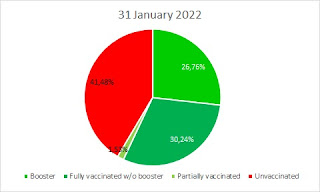
The customary month-end report of the sluggish pace of vaccinations in Poland.

1. Vaccine uptake in age groups


2. Vaccination status in the entire population of Poland

Tuesday, 1 February 2022
Poland is the only country in the EU to have reported less than 1,000,000 test carried out per 1one million citizens since the beginning of the pandemic. Romania, the runner-up in the nefarious ranking has made 1,001,131 test per one million citizens, while Poland only 808,195. In comparison, Denmark has tested an average citizen more than 20 times.

Wednesday, 2 February 2022
The fifth wave reaches in Poland its surprisingly low peak at 49,078 (7-day average of new infections).
In Slovenia 1 in 89 citizens tested positive. Over 35% of the country’s population (2.08 million) have been officially infected since the onset of the pandemic.

Thursday, 3 February 2022
The number of confirmed COVID-19 cases in Poland crosses 5,000,000. The last million was reached within 43 days, 8 days later than I had predicted on 22 December 2021. Even if the optimistic scenario materialises and the wave begins to decline, I bet the decline will be slow and 6,000,000 will be hit on 5 March 2022 (i.e. within 30 days).

Friday, 4 February 2022
Newspapers inform about 250,000 Poles who have been given a referral to get tested, have not shown up at testing centres. Reasons might be manifold:
1) too long queues to testing centres,
2) they feel to bad to get to a centre,
3) the fact that seven-day quarantine is shorter than ten-day isolation (in fact ten days plus the time of waiting for test result and to get tested).
The system might have clogged up, as the reported capacity is 192,000 tests per day and actual number of tests conducted is near 180,000.

Saturday, 5 February 2022
Looking at the positivity rate in Poland we it has ranged from 26% to 34% since 20 January. The steady percentage of positive test results does not confirm the hypothesis that the testing system has reached the limits of its capacity. Although in fact it has.

Sunday, 6 February 2022
European countries that definitely have gone past the peak (date of the peak in 7-day average of new infections in brackets) of omicron wave are:
- the United Kingdom (5 January),
- Ireland (12 January),
- Italy (14 January),
- Spain (17 January),
- France (25 January),
- Sweden (27 January),
- Belgium (28 January),
- Portugal (29 January).

Monday, 7 February 2022
The Polish Ministry of Health brings in reporting of reinfections. A positive change triggers chaos in reporting and prompts questions whether until now reinfections had been properly reported. With hindsight it turns out they were.

Tuesday, 8 February 2022
Number of officially detected cases worldwide hits 400,000,000, 4 days earlier than I foresaw on 5 January 2022 (when it crossed 300,000,000 mark). I predict half a billion will be exceeded on 22 March 2022.
R(t), the reproduction number declines in Poland below 1.00x. The peak in reported new infections was reached one week before most mathematical models had predicted.

Wednesday, 9 February 2022
The Polish Minister of Health announces the pandemic draws to a close (on a day when nearly 47,000 new infections and over 300 deaths are reported). To accommodate to such scenario, the government:
- lifts quarantine of people who have contacted an infected person,
- shortens quarantine for flatmates of an infected person (takes effect on 11 February),
- shortens isolation from 10 to 7 days (takes effect on 15 February),
- brings forward the end of remote learning by one week – children are to return to schools on 21 February.
But the jaw-dropping announcement is scrapping the obligation to wear mask indoors once new infections decline. For me the very latter is a step too far. Are they going to call the election? Last time the virus was retreating before the election.

Thursday, 10 February 2022
The 7-day average of new infections decreases below 40,000, after staying above such level for 14 days.

Friday, 11 February 2022
With some delay I find an updated pandemic forecast by MOCOS. Those quants a month ago predicted nearly 150,000 reported infections daily and 700 deaths daily after the wave peaked. The new forecast says:
- 7-day average of new infections will decline below 10,000 on 1 March 2022,
- 7-day average of new deaths will peak at 255 on 18 February 2022.

Saturday, 12 February 2022
Bulgaria is the first country in the UE in which 0.50% of the population officially died from COVID-19. Disregarding the virus, reluctance towards vaccines and poor health service have contributed to the dismal statistics.

Sunday, 6 February 2022

Nadchodzi Trzecia Wojna Światowa – book review

Struggling to recall how I have learnt about the book, but beyond all doubt I immediately ordered it in the district library of Ursynów. To my surprise, the wait was not particularly long after a mere few weeks I was notified I could borrow it.

Th recently (autumn 2021) published volume is a transcript of extended conversations between Jacek Bartosiak (expert in international politics with focus on military issues) and Piotr Zychowicz (historian). The two men hold unbiased discussions in which they keep to themselves their private political views (the latter is a right-wing ardent anti-communist) and brush aside their prejudices. The outcome is a detailed, substantive analysis of superpowers in the contemporary world and how the spheres of influences might reshape in the coming decade.

The book rests on a paradigm that the era of post-history in which carnages of the First and the Second World Wars are not going to repeat, in which only local military conflicts are conceivable, but the highly developed countries enjoy peace, is drawing to a close. The authors claim something is about to give in less than a decade. They cite China’s ambitions to take over the dominant role from the United States as a major motive and dissect several other aspects as minor reasons potentially leading to a clash that could spill worldwide.

The script has prompted me to revise my views on armament spending, which for years I had considered mostly useless. My notion would have held true had there been no enemy to Poland, which most likely is a naïve claim. Modern, well-equipped and professionally-trained army with continuously updated contingency plans is like an insurance policy. A country pays the insurance premium to scare off enemies.

The authors are critical in their assessment of how Poland has handled its military policy over the last 30 years and cannot point at any government over that period that stood out positively. The unconstrained trust in the alliance with the United States, thoughtless armament spending just to stick to NATO’s requirements or for the sake of showing of earmarking a certain percentage of GDP for the military purposes, excessive purchases of aircrafts and other equipment from the United States to flatter the America – all that is slated by the experts.

Mr Bartosiak and Mr Zychowicz also take a look at the history of Poland around WW2, its subjugation to allies who turned their back on my country. The bitterly admit Poland should have focused more on its vested interests, rather than relying on allies and acting like a saviour of the world, sending its soldiers to shed blood for other nations. Drawing on those experiences, they insist Poland should curtail its dependence and reliance on NATO and be as self-supporting as it can, while staying united with Western Europe and strengthening this alliance wisely.

My read of the book coincided with Russia’s preparations to invade the Ukraine. I have pinned some hopes in good job of intelligences of several countries which foiled Mr Putin’s plans. Maybe it was naïve to think an action which everybody expects to happen is less likely, but the war should be about taking the enemy by surprise. Some experts claimed the invasion was unlikely during the Olympic Games, traditionally the time when warfare was on hold. They give an example of 2014 when the Crimea invasion occurred after the end of the event in Sochi. I suppose Mr Putin no longer gives a damn. Weather might play a bigger role. The north-eastern swathes of Ukraine are swampy and frozen ground would make it easier for heavy vehicles to move, so the time might be running out. On the other hand, some pundits say the positive temperature anomaly of 10 Celsius degrees might be conducive to Russians. Regardless of which version is right, it is disturbingly certain turbulent times are ahead.

Sunday, 30 January 2022

Pandemic diary – weeks 97 & 98

Monday, 17 January 2022
A week ago children returned to school and several people returned to work after holiday. I expect new cases to take off very soon.

Tuesday, 18 January 2022
The 7-day average of new infections increases above 15,000 again, after staying below such level for 24 days. New infections are now bound to soar, we will follow the path of other countries.
In France 1 in 141 citizens tested positive.

Wednesday, 19 January 2022
More than 30,000 new infections, up by 89% week-on-week, the highest number since early April 2021. The surge has started. I spend the day in the office and meet around 30 people…

Thursday, 20 January 2022
New cases up by 95% vs. last Thursday and nearly 3,000 new infections in the capital of Poland.
The 7-day average of new infections increases above 20,000, after staying below such level for 34 days.
In Israel 1 in 136 citizens tested positive.

Friday, 21 January 2022
New infections up by 128% week-on-week, with a record-breaking number of new infections. I see no point in informing about new records, since they will be reported several times a week.
In the evening I attend a party to celebrate the success of Szlachetna Paczka after which I will self-isolate. Putting the booster to the test…
1 in 133 citizens tested positive in Denmark.

Saturday, 22 January 2022
As I wake up into my self-isolation, I just see an increase in new by nearly 150% week-on-week. But the really ghastly piece of information is that the number will be going up until around 10 February 2022 and reported stats will be just the tip of the iceberg.
The 7-day average of new infections increases above 25,000, which means the fifth wave is already higher than the second and fourth one.

Sunday, 23 January 2022
The number of patients hospitalised hits its low at 13,491. Does not bode if it is the starting point for the Omicron wave. Just to remind you, the starting point for the Alpha wave were 11,962 beds occupied on 14 February 2021.
The fifth wave is already higher than the third one.
Positivity rate creeps above 30%.

Monday, 24 January 2022
New infections up by 179% week-on-week.
The 7-day average of new infections increases above 30,000. From now on hitting round number will be reported after each 10,000 more. 40,000 expected on Thursday in an optimistic scenario. In a pessimistic one – the day after tomorrow.

Tuesday, 25 January 2022
P1 system in which referrals for tests are issued clogged up yesterday and has not been lifted until today afternoon. What a mess!
My employer forbids coming to the office by the end of February.
Wronki is the first municipality in Poland where 80% of residents have had at least their first jab.
The decision to partly close schools is taken. Except for pupils up to the fourth year of the primary schools, remote learning will be in place by 27 February.
In France 1 in 131 citizens tested positive.

Wednesday, 26 January 2022
For this day:
- on 29 October 2021 I predicted new infections would hit 4,000,000,
- on 22 December 2021 I predicted new infections would hit 5,000,000.
The outturn of 4,637,776 came closer to the latter prediction. I missed it by 363,224 infections, but it will be caught up with within a week, I suppose.
In Slovenia 1 in 119 citizens tested positive.

Thursday, 27 January 2022
From today on, each individual is allowed to take a free-of-charge antigen rapid test in a pharmacy. In theory the opening lists of pharmacies has 64 such places across the country, therein 3 in Warsaw and around (1 pharmacy for 1,000,000 residents). In practice tests are not delivered to pharmacies anyway, so the efforts to boost testing are a flop.
The 7-day average of new infections increases above 40,000 – the optimistic scenario materializes.
The number of people quarantined in Poland exceeds 1,000,000 for the first time in history. To decrease the figure which has impact on absences in workplaces, the government has shortened the quarantine duration from 10 to 7 days, coming into effect on 24 January 2022 and not applying retroactively.. Add up more than half a million in isolation and you get 4% of Poland’s population stuck at homes.

Friday, 28 January 2022
I read the draft law of workplace testing which imposes potential financial penalties on employees who refuse to get tested. The law is ludicrous, but I am so underwhelmed by absurdities that I hold back from commenting on it.
In Denmark 1 in 116 citizens tested positive.

Saturday, 29 January 2022
In Warsaw as of today:
- new infections down by 13% week-on-week,
- tests carried out up by 17.5% week-on-week,
- positivity rate down by 7 p.p. from 27% to 20% week-on-week.
Hard to believe the capital has just gone past the peak. Albeit the general trend will be disrupted by school closures and school holidays just commencing.

Sunday, 23 January 2022

Behind the wheel in 2022

The most impressive flop of early 2022 is definitely the overwhelming mess subsequent to the rollout of the Nowy Ład. What goes on around the new tax legislation is a topic for a separate posting, yet today I refuse to have my nerves frayed by it. It is no secret I am not a beneficiary of it, yet I would agree to pay higher taxes, provided the tax law is simplified and tax proceeds and spent wisely. Sadly, neither the latter not the former holds true for Poland.

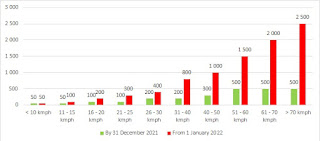
But wallets of motorists might be hit not only by higher taxes and other contributions, but also by fines for violations of the highway code. The penalty rates in Poland had not been revised since late 1990s and were laughably low in comparison to other countries. The fine rates for speeding, the most common offence on Polish roads have been revised upward, as shown on the chart. The lawmakers have turned out to be lenient for minor speeding, yet the higher the deviation of the actual speed from the limit, the more severity of the punishment increases. The point beyond speeding gets painfully expensive is 30 kmph. Besides, there is no flat fine for speeding above 50 kpmh, but fine amounts rise along with the scale of offence (or rather crime, given somebody driving 120 kmph in town where the speed limit is 50 kmph is already a criminal).

The upshot is that on the New Year’s Day Polish roads got similar to what I witness abroad. When venturing beyond the border of Poland I was always careful not to exceed speed limit, so that my holiday budgets were spared costly fines. Poles have been legendarily obedient abroad and careless in their homeland. Today it has changed for the majority of drivers, but I still see reckless idiots, usually in quite new premium-make oversized vehicles who do not give a damn about the higher fines. Nevertheless, the general tendency bears out a financial punishment serves best as a disincentive to commit offences.

Another change mentioned by some experts which should follow is the verification of speed limits on specific roads. I have no idea why the stretch of ul. Puławska along Wyścigi, with merely one intersection and no pedestrians crossing has lower speed limit (50 kmph) than the section between ul. Poleczki and the boundary of the city, where the speed limit is 60 kmph. I hold the view there are thoroughfares in Warsaw where speed limits could be increased by 10 or even 20 kmph, while traffic on minor roads should be calmed, as 50 kmph is far too much for several narrow streets.

Other pricing reshuffles which are taking place in early 2022 are:
- the increase in long-distance train ticket prices,
- the decrease in excise tax for fuel,
which given the effort to reduce carbon dioxide emissions, work the opposite way round than they should.

I have taken the trouble to compare a cost of a business trip taken in 11 days (planned yesterday for 2 February) for a six-hour workshop (which cannot be held online) in another bigger city (I have chosen 4 which have decent train connections to Warsaw – Poznań, Wrocław, Kraków and Gdańsk).

My assumptions:
- my destination is located 1 kilometre from a main train station so that I can walk there,
- start time of the workshop can be adjusted to match the train timetable,
- by car I drive door to door and pay a parking charge of 30 PLN in each city,
- I travel on my own,
- the cost of fuel is based on petrol price of 5.10 PLN per litre (envisaged after the excise tax cut) and the average consumption of petrol is 7.0 litres per 100 kilometres – this gives 0.357 PLN per kilometre,
- since I have no travelcard, I need to buy two 75-minute tickets each to get to W-wa Centralna Station,
- I travel in second class by train,
- on my way to Poznań I pay motorway charges, to Gdańsk I take S7 expressway,
- the cost of car journey increases by the cost of accelerated depreciation and higher upkeep costs on account of higher mileage – 0.10 PLN per kilometre
- journey time by car to each destination is calculated with Google Maps (mid-time for bracket) with 30 minutes added each way,
- I need to set off to the train station 55 minutes before train departure and return home 45 minutes after train arrival

Here come the results (cost and journey duration):

Poznań – still cheaper and faster by train

Wrocław – much cheaper by train, but slightly longer
Kraków – somewhat cheaper and faster by train

Gdańsk – markedly cheaper and faster by train.


I am positively surprised by the outcomes, especially with respect to the journey duration. But note with 2 passengers the journey by car gets cheaper. Is the proportion right?

Sunday, 16 January 2022

Pandemic diary – weeks 95 & 96

Monday, 3 January 2022
Everything seems to indicate deaths peaked in Poland yesterday, with 7-day average topping out at 466. Ghastly.

Tuesday, 4 January 2022
75% of Warsaw’s residents received at least one dose of a vaccine. Figures are boosted by the recently launched campaign of jabbing children aged 5 – 11. In Ustronie Morskie 75% of residents are fully vaccinated.
In Greece 1 in 206 citizens tested positive.
More than 2 million new cases reported worldwide, therein more than 1 million in the US, the UK and France only. Deaths keep falling so far.

Wednesday, 5 January 2022
Poland’s president, with track record of infection (October 2020), double vaccination (April / May 2021) and a booster (December 2021) is tested positive. I am not fond of conspiracy theories, but would not be shocked if his vaccination certificate was fake. He dislikes needles around his arm, besides he has track record of declarations of being sceptical towards vaccinations.
Konfederacja, a Polish far-right corona-sceptical party has its profile removed from Facebook for spread misinformation on vaccines. The move sparks a debate on limits to freedom of speech.
In France 1 in 197 citizens tested positive.
The United Kingdom hits its high of new infections with 7-day average topping out at 182,069.

Thursday, 6 January 2022
Frankly speaking, I feel the same sense of uncertainty as exactly 22 months ago, in early March 2020. Relying on maths, I expect a disaster when omicron takes over unconstrained in Poland. Too many will pay the ultimate price.
300,000,000 officially reported cases worldwide. I believe the 400,000,000 threshold will be crossed on… 12 February 2022. Let’s see!

Friday, 7 January 2022
There are provinces in Poland such as Mazowieckie and Małopolskie where infections visibly rise week-on-week. Even despite scant testing on bank holiday yesterday.

Saturday, 8 January 2022
In Ireland 1 in 192 citizens tested positive.
Records are getting harder to beat, but once the New Year’s tide ends, schools and businesses resume full-scale operations, in some countries new infections will break out.

Sunday, 9 January 2022
In Warsaw new infections rise by 66% week-on-week, in Kraków by 122%. You may partly put it down to scarce testing on New Year’s Day (i.e. base effect), but the two cities are becoming the first hotbeds of Omicron, which will soon spill over the entire country.

Monday, 10 January 2022
R(t), the reproduction number, inclines in Poland above 1.00, which means the pandemic is taking over again, for good.

Tuesday, 11 January 2022
100,000 deaths from COVID-19 miles a sad milestone of the pandemic. Yet the better measure of the epidemic’s death toll is a number of excess deaths which by now has reached around 170,000.
In France 1 in 178 citizens tested positive.

Wednesday, 12 January 2022
More than 3 million new cases worldwide (3.2 million to be precise), with the United States, India, France, Spain and Italy making up a half of the statistics.
In Poland new infections decline by 2% week-on-week, which is positively startling. Yet the frequency of social interactions was low by 9 January, since schools were closed by then and many people took days off.

Thursday, 13 January 2022
In Australia 1 in 172 citizens tested positive.

Friday, 14 January 2022
In Israel 1 in 157 citizens tested positive.
In Poland 13 out of 17 members of the Medical Council (board of voluntary advisors to the government) submit their resignations. They have had enough of government’s indifference to their counselling and succumbing to anti-vaxxers.

Saturday, 15 January 2022
Poland has been faring better than foreseen by the prophets of doom. New infections (7-day average) rose by merely 28% within a fortnight, while there were countries where the figure saw a 1,000% increase. Nevertheless, it is not the right time for complacency. Calm days will soon be over.

Sunday, 9 January 2022

Don’t look up – film review

A belated review (though Michael beats it to me), since I watched the film on 27 December, after reading several recommendations on Twitter on it.

My very first reaction before watching the film was that the title had been translated incorrectly into Polish. Don’t look up sounded to me as nie sprawdzaj, nie weryfikuj informacji. Such worked my fondness of phrasal verbs, yet I was wrong. I literally tells you not to look at the sky.

The film which premiered in cinemas on 10 December 2021 and on Netflix on Christmas Eve went absolutely viral among well-educated people I follow on Twitter during Christmas. While at my parents’ for Yuletide I could not watch it, my only access to Netflix is via application on my TV set (shared account).

Michael as he summarises the plot claims the film, dwells on dumbed down masses. The first word which sprang to my mind when I tried to describe Don’t look up with one word was ignorance. Overwhelming, dazzling, overpowering ignorance individuals feel comfortable with. A portrait of omnipresent ignorance and a bunch of pundits trying to tear down the walls of ignorance to save the planet is dejecting.

While watching the film I saw two parallels. First was about early stages of the COVID-19 pandemic. In late 2019 Chinese authorities strived hard to shut mouths of doctors who warned of a perilous new virus, then their reaction to contain the spread of the virus was delayed. They failed to nip it in the bud, so now we have what we have. Second was about the global warming, which unlike the pandemic is a relatively slow process with long-term rather than immediate implications. Experts presage how bad it might get in a few decades, but politicians remain deaf to it or make inconsistent moves to combat it or just pretend they do something, not to wind up their voters with inconvenient decisions to curb carbon dioxide emission.

If I were to choose one picture which conveys the same message as the film, I would opt for the one to the right. I first saw it nearly a year ago, in the context of people who worship self-styled experts who claim SARS-CoV-2 does not exist / is as dangerous as ordinary flu, mask and vaccinations do not work, etc. Those individuals are either too thoughtless or too cowardly to face the complex situation the mankind need to get to grips with. Some humans have a tendency to deny facts which are inconvenient to them, searching for a comfort and peace of mind. I realise why this happens, but advise to rise above it.

The film deftly depicts the worst human traits – greed, selfishness, unjustified self-esteem, ignorance, laziness and many more. The moving picture is well-crafted, but has left me exhausted after watching it. If the film is meant to be an eye-opener for many, I hope it keeps going viral, though I keep in mind the human memory is short-lasting and it soon will be forgotten.

Sunday, 2 January 2022

Pandemic diary – weeks 92, 93 & 94

Monday, 13 December 2021
R(t), the reproduction number, drops in Poland below 1.00, which means the pandemic is winding down.

Tuesday, 14 December 2021
If you look carefully at the map of new infections, you will be the epidemic has trundled from eastern towards western Poland. In eastern provinces the number of new infections is 5 – 10 times lower than over a month, with the number of tests carried out holding steady.

Wednesday, 15 December 2021
New restrictions are in force as of today. The number of visitors in several venues is limited to 30% of capacity, but holders of the COVID certificates are excluded from the limits. Ludicrously, the government has not passed any law empowering entrepreneurs to demand the certificates. Therefore a visitor may voluntarily show the certificate to a enter a venue. The strategy of the Polish government is to pretend to fight the virus and not to mess with the anti-vaxxers.

Thursday, 16 December 2021
In Poland vaccinations of children aged 5 – 11 kick off. On the first day around 10,000 children get their first jabs, while more than 100,000 are signed up by their parents. No big success.
In the UK after over 88,000 new infections are reported (therein more than 23,000 in London only), the 7-day average of new infection has an all-time high, going above level reported in early January 2021. The omicron takes over and stands a chance to wipe out the health care system.

Friday, 17 December 2021
The 7-day average of new infections declines below 20,000, after staying above such level for 25 days. It is a matter of less than a month before it bounces back and returns above that level.

Saturday, 18 December 2021
The ministry of health has published some time ago a detailed database of all infections and deaths in Poland, broken down into dates, sex, age and vaccination status. This substantial source of analytical material has passed unnoticed in the public discourse.

Sunday, 19 December 2021
I thought fake vaccination certificates were a marginal problem in Poland, yet more and more frequent news of hospitalised patients admitting to have bought one suggests the scale of the forgery is larger than I supposed. A fake certificate is an expense of 500 – 2,000 PLN.

Monday, 20 December 2021
Early in the morning I get my booster shot. After 2 doses of Pfizer I mix it up with Moderna, which is meant to boost my antibody count. Tomorrow I will learn that only 6.5% of Poland’s population aged 25 – 49 has taken the booster on that day and 14.7% of the entire population. Too little to bode well.
Off-topic: today the tunnel beneath Ursynów is opened; thus the Southern Bypass of Warsaw is completed.

Tuesday, 21 December 2021
I look at Omicron-related data from South Africa and wonder whether the world is not overreacting. The surge there was short, reversed quickly and did not result in many hospital admissions nor death. Keeping an eye on the UK.

Wednesday, 22 December 2021
On 29 October 2021 when the number of officially detected cases exceeded 3,000,000 I predicted the number of new infections would hit 4,000,000 on 26 January 2022. I got it wrong, by 35 days. The fourth million was reached within merely 54 days. For comparison:
- the first million was reported within 275 days,
- the second million was reported within 105 days,
- the third million was reported within 224 days.
I foresee 5,000,000 mark will be crossed on… 26 January 2022.
775 deaths reported on that day come as a negative surprise to me.
Keeping an eye on the UK – so witnessed over 106,000 new registered infections. I suspect 7-day average of new infections peaks out at around 130,000 (got it wrong already).

Thursday, 23 December 2021
More than 980,000 cases registered worldwide breaks the previous record of less than 905,000 new infections reported in late April 2021, when Delta was in overdrive in India. One million will probably be hit next week and I safely bet two millions will be detected on one day in January 2022.

Friday, 24 December 2021
Deaths (7-day average) peak at 453, lower than during the previous waves (604 in spring 2021, 506 in autumn 2020). Vaccines save lives, but not for thousands of families who will sit at Christmas tables in mourning.

Saturday, 25 December 2021
The 7-day average of new infections declines below 15,000, after staying above such level for 39 days. The metric will see an accelerated decline because of scant testing during the festive period. I predict it will bottom out sustainably somewhere around 9,000 cases.

Sunday, 26 December 2021

178 vaccine doses administered yesterday in Poland. I realise it is Christmas, but warfare against the virus ought to continue.

Monday, 27 December 2021
The Omicron wave, even if patients do not clog up hospitals and if a hard lockdown is not imposed, might have economic implications. A large number of infected isolated and persons in contact with them quarantined might paralyse the country.

Tuesday, 28 December 2021
In Malta 1 in 342 citizens tested positive yesterday. I believe such records will be broken several times in coming weeks.
Worldwide more than 1,200,000 new cases reported, with several countries on northern hemisphere breaking records. 2,000,000 expected next week.
R(t) in Poland bottoms out at 0.68.

Wednesday, 29 December 2021
In Denmark 1 in 264 citizens tested positive. This wave will definitely have a high tide, but will burn out quickly, hopefully with few fatalities

Thursday, 30 December 2021
In Ireland 1 in 244 citizens tested positive. Experts say this is not the last word.

Friday, 31 December 2021
Today could have been the turning point between the fourth and the fifth wave, with 7-day average of new infections bottoming out at 10,774. Or this was just the effect of increased testing on New Year’s Eve vs. Christmas Eve. I hope the latter explanation is correct.
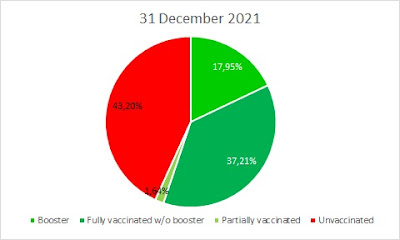
And the customary month-end report of the sluggish pace of vaccinations in Poland.

1. Vaccine uptake in age groups – sadly ECDC has taken a Christmas break, so this time a bit outdated, but in a new layout, with a booster.


2. Vaccination status in the entire population of Poland

Saturday, 1 January 2022
In Warsaw alone 6 more new infections than a week ago. For some 6 weeks the clear trend of 20% week-on-week decline was visible. It is the thing of the past probably.
Don't know whether delays in reporting are to blame, but 7-day average of new deaths reaches a new high of 464.
In Ireland 1 in 216 citizens tested positive. This wave will be a flash.

Sunday, 26 December 2021

Szlachetna Paczka 2021 , past the final weekend.

As some of the readers might remember, my experience with Szlachetna Paczka last year was rather bitter and shortly after the 2020 edition was over, I was intent on giving up on it (as a volunteer).

In mid-2021, as the virus eased and the vaccination programme was giving hope to put the pandemic closer to an end, I reconsidered my decision. In July, when I learnt a fellow volunteer had been appointed the leader of Ursynów area, I have made up my mind to join.

This year we started out early and closed our ranks in early September to look out for families which could become beneficiaries of programme. Thanks to concerted efforts we have managed to visit 74 families (vs. around 30 in 2020) and decided to organise aid for 46 of them (vs. 14 in 2020); thus we achieved a decent hit ratio of 62%.

I personally visited 15 families, 9 of them were brought in, for 4 I was a primary volunteer, which meant I had to do all the paperwork for them and co-ordinate contact with donators.

Back in July I was appointed to be in charge of logistics. This meant I had to find a centre of operations (magazyn) for the final weekend. I have fixed us up with the space in a newly opened Ursynowskie Centrum Kultury “Alternatywy”. The location and the very facilities have turned out to be a perfect venue. I have also drawn up a plan for collection and distribution of gift packages. Picking up 46 packages from donators and transporting them to 46 families seemed a big challenge, but thanks to an excellent planning (I will not spare myself praise this time) and execution (hats down to fellow volunteers), it all worked like a dream.

Human-wise, delivering packages to families, seeing their emotions and hoping the aid would kick-start them and open a door towards a better tomorrow brought off a lot of joy.

Although delivery of packages is over, the edition has not come to an end. I shall visit my families in coming weeks to see how they are faring and help them overcome some of barrier that hold them back.

Although we definitely pulled it off in 2021, there are lessons to be learnt before the 2022 edition in which I will definitely get involved. Firstly, we will start even earlier. Secondly, donators will need to instructed how to pack the gifts (nobody feels like lugging huge boxes whose weights reached 30 kilograms) and their preferences regarding pick-up timing will need to be agreed earlier. Thirdly, volunteers ought to handle transport of furniture and heavy white goods well ahead of the final weekend, so that those gifts do not go through the centre of operations.