Sunday, 7 December 2014

A farewell to old, good Nokia :(

1 December 2014 will go down in the history (of this blog) as the day when my Nokia 3110 Classic gave up the ghost. I bought the handset on 25 March 2008 and for six years and eights months it had served me almost beyond reproach. Much more reliable and much more durable than mobile phones produced these days, the Nokia would keep me company and had not been spared endurance tests. Over those years the Nokia survived being dropped several times (and went unharmed), withstood lying exposed to strong sunlight in temperatures exceeding +40C and unlike other phones remained totally indifferent when used in below –20C frost.

In the last two months the phone began to give first warning signs of the forthcoming end of its service. It crashed after being switched on and I had to wait some ten minutes before the phone returned to life, from time to time it also tended to lose network coverage and I had to shake it to help aerial catch the signal again. Despite those flaws I admit to have been too attached to the phone to think of replacing it with a less obsolete one. I am not fond of gadgets and the Nokia offered me everything I expect from a phone…

Then the fateful day came. On Monday evening I hooked in the phone to charge it up and after two hours I noticed it did not draw electricity from the charger. I grabbed the phone, but it did not react when I pressed any button. I called my number from the company phone, but it turned out my number was unavailable. I took off and put in the battery and turned it on again, waited until ten minutes when the phone is not responsive elapsed. The phone reacted only to numerical keys and had its menu accessible via navigation keys. I took the opportunity to recover all the notes I kept in it. Pressing menu and dialling keys resulted in the phone crashing for good. I tried to work out whether it was not the SIM card and sought many causes of the breakdown, but eventually gave up. Life of the phone naturally came to an end. Unexpectedly and swiftly, the Nokia let me down once, but properly.

Corpo smartphone unfortunately does not offer dual-SIM functionality, so I had to resort to the only unused handset I have in my drawer, namely Sony CMD-J70, “vintage” 2001. In 2007 I urged my friend not to throw out the phone his just then departed mother had used for six years and for seven years it has served as substitute phone when my parents’ phones (both low-end Nokias) were under warranty repairs or to me as a second phone, before I moved my number to Play. Sony had been idle for many months, so the battery perked up after some ten minutes since being plugged in to the charger. I have used the phone for six days and although the handset offers excellent quality of calls, writing messages on it (it traces back to times when T9 dictionaries were unknown) is a veritable nuisance and the phone does not read messages sent from newer traditional phones (oddly enough those sent from smartphones come through).

My first choice on what to buy was Sony Xperia E Black. At first glance it was not the newest model (it premiered in March 2013), but reasonably priced, seemingly durable and with lots of functionalities. The other day in the office it turned out my team-mate has that model and he complains about it. He handed me the handset and allowed to play with it for a while. When I took it into hand and saw how crappy devices it indeed was and then ran a thorough search on its quality on forums, I cancelled my order placed in the Internet shop I use to buy consumer electronics. I always choose cash payment when I pick up ordered stuff in collection point, so the resignation did not involve claiming back money, yet it has left me without a decent, normal phone (it lacks keypad locking feature which means it can initiate a call while kept in a pocket!) before a three-day business trip.

Actually reading Internet forums on handsets (one should make allowances for their contents, since many of the grumbles are written by people with exorbitant expectations) prompted me to revise my needs and expectations towards the new phone. I use the corpo smartphone, but actually am not fond of it, nor impressed by it. The corpo-phone has some limitations in scope of usage (restrictions on multimedia messages, downloading applications, private e-mails and social media), but apart from it I can have 1GB monthly data transfer to use up when I need to check something or to read some news or article and has built-in, though slow, GPS. I will gladly make do without a touchscreen and prefer a traditional QWERTY keyboard. I will appreciate reliable and durable, decently assembled phone with solid battery. It does not have to be fancy, I do not need it to swank about, it has to serve me well and meet my modest needs.

Finally I have made up my mind for Nokia Asha 302. The model was released in February 2012 and for this reason is not readily available in every bigger shop with consumer electronics, but garners excellent opinions from its users. Nokia Asha 302 was also the main company phone back at the Employer (I did not have one on account of not being eligible for company phone) and my colleagues, counting out those who expected too much, were satisfied with it. The only problem with it is that it takes some trouble to purchase it. I learnt it was available in Nokia shop in Żoliborz, but yesterday I could not afford to spend two hours to drive there to pick it up in person. Tomorrow I will check out whether any of the other two Nokia shops, in Śródmieście and in Ursynów, has any Asha 302 in stock. I sincerely hope they have some and price does not diverge from 248 PLN (superb price-quality trade-off) I was quoted by the Żoliborz outpost.

The thoughts on the phone could be put into broader perspective of critical assessment of unbridled consumerism and how most people relish on fancy stuff. Hard to deny, pursuit of only newer and more swanky goods also underlies economic growth and gives jobs to people, but when staring into the screen of the posh smartphone, it is important not to lose sight of other people…

Sunday, 30 November 2014

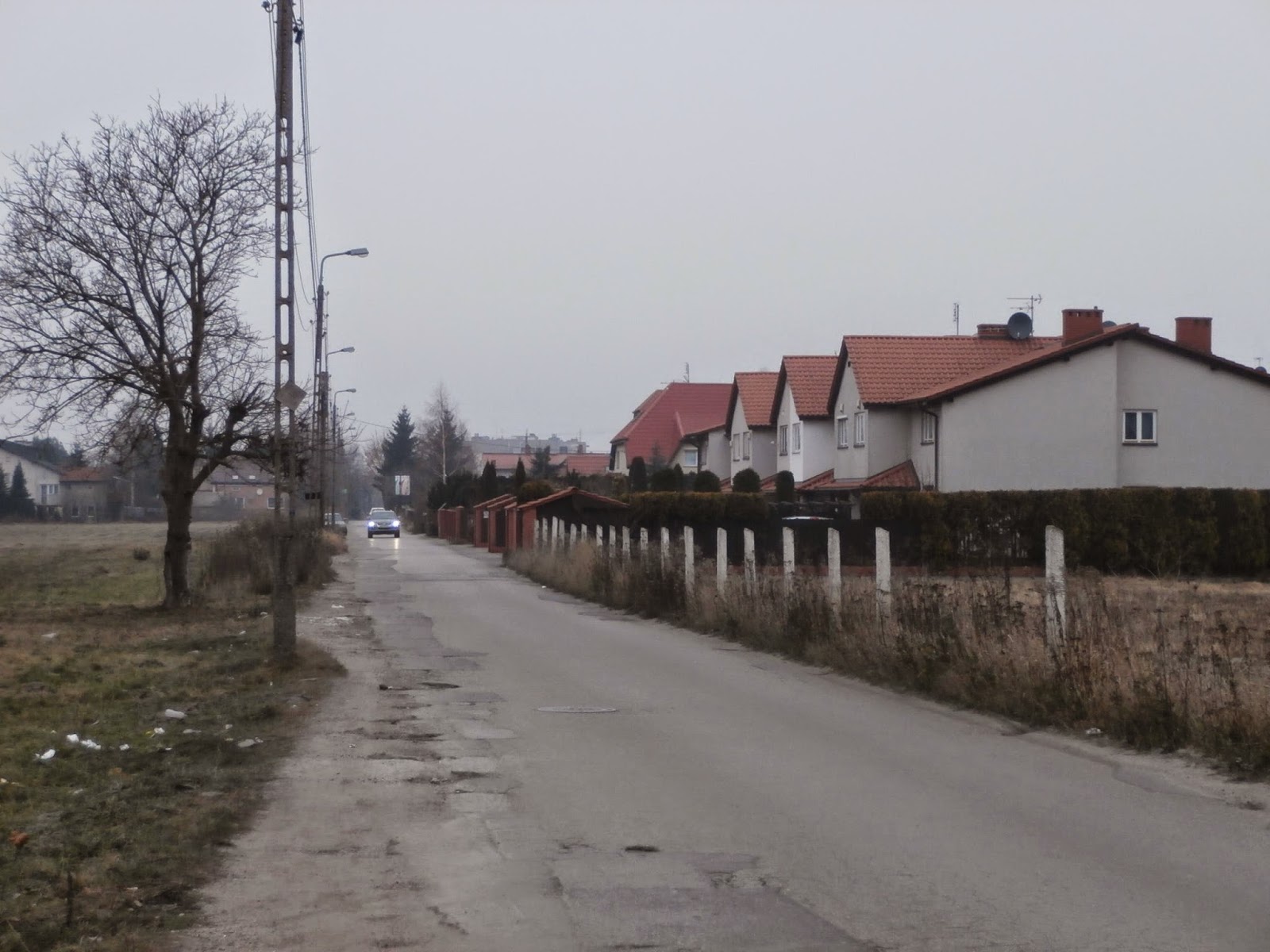
Ul. Mleczarska under construction, at last

A stride in infrastructure development, long overdue, is being made. Ul. Mleczarska runs parallel to ul. Puławska and not only links Piaseczno with Nowa Iwiczna and Mysiadło, but also serves as alternative for congested ul. Puławska. Local authorities from Piaseczno have been setting about pursuing reconstruction of the street for months, but finally works kicked off last Monday.

Curious to behold the first effects of reconstruction, I strolled down the street towards Piaseczno. As run-off in the mayoral election in gmina Lesznowola was not necessary (pragmatic voters have decided the incumbent mayor, not outstanding, but reasonable and predictable, will hold her office for another term), I had no civic obligation to fulfil… I will try to oversee and document the investment (a few posts on it ahead), although its completion will not affect me much, as in the second half of next year I plan to move out to Warsaw… Yet, for locals, the new road will certainly facilitate moving around, but before it happens, a few months of traffic commotion have to be endured…

To the right, section of ul. Mleczarska (which marks the border of Piaseczno and Stara Iwiczna / Nowa Iwiczna) closed off from the south on its intersection with ul. Sękocińska (Piaseczno side) and ul. Słoneczna (Stara Iwiczna side). Further down no works have started out. Drivers consistently break the traffic ban. In the distance – railway track running to Siekierki power plant.

To the right, currently the intersection of ul. Mleczarska and ul. Energetyczna. In a few months a sizeable (in relation to width of the road and traffic density) roundabout is to be built here. So far patched-up tarmac has been ripped off and rainwater drainage is being built. From my cursory reading of the construction plans, I infer the next stage will be putting the low-voltage electricity mains underground, which is immensely commendable. The fewer wires hang overground, the less susceptible they are to damages done by gusty winds, heavy snows and breaking trees and so the less frequent the resultant power outages…

While machines and workers are out, the detour via roadside is free for drivers. I look at those desperate folks trying to pass by holes and ruts and cannot make out why so many motorists put suspensions of their vehicles at peril to save one or two kilometres…

The section between ul. Energetyczna and ul. Raszyńska (Piaseczno) / ul. Krasickiego (Nowa Iwiczna) has not been impacted by any preparatory works. The very photo shows how pitiful the state of the road is. The whole reconstruction (the street with alongside pavement and cycling path) is to be finished by 30 June 2015. It will be a pleasure to see the revamped place illuminated by the setting sun (see post dated June 2011). Hope lifts spirits on a dark, glum day like this…

To the right – the north-most end of the development, the intersection of ul. Mleczarska, ul. Raszyńska and ul. Krasickiego. The two drawbacks of the junction are the narrowness of ul. Mleczarska and poor visibility. Seasoned drivers generally have no problems on this intersection, however not few motorists turn helpless here. Consequently, during 10 years of living here I have seen or heard of several prangs and witnessed three serious accidents. To improve safety, the intersection will not only be broadened, but traffic lights are to be put up…

Basically, this is the scope of works to be carried out over the next months. If the winter turns out harsh, the completion deadline of 30 June 2015 might not be met… For the time being, the most perceptible fallout of closure of ul. Mleczarska is increase in traffic volume on ul. Puławska. In the morning rush hours, the jam begins a few hundred metres further, just ahead of ul. Karczunkowska, as fewer cars come out of the bottleneck in Piaseczno – good for me. In the evening, alas, traffic on ul. Puławska is snarled up from Pyry and around the border of Warsaw the street is absolutely clogged up. Since there is no link between ul. Karczunkowska and Mysiadło, I can slip off ul. Puławska nowhere ahead, but in Mysiadło… Further down in Piaseczno the snail’s pace is ghastly…

The photos might be weather-wise misleading. There’s no snow on ground, so it doesn’t look like winter. In fact temperature while I walked was –7C with wind chill of –15C. Not a conducive weather to hang around in the open air. I fear the chill may keep lots of lazy voters indoors and turnout in polling stations might be lowered by cold weather…

Sunday, 23 November 2014

Poland’s middle class

A quarter of century elapsed since the break-up of the Soviet bloc and subsequent free-market reforms in Poland. Needless to say, such period of time is well too short for a society to undergo radical changes, however more than enough to relinquish the paradigm of equality in favour of more stratified society. In countries who have been sticking to free-market economy for centuries, the split of society into classes is natural. In Poland, sternly mangled by the history (lame country after WW2, imperfect before WW2, 123 years of being wiped off the map before WW1 and falling apart, malfunctioning state before partitions), the indispensable part of a Western society, the middle class is still nascent. It will take years before it emerges as an established social strata; but while it is in the making, I suppose it is worthwhile to have a look at determinants of belonging to the middle class in Poland.

Descent. Unlike in the Anglo-Saxon world, membership to a social class does not run in the genes in and in sparse instances can be put down to heritage. Poles’ ancestors are mostly peasants and workers, hardly ever their origins can be traced back to aristocracy. The ancestry criterion puts Poland well behind many other countries in terms of society formation, yet this backwardness gives room for mobility between social classes.

Education. I would argue an overwhelming majority of those thought to be the representatives of the middle class are holders of university degrees. It does not hurt to note a proper education (consequent to some trouble taken to gain it) is requisite to become a member of the middle class. Unfortunately, with the springing up private universities, equipping their graduates with little knowledge and a diploma in exchange for steep tuition fees, the significance of university degrees has been somewhat debased. Fortunately, the labour market verifies actual competencies of graduates put out by factories of master’s degree holders. In a few years I hope many of those private school will end up closed down. Invisible hands of the labour market are one factor, demographic trends being the other, forcing closures of unviable education businesses. Poland needs more decently trained vocational school leavers with ‘professions in hands’ rather than superfluous possessors of master’s degrees. The former, however, will not form the middle class. Decent university education is the common denominator of almost all representatives of the middle class and may it stay so.

Profession. In the western world middle class is associated with professions which require comprehensive education and several years’ of practice before gaining recognition and esteem, such as doctor, lawyer or professor. Senior managers and outstanding experts, regardless of industry they work in, also rank among the middle class. In some countries that strata covers also high-rank civil servants. In Poland the fledging middle class has two types of representatives: entrepreneurs (sole proprietors or owners of small businesses) and white-collars toiling away in corporations.

Dwelling. In many countries where you live in and the standard of your dwelling determines your status. In Poland, where societal stratification takes place mostly in bigger agglomerations, where the middle class settle down either in newly built housing estates in modern blocks of flats or in more-or-less detached houses sprouting in the suburbs. Since the middle class are still in the phase of struggling to accumulate wealth, their dwellings are burdens with mortgages (often massive) taken out to finance them. Location and size of the dwelling do not matter as much its standard. This might change over time…

Car. If you think a shiny SUV is a distinguishing mark of the middle class, time to realise you’ve been wrong all along. SUVs are characteristic for the new-rich and wives or mistresses of middle-aged fat top dogs. From my observations, many people from middle class buy second-hand compact or premium cars for the equivalent of less than their half-year after-tax salary and then struggle to shell out thousands of zlotys for repairs, as their vehicles turn out not to have been a good buy. But on the other hand not few buy brand new cars, with the intent to take care of them and keep them going for 10 – 15 years, which in my view proves more practical and economical than buying a pig in a poke and citing argument that a brand-new vehicles depreciates by 50% during first three years since driving out of a dealer’s showroom. Why should I care if I plan to sell it after 15 years?

Travels. For the middle class it is not on to stay at home during holidays or longer weekends. Poland is good for longer weekend or if you have small children. Trips around Europe are nothing unusual, so exotic destinations (far Asia, South America) are gaining popularity. What I find disturbing is that many people fly for holidays to lie about on a deck chair next to a hotel swimming pool and do not take trouble to sightsee or familiarise with different cultures. Travels hence seem undertaken to be able to boast to friends where they have been, not to broaden horizons…

Pastime activities. Well… Golf is not a popular sport discipline in Poland, but for people from the middle class loafing about is totally out of fashion. The pursuit of healthy lifestyle is taking it toll on them – they go to swimming pools, gyms, jog, run, cycle. This tendency is beyond all doubt positive, but in some other aspects, Poland lags behind the West. In my view Poles spend too much time roaming around shopping malls. Reading statistics show Poles are far below the old EU average (although the middle class’ contribution is positive anyway), cinemas record high turnout, but theatres or operas are seldom visited. One could only wonder whether high prices for access to ‘high-brow’ culture or lack of interest in it is to blame.

Wealth. The theory of finance sets out the concept of net worth, i.e. one’s assets less liabilities. Oddly enough, some households falling into middle class would report negative worth. In simple words, proceeds from sale of all their goods at their market values would not suffice to repay all their debts. In most instances negative net worth arises from CHF-denominated mortgage loans. Since credit-fuelled property boom of 2006-2008 CHF/PLN rose from little more than 2.00 to 3.50, while property prices declined by 20% - 30% in nominal terms. The upshot is that several representatives of the Polish middle class are stuck for years in their dwellings bought during the property boom, owing banks more than they borrowed, despite repaying loans for a few years. Given the debt-financed nature of consumption pursued by the middle class, its aggregate net worth is still relatively low and wealth is delusory.

Manners. It is what really matters and what probably should be a distinctive feature not only of the upper class, but also of the middle one. Mindful of early stage of formation, one should not expect too much. Aspirants to be a part of the middle class hail from different backgrounds and often are determined to climb the social ladder hurriedly. Socialism apart from numerous drawbacks had one huge advantage – it provided for real chances for social advancement. Children from poor families stood a chance to finish school, go to university to start a better life than their parents led. Today moving upward between social classes poses a bigger challenge, which is natural in the market economy, however by far not as hampered as for instance in the United States. Nevertheless I need to pledge there are moments when I ask myself whether the pace of social advancement can be too fast…

Are there any other features I have (unintentionally) left out? Have my diagnoses fallen out of place? I wonder whether this post sparks off a discussion among readers.

Sunday, 16 November 2014

Schadenfreude - the response

As pledged on Tuesday, a longer reply to Michael’s commentary on the recent travel expense scandal (whose echoes faded quickly)

Oh what bliss it was to watch TV news on Friday evening! Earlier that day, the story broke that three PiS deputies - Adam Hofman, the party's spokesman, Mariusz Kamiński (not to be confused with the former head of the anti-corruption agency, the CBA) and Adam Rogacki - were caught flying to Madrid on Ryanair when they had all claimed expenses for driving there and back on parliamentary business.

They would have gotten away with it, had it not been for the fact that their wives, travelling with them, were drinking alcohol that they'd brought onto the plane (something forbidden by the airline), and were remonstrating aggressively with cabin staff. The in-flight fracas was brought to the attention of the tabloid press, which led to some investigative digging. This in turn resulted in some interesting facts coming to light.

The introduction deserves a referral to a brilliant editorial by Jacek Zakowski, published in the recent issue of “Polityka”. As the author points out, the scope of the problem is much deeper than one-off incident of wheedling out public money. After all, just like Mr Zakowski, I also kind of regret those guys; no matter how nefarious they were, they could not have been denied wits. Mr Hofman, remarkable for his mordant retorts, was one the cleverest representatives of youngsters (by relevant standards politicians in their 30s) in Polish politics.

Firstly, that Hofman had done this fiddle before many times over the years - claiming mileage for driving to foreign destinations on parliamentary business, yet buying tickets on low-cost airlines. The sum of 64,000 zlotys (about £12,000) has been mentioned in media reports. The other two were also discovered to have been doing this. They'd been buying the airline tickets weeks in advance of claiming for travel expenses.

I recall testimony of 53 thousand zlotys claimed during this term of parliament, but the exact amount misappropriated is of secondary importance. What comes to the forefront is that as criminal lawyers adjudicated, such contrived scheme has all features of a punishable crime. Therefore, the up-and-coming politicians will not only end up at best on the sidelines of politics, but may also face a prospect of a few years spent behind bars.

Secondly, that once at his destination, Hofman only voted six times out of the 25 parliamentary deliberations that he had ostensibly gone to attend. He'd sign his name in the register and then slip away. So rather than sticking up for Polish taxpayers' best interests, he'd be off sightseeing, at their expense.

More than surely, scale of depravity runs well beyond one-off offence and well beyond three deputies caught red-handed. The more insightful analysis of misdemeanour of the trio indicates they had engaged in the murky scheme of claiming excessive reimbursement and not attending voting sessions without inhibitions and not even trying to conceal the deceit. As Mr Zakowski argues, Mr Hofman and the likes have been spoilt by the politics to such extent that they have grown blind not to distinguish between right and wrong. Same was the case with Mr Nowak rubbing shoulders in expensive clubs and swanking outfits worth more than an average Pole’s annual salary, or with Mr Wipler who makes a martyr of himself after picking up a night-time brawl.

All the glee and schadenfreude at the political end of this slippery trio has come at a particular inauspicious time for PiS - a week before the local and provincial elections.

To his credit, Prezes Kaczyński has terminated the trio with extreme prejudice - they've been expelled from the party earlier today. Oh what bliss it was to watch the TV news this evening! Mr Kaczyński has lost his able spokesman, who always knew how to make his boss look good, just as Poland is about to vote for its mayors and provincial parliaments.

Firstly, Prezes acted firmly, but… Back last weekend, at the trio were ousted from the party, I brought back autumn of 2006, when Prezes threw Mr Lepper out of coalition and pledged not to consort with people of sullied reputation and three weeks later let Mr Lepper in through back door, only to shield parliamentary majority. So back then I thought ‘I will believe if in half a year they’re still away from the party’ any my doubts were fuelled by the track record of Mr Hofman getting away with other acts of misconduct. In my today’s perception, the odds of the three young henchmen of Mr Kaczynski winning back his favour have diminished.

Secondly, I cannot believe Mr Kaczynski had not known what sort of arrogant, cynical, coarse lout Mr Hofman was. He had put up with all of his partisan’s smaller and bigger sins just because he had needed him. The Madrid trip scandal tipped the scales and to protect credibility and integrity of his party, Prezes had to choice but to kick out Mr Hofman and cut off his wrongdoings.

Thirdly, Mr Hofman has been swapped for Mr Mastalerek, who will now serve as spokesman of the party. In comparison to his predecessor, Mr Mastalerek is more arrogant, more cynical, more aggressive, more hatred flows from his mouth, however is far less witty than Mr Hofman. The glee at disappearance of Mr Hofman from the position of media foreman of PiS seems thus premature. One day we might be missing polite Mr Hofman who, while giving an interview, could at least summon up a feigned smile.

Fun though it may have been watching PiS squirming in extreme discomfort, it is worth putting this Polish MPs expenses scandal into perspective. Do take a minute or two to see the size and scale of the 2009 UK Parliamentary Expenses Scandal. How the mighty have fallen, eh?

I'm sure that PiS deputies were not alone in this form of misbehaviour. It is evident that there were no checks in place to make sure that the money given as an advance (zaliczka) was ever accounted for later. Having worked all my life in the private sector, this is unthinkable. When I return from a business trip, I account for all my bus tickets, taxi receipts, hotel invoices etc - or I don't see my money back. That's fair. I cannot get to grips with an expenses system that's so lax that money is just handed over on trust - and that's the end of the matter.

I’m sure they trip to Madrid is just the tip of the iceberg that has come above murky waters of politics thanks to lack of foresight of politicians’ wives. Had they not felt over-confident on board of cheap airline’s plane, the scheme would carry on, at the taxpayers’ expense. In the private sector each corporation (I assume) has a business trip policy, a document which sets out a system of checks and balances that ensures travel expenses are thriftily managed. In a sound private company no one would give approval for a business trip to Madrid for three employees, each travelling by their private car (Mr Kaminski, as his wealth declaration says, does not even possess a car), because the journey takes 27 hours of continuous driving, which means the journey would take at least four days there and back and require accommodations along the way – this is a waste of time and would mean employees would be weary performing their duties in Madrid. Alternatively, one of three guys could be damn afraid of flying, then they could all go by one car and change behind the wheel, but not by three cars! Not to mention the matter of safety of air travel… The story of driving to distant Spanish capital does not hang together at first glance so in a properly functioning company such request would be declined right away. In a sound company a manager who approves business trip expenses (in advance and upon return) can be held accountable for mismanagement, if approvals are out of line with internal policies and costs are not sought to be minimised. The New Factory in its policies has the overriding goal of ensuring the lowest total cost of travel per person, including hotel expenses, which means faster means of transport might be selected if they allow to save on accommodation. The laxity of Polish parliaments procedures is inexcusable – I bet no private company’s policies would give so much room for abuse.

And the idea of flying to a conference and not taking part is equally scandalous. If the taxpayer is paying these parliamentarians to represent them internationally - that is what they should be doing.

The arrogance and complacency shown by these three deputies should, I hope, result in none of them ever holding public office again. And a thorough investigation needs to be carried out into our parliamentarians' foreign trips - how much they cost and what they accomplished.

If a really comprehensive review of politicians’ trips was to be carried out, spanning not only legitimacy of those journeys, but also expenses reimbursed, several more interesting facts could come to the light.

It is worth copying the idea of TheyWorkForYou.com. This website gives UK voters all the details about the person who represents them in Parliament. Take a look, for example, at Stephen Pound MP, who represents my parents' constituency, Ealing North. To quote something that three different visitors from the UK have said to me over the past week, 'this is what "good" looks like'. Poland needs to replicate this. OniPracujaDlaCiebie.pl, anyone?

For the very – a plea on election day. I walked to the polling station, collected the ballot papers, looked at names, did not even touch the pen and threw the papers to the ballot box. Such is my displeasure with the local politicians that I deliberately cast a null vote. According to exit polls, PiS gets the edge of four percentage points over PO and will mark its first victory after seven elections in the row won by PO.

Sunday, 9 November 2014

The daily slyness

Went to a nearby garage yesterday to have my tyres changed for winter ones…

Here a succinct interleaf – Poles are masters of procrastination. The example of tyre change is spot-on. Garages where tyres can be changed are chock full of clients desperately trying to make an arrangement for a service when the first snow falls. Before the first whiff of winter makes itself felt, tyre change is being put back. Collective lack of foresight repeats every year…

Yesterday I my vehicle was the first in the queue, scheduled for 9 a.m. and despite Saturday time, convenient for many drivers who, like me, suffer from deficiency of spare time during the working week, I learnt the list of clients was very short. Even nearing middle of November has not prompted most drivers to see the back of this duty. Who cares that winter tyres prove superior in temperatures below +7C? I prefer to have a comfort of being prepared for the winter conditions.

Back to my experience – the car was dealt with by one guy (usually this garages hires more staff in peak season, but since there were few clients signed up, sharing the same price for changing tyres among more guys was not economically sound) and while I was reading a newspaper in the waiting room (EHS first and foremost), the owner of the garage showed up. He glanced at the car, looked something up and called me in. “Rear brakes need to be replaced badly. Not today, but let’s arrange for a change next week”, he muttered. I was kind of stunned. Back in June, some 3,500 kilometres back, brake system was thoroughly inspected at Renault garage and said to have been is very good condition (had it not been, they would not have passed up the opportunity to mend it in exchange for appropriate payment). I immediately asked whether he had looked at front brake blocks and disks, since their wear and tear is for obvious reasons greater, but the garage owner fobbed me off. “Never mind the front brakes, look at the rear axis, they need to be replaced, just look at the disk”. He pointed his finger not at the face of the disk against which the block rubs, but at its rim, part which has little to do with efficacy of brakes. This smelled a rat already, but I carried on the conversation, inquiring how he had come to the conclusion blocks were also in need of immediate replacement without taking them off. “They’re damn thin, much too thin”, he said and walked away adding he had some capacity in the evenings the coming week. Had I been as assertive as I wish I were, I would have told him what I thought of his method of fleecing clients, but I have only reached the stage of being assertive enough to firmly turn down such proposals…

To avert wasting money on needless repairs, I have found a way to get to grips with dishonest mechanics. Last year, while having my car serviced with the car producer’s authorised garage, I paid extra for longer labour charges of mechanics and together they showed me around the car, so that a sly mechanic does not wheedle money out of me. The only way not to be deceived is to be equipped at least in basic knowledge. Otherwise the ignorant and his money are soon parted.

Why in Poland pecking order is too often set by measuring one’s ability to fleece, dupe or outwit a fellow man? What the hell drives the desire to exploit someone else’s inexperience or ignorance to unduly grow rich? Such behaviours undermine the social trust whose level is disturbingly low in Poland anyway.

Actually there are professions whose representatives which stand out in disgraceful ranking of cons hoodwinking their clients. Car mechanics are one of them. Many of their customers, especially women, have little notion about how a car works, plus when the mechanics repair a vehicle, they often come across (or make up) other defects that need to be repaired. Then a totally unaware client hears a story about a breakdown which can potentially threat their safety or cause the car to pack up in the middle of the road and, scared away, forks out money for a repair which not always is necessary or could be deferred. In extreme cases there is no breakdown at all. With such low level of integrity, many people as a matter of principle refuse to pay for additional service which means when a mechanic detects a serious problem which needs to be fixed, the defect might be disregarded. I wonder whether the mistrust can be quantified in terms of casualties and fatalities being aftermath of such state of affairs in Polish garages.

The other professions I am particularly mistrustful of are:
1. Builders and akin “professionals”. It looks like a perfect moment to underline the linguistic difference, between the English word “professional” which refers to lawyers, doctors and other well-respected specialists who have earned university degree and can boast about many years’ experience, and the Polish word fachowiec, the term coined to name a self-possessed dab hand. Whenever you need to rely on a builder, electrician, plumber, tile-layer or any other fachowiec you’d better beware and in advance take advice of somebody having notion of construction, or even better ask such person to look after the fachowiec. A typical Polish fachowiec cuts corners, does his job quickly and carelessly, leaves a mess when he finishes and at the end of the day overcharges you.
2. Taxi drivers. It is easiest to fall victim of them if you show you do not know a city where you take a taxi. For some reason the more estranged a passenger looks, the more a taxi driver is likely a sub-optimal, i.e. not the shortest, nor the fastest route. My way with taxi drivers if I pay for a ride with my own money is to tell them which streets to drive, not the destination. If the corpo pays, I don’t care (then the weaker once stands a chance to fleece the stronger).
3. So-called financial advisers. By dint of working in a financial services industry, it is hard to foist upon me a “product” which does not suit me needs. However, ordinary people who are not versed in finance can easily fall prey to hard-sellers chasing their sales targets.
4. Used car traders. Rolled back odometers and vehicles after serious accidents beaten up and sold as low-mileage non-accident cars are said to be the order of the day. Bearing in mind the market is plagued by negative selection (why I don’t sell my car) and finding a reliable car in decent condition is a challenge, I hope I will never be pressurised by buy a second-hand car.

The struggle to move higher in the pecking order thus goes on. A banker is tricked by a fachowiec who finishes banker’s new apartment and pays over the odds for servicing his car. A builder fools his starry-eyed clients, but when his rickety car breaks down he is ripped-off by a mechanic. A taxi driver knows his onions when it comes to his car, but will be ripped of by a guy refurbishing his flat. And at the bottom of this idiotic system are humanists who lack technical and financial expertise and are duped by everyone.

Sunday, 2 November 2014

Business trip in the sticks

Whenever I travelled in business, my destinations were always larger or smaller cities, but until last week I had never had to take a trip to the back of beyond. The destination will not be precisely divulged for obvious reasons, I can only reveal it was somewhere in Wielkopolska province.

The very idea that the New Factory has its own training centre (purchased back in early 1990s when the whole site was a dilapidated remnant of state-owned farm) makes a good alternative to paying for hotel / conference centre to hold in-house trainings, however if most attendants have to get to the remote facility from Warsaw, logistics becomes a nuisance, since you can get there directly virtually only by car which means if you don’t have a car, you need to rely on someone else’s lift or change means of transport several times.

The upside of the trip was the weather – although quite chilly and frosty at dawn, it still could be classified as clement – clear blue skies from dawn to dusk lift spirits at this time of year even in the absence of warmth. To the right – the only photo I will share which should not let anyone recognise the place (is the back of beyond easy to recognise?) – Wednesday, 7:42 a.m., a short stroll through the countryside just before a quick breakfast. Temperature of some –2C, frosty mists are lingering over undulating land (the anything, but plain landscape was a kind of astounding for me in that part of Poland), first rays of sun turn the hoar frost into dew, autumnal riot of colours pleases the eye of few beholders. Sight hard to be caught in Warsaw.

Now some little grumbling – I cannot say I thoroughly enjoyed the trip. The workshops were fairly intensive. On the first day we set off at 10 a.m. and, with two breaks for lunch and dinner, finished at 9:30 p.m. Having woken up at 4:30 a.m. to drive to Warsaw and pick up three other participants I was prostrating in the evening. On the second day workshops kicked off at 8:30 a.m. and finished at 3:30 p.m. (with a half-an-hour lunch break). And the journey to Warsaw, three and a half hours spent behind the wheel, was ahead…

The trip has made me realise why it is wise to travel in business around the country by train. I used to think people choose to go by train because they can work in the meantime, instead of focusing on driving. The other reason I had in mind was that whenever your destination is in a centre of a town, you just quickly reach a train station, jump into a train and are on your way home. The recent trip added the argument when you are tired-out, it is no fun to drive 350 kilometres and take responsibility not only for yourself, but also for your passengers and other road users, all innocent human beings. Back in Warsaw, where traffic despite late rush hour was still dense I had to be damn careful making manoeuvres, mindful of my impaired judgement of situations of the road. I drove safely back home, but the very end of the journey has made be break sweat out of stress – something which has not happened to me behind the wheel since some three years.

The trips to the back of beyond will likely repeat so I will have to either get used to it, or desperately try to cadge a lift (too many folks do this). Getting there for a training / workshop kicking off in late morning would require me to get to Warsaw Central Railway Station, then take the service to Poznan (which is fast and reliable so up that point I do not mind it), then change for a service to a district now nearest to the back of beyond (they run every 30 – 40 minutes and the journey lasts around an hour), from there can I take either a taxi or a PKS bus. I would need to collect receipts or invoices for all services and then submit them to get the reimbursement. With a personal car the journey is door-to-door, does not involve waiting for trains and getting reimbursement takes a single slip of paper entitling to a payout covering cost of petrol and motorway tolls with a decent surplus.

Alcohol and speed are most often cited reasons of traffic accidents. But has anyone taken the trouble to count how many people lose their lives or are severely injured as a result of collisions caused by tired drivers? On this weekend when we bring back memories of our departed ones, it is also a good moment to rethink our habits behind the wheel, unless we want to join them too quickly.

Sunday, 26 October 2014

Watching one's tongue

If there is an area in which I could mend my ways, I would surely point at being less impulsive. I tend to quickly say or write some thoughts that come to my mind, without second thoughts. The outcomes of acting too spontaneously at times happened to be slightly embarrassing (I was too sincere and straightforward like an innocent child), but never offensive for anyone. Additionally and fortunately it has never occurred to me that I acted hastily in official situations, when weighing carefully one’s words is of paramount importance. But slip-ups with which a young corpo-rat can get away with, do not befit public officials. In Poland one such scandal follows another and the spate of such anything, but well-thought-out public statements is probably bound to never come to an end.

Last week agriculture minister, Mr Sawicki, during a press conference called farmers“suckers”. The government, to tackle the problem over-supply of domestic apples in the wake of ban on imports of Polish fruits to Russia, has put into operation an EU-co-funded apple buy-up scheme, paying growers PLN 0.27 per kilogram of apples (up to a certain quantity). Some growers instead of letting their apples being dumped, sold their fruits off for processing for less than half of the buy-up price… Their economic decisions (analysed up to that point only, since there might be other factors which have not been assessed in this short analysis) did not appear economically rational…

Not seldom does it happen that economic actors behave irrationally. Yesterday the price of one litre of 95 unleaded petrol at Orlen station in Piaseczno was PLN 4.95. At the same time, identical fuel at Orlen station in Konstancin Jeziorna was PLN 5.32. This means the same petrol was 7.5% more expensive on a station of the same distributor (for simplification I do not try to find out whether franchise could be in place) If you buy a full tank of petrol, i.e. 50 litres, you need to fork out PLN 18.50 more and even the cost of driving to Piaseczno and back to fill up a car, which is no more than PLN 8.50, leaves a tenner in your pocket. In simple words such price discrepancy is a simple rip-off. But because free market rules are in place, decision whether to fill up cars at Orlen station in Konstancin rests with drivers. Rational drivers would boycott the station, but yesterday (and on any other day_ the station in Konstancin was chock full of cars. In private, I deem the drivers who came there to buy fuel, suckers. If I were to explain to a wider audience (I do not consider this blog as a way of reaching wider audience) why the station has not gone bankrupt nor has had to decrease prices to stay competitive, as it should if the market was efficient, I would not dare to call those hapless drivers suckers. Mr Sawicki dared…

The next day former foreign minister and current speaker of parliament, Mr Sikorski, in a hurriedly given press interview, mentioned in 2008 Mr Putin in a conversation with Mr Tusk had put forward to divide up Ukraine between Russia and Poland. Several hours later he took back his words, citing lapse of memory as an excuse. Mr Sikorski’s misdemeanour is much serious than the blunder of Mr Sawicki. The latter only offended a group of his party’s potential voters, while the former (according to the version everyone officially sticks to) misrepresented the course of official meeting of prime ministers, compromised his own credibility and held himself up to ridicule. To boot, this clanger was dropped by a seasoned journalist who spent over a decade in the Anglo-Saxon world. I have never thought highly of Mr Sikorski, but the most recent confabulation puts him in even worse light…

Then things went as usual. Contrite Mr Sikorski staged a press conference and apologised, citing ample reasons for why he had made up a story of Putin’s proposal and had given a false testimony. Politicians from the opposition held out for dismissal of Mr Sikorski, politicians of the coalition, with the customary exception of deputy Kłopotek, in unison moderately defended him and tried to sweep the scandal under the carpet.

Poland has really peculiar standards in terms of dealing with reputational scandals. I do not posit one misstep should drag a person down for the rest of their career and do not view the other extreme as appropriate. Standards vary from country to country. In April 2014 South Korean prime minister resigned from his office after a ferry sunk near Korean shore. Five months earlier the Latvian prime minister also submitted a resignation after a roof collapse. I have to admit until today I do not construe motives for both personal moves. The reasoning implies a prime minister can be indirectly responsible for every tragedy in a country they run, regardless of total lack of their involvement in the disaster. This brings us towards a foregone concept of wina Tuska, which is ludicrously absurd. How can you hold a prime minister responsible for a disaster caused by a few construction workers failing to obey safety rules. If there is any explanation, I must be a matter of honour, a concept with which Polish politicians are totally unfamiliar with.

Whatever shameful deed they make, whatever subsequent scandal breaks out, for a few days they are under fire and then the dust falls and they carry on as if nothing has happened. Sometimes there are profound reasons to pretend everything is alright. Such was the case when members of Monetary Policy Council, offended by Mr Belka in wiretapped and then publicised conversation with minister Sienkiewicz, officially claimed nothing happened. Had they taken umbrage in public, they would have jeopardised the stability of the Polish currency, so the price of keeping up appearances was high enough.

I personally view a long-term track record and competencies as crucial in assessing one’s capacity to hold a specific office. For such reason I was not distasted by over-sincere “apologies” of Mrs Bienkowska “sorry, taki mamy klimat”. But if slip-ups tend to recur, it would be better to reconsider whether it would not benefit society if a person prone to get involved in repeatable embarrassing situations stepped down. Being unforgiving rarely pays off, but being too forgetting does not teach to think twice before going one step too far.

Sunday, 19 October 2014

Szajsung

Never ever before, during almost six years of blogging, hasn’t my temptation to commit my thoughts to the blog had to be suppressed by auto-censorship. No matter how preposterously it sounds, self-imposed constraints are the price to pay to stay in the charmed circle. The heading of his post could have contained idioms such as “to throw in the towel”, “put oneself out of misery”. Some of you are able to read between the lines, however haphazard visitors are quite likely to be kept guessing and may it stay so.

It is Scatts who excels at writing rants over crappy customer service, breaking down brand new cars or defective electronic devices. He has a gift of depicting his tribulations in amusing and quaint way. I do not wish to take away the primacy in grumbling he undoubtedly deserves. I need to get off my chest how irritating Szajsung Galaksi Srent might be.

From the word go… I actually don’t need a company mobile phone. Back at the Employer’s I didn’t have one and held dear being deprived of such perk. Many times I had to use my private phone to handle work-related stuff and my private number was spread around the company, but I always had the right (hardly ever exercised) not to pick up the phone when I was off work. At the New Factory everyone can theoretically expect to reach me at any time and it’s a nuisance.

I actually should be contented. The limit for private calls and text messages and 2GB data transfer package could easily allow me to give up on the private phone (something I won’t do since private stuff and work need to be separated) and actually the opportunity to check something online, such as timetable or tram route, is immensely useful. I also appreciate built-in GPS which consumes little data transfer. It all comes in handy and is convenient, but…

1/ GPS can locate you well, but before the phone finds your location, it needs to spend between two and five minutes searching, not very practical when you’re short of time.

2/ Despite running on 4G/LTE Internet connection, pages in the web browser load more slowly than with my shitty 3G Cyfrowy Polsat modem plugged to my laptop.

3/ The cell phone switches between “silent”, “vibration” and “sound” modes at its own discretion. Consequently either I do not know the phone is ringing or the ringtone, resembling flushing a toilet (called ‘waterfall’), resounds at least appropriate moments.

4/ Whenever I shake the phone (and screen is unlocked), it asks me to set up the starting display. It is quite bothersome and if I put the handset to the pocket or lay it somewhere, I need to do it gently, otherwise the request pops up.

5/ I have absolutely no idea why it randomly chooses what to display after unlocking or after entering the menu.

6/ The prediction mode does more harm than good in assisting writing. I eventually turned it off, since after the phone guessed a word, making the handset change its mind required too much effort.

7/ Due to restrictions, I haven’t downloaded any applications, so memory and operating system of the phone are nearly empty and despite this the phone tends to think very slowly and sometimes simply crashes and I need to wait a few minutes before the device comes back to life.

Besides, it’s a quite fancy device. Everyone in the office has the same model of Szajsung and almost everyone whines about its ample shortcomings. There is a rule that you should not look gift horse in a mouth, therefore maybe the rant is out of place. I don’t wish to blame the corporation which has equipped its staff in such devices, as they’ve done it in good faith and it was probably the best model they’ve negotiated with the telecom operator at reasonable price. It’s rather about the producer, opinions on whose products vary considerably, but the term “Szajsung” repeats disturbingly often.

The other story is that myself I can do nothing about faults of the phone, because it is not my property. I can of course report defects to the sourcing department, setting a huge bureaucratic machine in motion and embarking on more trouble than it’s worth. One workmate’s Szajsung totally broke down and he went through veritable hell to have it repaired… Shit happens, but the future seems bright anyway ;-)

For the record – today temperature topped over +19C, one could bask in the rays of autumnal sun in the afternoon. Although the weather is to break soon, October 2014 stands a chance of going down as one of the warmest in history of measurements. Until yesterday, average temperature was +12.7C. It eventually will be lower, but so far it beats October 2000 when temperature over the whole month averaged out +11.6C, but falls short of October 1907, the warmest since records began, when average temperature stood at +12.9C. May the warmth stay with us long!

Sunday, 12 October 2014

Rates down

Most economists expected the Monetary Policy Council to gently set off monetary loosening by decreasing the interest rates in Poland by 25 basis points, while the outcome of its recent session, effective from Thursday 9 October 2014, might be staggering for many. Except for slashing the policy rate (at which the central bank conducts open market operations) from 2.50% to 2.00% (which is another consecutive ever-time low), it also decreased spreads between two other central bank rates that had been stable for many years. Spreads between deposit rate (at which commercial banks may deposit their cash surpluses at central bank) and the policy rate, as well as between lending rate (at which central bank extends to loan to commercial banks to help them meet compulsory reserve requirements) and the policy rate have been narrowed from 1.50 percentage points to 1.00 percentage point, with the former now at 1.00% and the latter at 3.00%. Implications of the latter move are quite fascinating (actually depending on what turns you on)…

The decision to bring down the interest rates was justified by accommodation to extremely low inflation (at times deflation) driven chiefly by depressed prices of foods and beverages and fuels and a response to slower pace of economic growth, suppressed by decline in exports to Russia. By the same token, the disparity between Polish central bank’s policy rate and policy rates set by other European banks (I leave out special-care examples, such as Hungary) has been bridged. The real interest rate in Poland is now near 2.00%, which is perceived by many economist as sound and sustainable level. What raises my concerns is whether the Polish central bank gets its act together to respond swiftly to first signs of rising inflation or unsustainable economic expansion which will sooner or later make themselves felt in the wake of pursuit of easy monetary policy.

In theory, lower interest rates should spur economic growth (hey, parliamentary election is coming) via several macroeconomic channels (increasing consumption and discouraging from saving, lower cost of credit for enterprises and the government, downward pressure on currency benefiting exports, etc.), in practice I believe interest rates primarily provide guidance for economic actors rather than substantially impact their choices. There are plenty of other factors influencing how capital circulates around the economy, other than interest rates, although I do not point out monetary policy should be totally disregarded. The most crucial factor is popularly called ‘sentiment’ and with respect to individuals refers to how secure they feel about the future, while for businesses it has to do with confidence regarding future environment. Whenever future prospects are upbeat, individuals are more likely to consume and to take out loans, while enterprises are less reluctant to launch new investment projects; while when future looms insecure all private-sector economic actors tend to save more, their propensity to incur debts goes down and many plans are put off or given up. Level of interest rates only impacts the costs and profitability of their decisions.

Much more interesting is the impact of low interest rates (in particular the lending rate of tiny 3.00%) for banks. Those institutions, as long as they fit the definition of ‘commercial banks’, raise deposits (liabilities) in order to grant loans (assets) and costs and incomes generated by both sides of their balance sheets are interest-rate-dependent.

Deposits can be broadly divided into: (1) sight deposits or float, i.e. money kept on individuals’ and entrepreneurs’ current accounts to meet immediate liquidity needs and (2) term deposits. Majority of current accounts pay no interest. For banks it means free-of-interest-expense funding, but note when interest rates are lower, spread between the rate at which banks borrow money (0% in this case) and at which they lend it, shrinks, putting pressure on banks’ profitability. Term deposits will also pay less, however their impact on banks’ profits will be less substantial.

Banks’ assets are composed mostly of loans, which in turn can be categorised either as: (1) business / corporate loans, based on variable rate and margin (there is no such thing as fixed rate loans in Poland, in order to get a synthetic fixed loan, a bank and its customer must conclude a hedging transaction), (2) mortgage loans, also based on variable interest rate and margin (without dwelling on FX- and PLN-denominated portfolios), (3) consumer loans, i.e. cash loans, credit cards, auto loans and other products of similar nature (financing current consumption).

Corporate loans and mortgage loans, due to their variable-rate nature, will not largely hit banks’ profits. Banks’ earnings on those products (or maybe services, since bank loan is anything but tangible) are, to put it simply, a function of margin over the variable rate they charge. Corporate clients in Poland can obtain dirt-cheap (in terms of margin over WIBOR) financing, while newly extended mortgages are getting more and more expensive in that respect.

For consumer loans the situation is the most interesting. The anti-usury law in Poland caps the interest rates of granted loans at four times central bank’s lending rate, so currently at 12%. Perplexed? Try finding a consumer loan which will bear an actual cost of 12%. It is impossible, because interest expense is just a component of total borrowing cost, which is also made up of up-front fees, obligatory insurances, pre-payment fees, servicing fees and God knows what else contrived to rip off borrowers. The cap, however will not be circumvented by the banks so they will be attempting to find ways to pass on the cost of missed opportunities to their clients, not necessarily to borrowers but also to depositors. Drop in net interest income will be more than surely to some extent offset by incline in net fees & commissions income. Those who will bear the brunt of slashed interest rates will be ordinary customers of banks. Banks are definitely more powerful than their customers and will try to shield their profitability. Since 2012 many external and regulatory factors have exerted downward pressures on banks’ profits, while the whole banking sector’s net income does not decrease. There are reasons for which banks hold strong, however they are beyond the scope of what can be discussed on this blog ;-) takie życie

If you want to know what I make of loose monetary policy, I recommend you revisit my post on the topic dated December 2009. Five years have passed and again I have not changed my mind. I wonder what would it take to persuade me to change my economic views. Poland’s current leading ultra-liberal, Leszek Balcerowicz forty years ago used to be an avid Keynesian. What would need to happen to make my approach to monetary policy dovish, convince me to embrace pension funds in shape they used to function in Poland since 2009, or forego my belief in free market being the best possible economic environment?

Sunday, 5 October 2014

Straten boven de tweede metrolijn geopend

On Tuesday morning, as I sauntered from the Świętokrzyska underground station to the office along ul. Świętokrzyska, watching construction crews bustling about to tidy up the unfinished street to meet the opening deadline of the turn of October, I said to myself “If they’re going to the works and open the street tonight, I’m a Dutchman”. The upshot of my unbefitting doubts is reflected in the title of the post… (credit to Google Translate)

On Tuesday late afternoon works were in overdrive, it seemed the general contractor was determined to bend over backwards and finish off by the end of September… On Wednesday morning I learnt online the streets above the central section of the second underground line had been opened. To the right – what I beheld as I emerged from underground. Doesn’t look spick and span, but it has been opened – the intersection ul. Marszałkowska and ul. Świętokrzyska.

As I march west, the sight of flowerpots, benches, cycling path and the very road, narrowed down to two lanes, gives ample evidence the development has been finished in haste. Looks nice, but lacks freshness it should exude… The opening could have been delayed by a few days to polish all the stuff up.

I approach ul. Emilii Plater and decide to snap (this time the regular camera is employed) part of Warsaw’s skyline; looking from the left: Żagiel (one of symbols of construction boom in Warsaw, under construction since 2007, after many tribulations, including suspension of works for over a year and finally termination of loan for the investor by Bank Pekao S.A. in late winter 2014; following the default the building was sold to another investor, however future dwellers, some of who paid tens of zlotys for each square metre of their apartments, still cannot move in as the occupancy permit has not been issued), Intercontinental Warsaw (I once went to a café there), Warsaw Financial Centre and beyond it, Rondo 1.

At Rondo ONZ it turns out traffic light are switched off, causing chaos on the roundabout. In the foreground – cycling paths. While looking at arrangement of cycling paths and how they cross pedestrians areas, it occurred to me at some places layout could have been more wisely designed. As the letter to weekend edition of Gazeta Stołeczna shows, I’m not the only one to have reached such conclusion.

And for the record, almost the same place in July 2011, construction site fenced off, long way before life returns to that place and changes its face.

West beyond Rondo ONZ, ul. Prosta has been broadened to three lanes in each direction. Prior to underground construction, this section of ul. Prosta has been a bottleneck. Now, after rearranging the historical Norblin factory, the street deserves a status of regular thoroughfare, as it goes further behind Rondo Daszyńskiego.

Again for the record – the very bottleneck in November 2011. A gloomy, dejecting picture, with hindsight filling one with hopes for a brighter future; the future that has become the present.

And another snap from November 2011, taken at the very end of the central section, where construction works began in September 2010. Now Żagiel (in the background, surrounded by cranes, under construction) is almost finished, where building machines stood, now is a wide dual carriageway.

For me the just opened streets bring little benefit in terms of improving my ways of moving around Warsaw, but for many residents of Warsaw it may signal the intense public infrastructure development programme, inconvenient for many of them, is drawing to a close. No doubt, the worst is over and effects are visible. I sense HGW will be elected for the third term as Warsaw’s mayor. Far from being a perfect host of the city, her pursuit of ‘lukewarm water in the tap’ policy is quite successful…