Sunday, 25 August 2013

Depose her or not?

The underground, divided into two separate sections since 29 June was opened last Friday, 9 days before original deadline. The decision the two stations located in the hub of the capital would be opened on Friday was announced on Monday and accidentally coincided with another important piece of news.

Last Monday it was proclaimed the number of valid signatures collected was sufficient to call the referendum. Now the fate of mayor lies in voters’ hands. Thus, the campaign has started out. The communiqués in the underground on Thursday and Friday smacked of success propaganda. The tone in which a speaker informed the passengers of the success of getting ahead of the schedule was repulsive and infuriating. I looked at fellow passengers’ faces and felt I was not the only one holding such view.

Is the just called referendum a political move or an essential step taken to improve the way capital is governed? Probably the answer is ‘both’, however with a tilt at the former. The current mayor had several slip-ups, which spoilt her image rather than had real influence on how the capital is run, but also made several errors, some of which are hard to be forgiven.

What I remember and hold against her? Increasing the number of clerks in the town hall, bonuses and pay rises for them, ignorance in terms of the simple things that affect city inhabitants (e.g. how much a single ticket costs), badly organised implementation of new rubbish collection law. And that complacency, conceit and smugness she and her henchmen exude every day.

Which situations will I remember? Her refusal to purchase an entrance ticket for 5 PLN, her statements irate drivers sitting in traffic jam on detour of the flooded tunnel along the river should enjoy beautiful sights, the ludicrous page showing what was done since the beginning of her first term in 2006 – the map is full of spots, such as “building an individual waterworks link to a building located… for 65 thousand zlotys”.

What I cannot understand? How, despite ticket price hikes, proceeds from public transport fares diminished? Laffer curve worked in practice? I am in two minds about rising prices of public transport – the value for money in terms of 90-day ticket is still damn good, but how come a 20-minutes ticket costs the equivalent of petrol used to drive 7 kilometres in town (if you drive on your own, take three passengers and same money is enough to drive 28 kilometres – from one end of the capital to the other).

What I can say to defend her – really a lot has been done in the capital since the beginning of her first term, the stride made is noticeable. The city has caught up on development that was really overdue… Lack of proper co-ordination is the other story… Only the one who does nothing does not make mistakes… In 2010 voters elected her almost unanimously, as the first term was indeed fine. Only later she fell into the same trap of complacency as her party did…

I am registered beyond the borders of capital, so even if wanted, I would not have the right to vote. If I could, I would definitely go, but cannot tell you in which rectangle I would put a cross. The party is shooting itself in a foot by discouraging citizens from participation in the referendum which is a vital instrument in democracy. If somebody thinks the mayor should stay, they should go and vote against ousting her. They probably think urging on boycotting the referendum is a better strategy as the low turnout will make it invalid. Guys, this is a dead-end street. The true virtue will defend itself (in fact here you cannot talk about a true virtue, so a drowning man tries to catch a straw), so whoever thinks she should hold the office until the end of the term, do not stay at home!

What will the referendum change? My guess is nothing, it will just serve as a barometer of support for the mayor and her party. The more probable scenario is that she is deposed. Then the prime minister will likely appoint a caretaker mayor to run the city until local election scheduled in autumn 2014.

No matter what you think of it, follow my short reasoning. You cannot have your flat refurbished without letting in painters and having to endure a few days of total mess (or spending more time doing it on your own and falling flat on you face at the end). Similarly, you cannot enjoy the pleasure of using modernised infrastructure without enduring inconveniences beforehand. In other words, each improvement requires some sacrifice… Therefore I put up with inconveniences patiently.

I somehow sense the summer won’t last long, autumn will come this year soon and will be chilly, wet and gloom. Take delight in wonderful weather until it flies past.

Sunday, 18 August 2013

Priorities in life

Second half of August. Still warm and sunny, but after prolonged drought trees begin to shed their leaves, nights are getting longer, evening and morning are getting colder. Imminent onset of autumn brings out reflective moods, thoughts of time inexorably passing by. Seasons of the year change and with each next such cycle each of us a year older, one year closer to departure, has one year fewer to make the most of our lives…

On 1 August I got a text message. An university friend invited me for a party thrown on occasion of her 26th birthday. Many of us after passing by the quarter-of-century milestone avowed to desist from fulsome celebrations. These were naturally jokes, we are far from being and feeling old, but one’s 20s are the times when you no longer want to be older to get more independence, freedom, etc. The best years, that are said to be the period of studies, are gone and so many of my peers, although they still feel young, would appreciate a chance to rejuvenate themselves… Coming back to the main thread, I was delighted to get the opportunity to meet up with some of fellow students and to… maybe meet some new people. From what I noticed, with time such opportunities may become rare, especially if you have a specific circle of friends that seldom extends beyond them and if your life begins to revolve around work… The party was scheduled, conveniently for me, for Saturday evening, but on the preceding Wednesday the friend decided to bring it forward for Friday evening. Not a favourable coincidence. Had that day a rough ride at work that went on despite Friday late afternoon and continued, for me, until after seven p.m., when I could hand over the job to another team, whose members were supposed to finish it, and knock off. Tired, hungry and anything, but freshened up I turned up home twenty minutes after eight p.m., barely escaping an impending rainstorm. An opportunity missed. A friend who, for the same reasons, also could not make it on Friday promised to meet the party host when pressure in her office eases up, but… well, it won’t be the same.

What I’m getting at is that life after graduation has grown in some monotony and funnily enough, amount of spare time has shrunk since then. Just look at the history of this blog – in summer of 2010 when I began the first full-time job with my current employer, posting frequency declinde to reach the bare minimum of one post per week (such frequency, on average, allows to call your blog “regularly run”). Weekly timetables changing each semester, new courses and lecturers, every-day opportunities to get familiar with someone or something new are, in their pre-2011 intensity, thing of the past. Each day begins to look the same – knocking on at 8 a.m, leaving office between 4:30 p.m. and 7 p.m., each day roughly the same faces (I should be thankful to my employer for its methods of accelerating staff turnover ;-)), one of a few routes to and from work. Don’t get me wrong – I’m not complaining. I do draw a lot of satisfaction from my work, get on well with my workmates (feeling of being the odd one has waned a bit), the job is financially rewarding and despite some drawbacks, the bottom line is without doubt positive. The monotony has crept in and it can’t be helped. If you say changing a job might be an option, I will refute by saying “not really” – I’d meet new people, face new challenges, immerse in new corporate culture, etc., but after a few months the problem could revert and even exacerbate, if I felt the decision had not been right.

The real issue is that, like many people of my age, I utilise nearly 100% of my bountiful energy at work. This means I’m motivated, flexible, energising – each employer would appreciate such employee, before they burn out. From my standpoint such risk doesn’t threaten me, but in a few years, who knows? The rest of my energy I offload by cycling and swimming regularly and doing household chores that require more physical effort. This has commendable side effects, as I’m fitter than as a student (despite starting to use a car every day), and should be kept up no matter what future holds, but is not a sustainable way to ensure mental balance in the long-run. To be truly happy in life, you can’t live for pleasure or for money, you can’t live for yourself, you have to live for the others… Focusing on work is not sustainable, especially if your employer doesn’t offer you stability. Job loss hence does not have to be confined to loss of salary and financial hardship or blank hole in your CV, for someone whose commitment (not mistake it for a drama of workaholics, these are two different problems) to work is excessive, mental shock might be more painful…

The only real option is pairing up and raising a family. At some stage bonds with friends naturally loosen up when they get married, go abroad, become preoccupied with their carriers. Personal life should have a priority, professional life is essential, should give satisfaction and pleasure, be the source of income, but should not occupy the top position on the list of priorities…

Just signed up for the level 2 of the exam. The exam is traditionally scheduled for the first Saturday of June, my self-study is planned to kick off with the end of summer holidays. Nine months spent learning. A friend (incidentally the same who failed to come to the party on account of burning the midnight oil at work) said it would do me good, as I would have a goal to pursue. I argued this coin had the other side, as this goal is too specific and set in time, so that there is little beyond it. I can take the exam, a few weeks after learn to have passed it, maybe get a pay rise. And then what? The third level? Next some nine months spent swotting up? If I do well, again passed. Then what? Earning a charter? Getting a promotion? More money? More authority? More respect? And on the sidelines what? Life slipping through my fingers, feeling of time passing by more and more quickly – turning 30 soon and apart from professional success anything else?

I’m not trying to debase the importance of development and education. Such career path is chosen by many young people who deliberately put back raising families until they turn 30, reach financial stability etc. Some do this successfully, some fail and suffer. It’s not that I claim one idea for life is right, while the other wrong. It’s not about passing judgements, it’s only about weighing up pros and cons, before it’s too late, to avoid regretting.

“Polityka” in July printed an article on singles and their loneliness. My Soulmate (my workmate, aged 38, married woman) upon reading this said I was on the path on become one from the most pitiful group of singles… Young (below 30 or even 35) singles have been accepted by the society and postponing the moment of tying the knot is natural these days; reasons to worry crop up when you turn 35. The group is said to be most pitiful, as one of their representatives, woman aged 38, TV producer, claims even her rubbish are pitiful. Key conclusions from that part of the article are:
1) most of older (>35) singles in fact don’t look for a partner or their search is doom to fail, as their expectations towards idealised second half are too exorbitant,
2) they have been convinced by their nearest and dearest they deserve someone exceptional,
(my comment: the two together entrap them, in a certain age it’s no use in “cherry picking”, as cherries are long in relationships are few of them return to “secondary market”, they can only go after “leftovers”)
3) one fourth of well-educated women from big cities are not in a relationship and fill in the emptiness by working like dogs,
4) the demand for a self-confident, motivated, excessively committed to their employer single has been created by contemporary capitalism, which apart from letting singles earn well and bringing them on unfettered consumption, produced hollow employees who might easily get lost in critical situation and whose value for the company might diminish rapidly,
5) being in a relationship increases resistance to stress and reduces risk of burnout and becoming a workaholic, because living for another person gives sense of life…

Of course as one day your company may fire you, your personal life may also shutter unexpectedly. Bereavements, divorces and other misfortunate events happen and so what – life’s about taking risks. You may say having a happy personal life without good job, decent money, wealth, feeling secure is worth little, but having all things people bend over backwards to chase and grab, and having no personal life, is then worth nothing…

How many times can the delusions be shattered? Over the last two years, how many times did it seemed this gloom was coming to an end? How many times did I think the orange glow on eastern sky signalled those were the last moments of darkness before the dawn? Each time the glow darkened and there was no sunrise. There were intimations of daybreak, the was some dim light in the night, but the sun has not come up. After each such dashed hope there is a period of withdrawal that lasts some 4 months (in more serious cases it takes longer to recover). Then ensues a revival. If you don’t try, you won’t succeed. Happiness is in your hands, if this time and next time it doesn’t work out, you can’t lose your heart…

Sunday, 11 August 2013

"Katastrofa emerytalna..." - book review

Imagine an economic system 18th-century liberal economist Adam Smith called for. Imagine a state which serves only as a night watchman, i.e. secures law and order, sets regulations and enforces observances of law and leaves all other aspects of social and economic life in hands of citizens and the invisible hand of free market. A mind-bending picture? No wonder, post-WW2 societies have become so accustomed to governments’ interferences into social and economic interactions that any attempt to whittle down the scope of government’s tasks would trigger hue and cry among spoilt populace…

Despite this, still there are niche associations that advocate idea of lean state and returning to traditions of classical economics. The most important such organisation in Poland is Centrum im. Adama Smitha, headed currently by Mr Robert Gwiazdowski. This ultra-liberal think tank which espouses ideas of lean state, low taxes and deregulation, from the very beginning of the pension reform in late 1990s was against compulsory participation in private-run pension funds… The profound justification of the think-tank’s stance is comprehensively explicated in a book released last year, titled “Katastrofa emerytalna i jak się chronić się przed jej skutkami”, literally: “The pension calamity and how to shun its aftermaths”.

Bemused? You thought if the free-market campaigner, Mr Balcerowicz fiercely defends private entities facilitating the pension reform, each free market believer should support private-run pension funds? Well, life’s a bit more complicated. And Mr Gwiazdowski can tell you why!

What’s your first association when you think of free market and capitalism. Words that come first to my mind are freedom and responsibility, but because those two rarely go together these days, Mr Gwiazdowski claims an average citizen when he thinks of capitalism has in mind huge investment banks, too big to fail, bailed out by governments in 2008 and free market is for him a game similar to tossing a coin: head – I win, tails – you lose. In fact this is how the economies work now and, as Mr Gwiazdowski rightly notices, those to blame are politicians, who have given financial sector freedom, but have failed to require responsibility in return. The current economic system is a blend of free market mechanisms and socialism, an upshot of decades of attempts of combining security citizens want from the government with market mechanisms which in economic theory should allocates resources most efficiently. Mr Gwiazdowski claims as you cannot mix up water and fire, there is no point in building in market mechanisms to socialist solutions. Such actions only lead to expansion of socialism and its further distortions… Conclusion? If a society requires a certain level of security from the state, the state should provide them with such “bare minimum” in the most simple way and refrain from improving anything by harnessing free market mechanisms or private sector.

At least for this very reason privatisation part of pension system in Poland was doomed to fail from the very beginning. If at the end of the day how high the pensions will be depend, apart from demographic trends and labour ratio, on general performance of the Polish economy as it underlies both stock market performance and solvency of government as sovereign debt issuer, does it make sense to put in private sector entities and entrust (and pay) them managing assets whose value in the long term will not rise much above GDP growth rate? And after all, is it possible and fair to encumber one generation with a burden of paying for current pensioners’ benefits and at the same time saving for their own pensions, if the only beneficiary of such shift would be the last generation living on earth and knowing about the oncoming doomsday?

For all those less familiar with pension system and its origins, Mr Gwiazdowski delineates a chronicle of insurance and social security schemes. This introduction helps a reader realise the pension system has a form of insurance protecting from the risk of old age and disability to work. Shift towards obligatory pension savings is an experiment then…

Mr Gwiazdowski points out the Polish pension system is full of absurdities and generally has a built-in inability to generate decent pension benefits. Ludicrous are the workings of state-run ZUS, that costs each year taxpayers over three billion zlotys, or 3 percent of paid contributions (compared to 3.5% charged by private pension funds). If you are curious what the load of money is spent on, Mr Gwiazdowski quotes a list of tasks of the ZUS that occupies several pages of the book – the purpose of author was not to bore a reader to death by enumerating what the social security system administrator has to do, but to give the feeling of how bloated the state sector is. Given the multitude of tasks ZUS must carry out, hundreds of clerks the institutions employs should not sit on their hands! Some of the tasks are truly ridiculous and expenses incurred for them totalled to billions of zlotys, such as the system for administering the pension reform which inter alia serviced transfers to pension funds and calculated so called kapitał początkowy (starter capital), an imaginary amount of paid contributions which then influenced pension amount.

Pension funds and their defenders are given a proper belting. Stability of safety of the private-run part of the pension system is called into question. Look just at the numbers, more up-to-date, from the government’s recent review. If assets under management totalled to 270 billion zloty at the end of 2012, and aggregate equity + guarantee fund totalled to 4.5 billion zloty, it means on average the safety valve covers 1.7% of assets amassed in pension funds. Lehman Brothers just ahead of its collapse had lower leverage! In the meantime owners of pension fund management companies paid out 4.2 billion zloty in dividends. In fact profits have been sucked out of Poland and in case something goes wrong, the private pension fund manager loses its equity (3.4 billion zloty, the rest is in the guarantee fund), liquidates the profit-making business and its responsibility ends. Responsibility for benefit payments rests then with the state or, let’s face it, taxpayers. Profits – privatised, losses – socialised! Please note with time the ratio of pension fund managers’ equity to assets under management will only rise, as assets will grow faster than equity, each year depleted by generous dividend payouts.

Pension fund supporters have a separate chapter dedicated to them (“Wojna o OFE…”). Their ferocity is best described by sentence “Profesor Balcerowicz zachowywał się, jakby OFE były najważniejszą rzeczą na świecie, a poza OFE życie na istniało w ogóle” (Professor Balcerowicz acted, as if pension funds were the most important thing in the universe and life without them did not exist). In all developed countries private institutions do not run obligatory pension schemes and life goes on despite this, but this is not the case. I recommend reading of this chapter, as Mr Gwiazdowski does in it what I called for – quotes specific statements of OFE defenders and then disproves them. Instead of shouting with angry face and talking of distortions and manipulations just like Mr Balcerowicz does, Mr Gwiazdowski puts under microscope each single myth on pension system and debunks it. You an argue with his reasoning, but can’t deny him precision and clarity.

The final question Mr Gwiazdowski asks is – if pension funds are as good as their defenders assert, why is participation to them obligatory? The true virtue will always defend itself! In fact Mr Balcerowicz, who refuses to give people freedom whether to choose to rely on state-run social security system, or to trust private sector asset managers, treats people like idiots (barany), not the government.

In the last chapters the author lays out the concept of the ‘civic pension’, a pension scheme similar to the one in Canada. The ideal pension system in Mr Gwiazdowski’s opinion should be as simple as possible – not to generate unnecessary costs for taxpayers, guarantee subsistence allowance, leaving any initiative to save for or insure against pension in citizens’ hands, and… be funded directly from taxes… Then he casually muses about workings of the state and advises how to save for pension on our own.

For my part, the book is:
- deftly and brightly written (I noticed some complication of Mr Gwiazdowski’s blog posts),
- could do with some more thorough editing, as spelling and other minor, easily discernible errors have not been eliminated,
- biased, but this not an academic publication, but expresses private judgments of its author (probably therefore strikes a chord with me),
- thought-provoking and compels a reader to think over how a variety of pension system solutions work, what their advantages and drawbacks are and which of them can be eliminated.
All in all – a recommended read, particularly less than a month before final settlement on the shape of pension system in Poland.

Sunday, 4 August 2013

Pension funds – awaiting the resolution

Low season is reaching its nadir. Summer, that according to long-term forecasts issued in May was supposed to end in June, brings weather ideal for those holidaying and not enviable for those having to work. In the meantime, far in the background, the government runs consultancies on the future of pension system in Poland. The temperature of public discourse is not as hot as in the last days of June, when variants of pension system turnaround were unveiled, yet at some moments emotions are running high.

Last Tuesday Jacek Żakowski invited for his radio interview in TOK FM prof. Leokadia Oręziak – probably the most avid academic critic of private-run pension funds. Her view of the issue is more or less the total contradiction of what Mr Balcerowicz advocates. Whoever wants to acquaint with the problem, can read the transcript, I will only take the liberty of pointing your attention to comment thread. In the last weeks I began to observe a shift in Poles’ view of pension system reform. In brief – Poles badly assess performance of private-run pension funds and costs (including charged fees) they generate, but discern superiority of pension funds over state-run social security fund (the lesser of two evils). The superiority consist in the fact pension funds are a pool of real assets, while the social security fund has no money, just a book record. Commentators frequently argue whether the assets in pension funds belong to them or not, quoting manifold arguments to underpin their assertions, some resort to insults to prove their supremacy :)

I particularly liked one comment (not remember where I read it) in which someone aptly noticed those who now are trying to capitalise on demonising pension funds and urge on scrapping them might in a few months end up is management or supervisory boards of newly created state-run institutions managing assets taken over from pension funds…

Some time ago I mentioned my futile attempt to check correctness of calculation of returns fetched by two pillars of the pension system. Last week the ministry of finance responded to accusations of Komitet Obywatelski Bezpieczeństwa Emerytalnego (literally: Civic Committee of Pension Security, abbr. KOBE) regarding wrong methodology in government’s calculations. The whole, 35-page-long response is available here. Whoever wishes to drill down into its, good luck, I see some more productive activities for Sunday summer afternoon, but one day I will probably revert to that document. So far the Civic Committee has not issued any announcement after the government’s counter-report. I leave the assessment up to you and can only bring two statements to your attention:
1) “prof. Marek Góra (...) Pytany, czy weryfikował obliczenia rządu i obrońców OFE, odpowiada, że nie. - Wyliczenia przygotowali znakomici ekonomiści, którzy nie mogą się mylić. Ministerstwo Finansów nie ma takich ekspertów” – these words have wound me up. There are no infallible people, even the most outstanding economists can be wrong and blindly trusting somebody on account of their impeccable academic credentials is appalling!
2)Wyniki przedstawione w opracowaniu pokazują jak wrażliwe są one na przyjęty zestaw założeń „upraszczających"; w szczególności dowodzą, że w zależności od formułowanej hipotezy możliwy jest taki dobór mierników efektywności, aby wnioski z ich zastosowania przemawiały na korzyść OFE lub I filaru w ZUS” – this is what the whole dispute is all about and why it might never cease. Given multitude of variables and simplifying assumptions one has to make, there is plenty of room for manipulation. Tack on the pressure for reaching a specific outcome (the government wants to prove superiority of ZUS, while pension fund defenders will seek to prove superiority of OFE – look at KOBE’s webpage – am I only one who has impression their goal is to save pension funds, not the benefit of future pensioners?) and you will realise dashed are the hopes for finding impartial calculations…

Sunday, 28 July 2013

Meg - the first decade gone by

Some two weeks ago I was scoffed at, by my somewhat older female workmates, for sticking to my almost six-years-old, always reliable, Nokia 3110 Classic and not upgrading to an all-the-rage smartphone / iPhone or whatever else a modern corpo-lemming needs to swank. I refuted their half-jocose, half-serious remarks with a question how long their previous devices worked before packing up. Unsurprisingly, one said her previous smartphone had cracked after hitting table surface after being dropped from the height of 20 centimetres, the other’s iPhone had broken down after a few months from purchase, helpless technicians hadn’t known how to fix it and eventually she’d had it replaced under warranty with another shitty iPhone which even doesn’t have a removable battery. Since early 2008 when I purchased my Nokia, it has never let me down. A few times over that time it crashed and I had to turn it off and on, a few times it lost signal and needed a restart, but except for those minor incidents, the handset worked like a clockwork and nothing seems to indicate its end is near. Of course given its age it can conk out any time, but if it happens, I’ll have a justification to buy a better device, probably a low-end smartphone.

The other story is that they also asked me how I can live without access to internet in my mobile phone. Well, the real life is offline and may it stay so. I don’t keep track of the ever-accelerating world and don’t follow my friends on facebook incessantly and don’t miss it. It’s simply healthier not to be in a debilitating state of continuous partial attention… Is it something worth missing out on?

How I’ve used my phone and why I’ve not upgraded to a state-of-the-art device is the essence of my policy towards consumer durables. I generally:
- buy only brand new stuff,
- choose items of good quality, with as many features as I need to have (why paying for gadgets I won’t use?),
- take care of the stuff so that they serve me longer than their built-in obsolescence,
- get rid of them and replace with new when their wear and tear justifies it.

Such should be also the way of handling probably the most expensive consumer durable – a car…

As a matter of principle I wouldn’t buy a used car. Supply of used cars in Poland is limited by low number of sold new cars (many of which serve as company cars which doesn’t bring a good testimony of their condition after a few years of use), so used cars come to Poland from its western neighbours. Given how much I heard and read of crooks trading in used cars, I’d never buy one. Well-maintained used cars are:
- either not for sale, because due to price homogeneity market values them almost at the par with their rickety counterparts, hence owners to well-maintained cars have no motivation to sell them,
- if they are sold, the new owner will be someone from family or friends of an old car owner or a car trader, which brings about negative selection…

With a brand new car you get the producer’s warranty, new technologies and clean history of the vehicle. It does depreciate over the first years rapidly, but why should you care if you plan to keep that car going for 10 – 15 years? You use the car properly, have it serviced at regular intervals, parts which wear out and engine oil are changed when due and the car should serve you for 10 – 15 years. Then comes the moment when each, even the best car, becomes less reliable or simply requires more money sunk to keep it going. Even if repairs are not expensive, you need to take the trouble to find a cheaper spare part, pick it up and have it replaced. So after all there comes the moment to part company with the old car without regrets and buy a brand new car that should serve you years. Provided in the era of built-on obsolescence the newly produced car are that durable... Time will tell…

The reason why I write it all is that today is the 10th anniversary of the day when my car was purchased. As a young driver I’ve been in the luck of having my first car neither purely brand-new (not recommendable for beginners behind the wheel), nor purely used. My parents signed it over to me two years ago when my father decided he wanted a new car. Probably hadn’t it been for my need (a proper word, maybe I should write ‘whim’) to have a car, he would’ve driven it for some time more, but given the circumstances, the choice was obvious…

After 10 years the car still looks well and holds up well. Engine and transmission are in superb condition, bodywork and some of auxiliary elements signify their wear and tear (although there is no trace of rust!). To the right – snapped on 18 June 2013 after a wash and some polishing ;) Maybe not like driven out of showroom, but as for a decade-old vehicle, looks splendidly.

The car:
- has never had a collision on the road, although has scratches and one repaired dent after too close meeting with objects other than other vehicles,
- has never broken down on the road to the extent it had to be towed away to a garage on a trailer and never has it failed to start,
- has always been serviced by Renault dealership’s garage (a bit more expensive, but as long as you prove you know the onions and keep tabs on mechanics, they won’t rip you off) and most of the time parked in a garage,
- when I was behind the wheel endured temperatures (thermometer readings) from –24C (cold start, not just driving out of garage into such temperature) to +36C and tomorrow the latter record stands a chance of being tomorrow, when heat wave that has come over Poland is about to reach its zenith),
- over 10 years had 6 breakdowns of auxiliary elements (in a French car inevitable), out of which 3 over the 3rd year of usage and 2 over the last year (total cost of unplanned repairs over the last year: slightly less than 500 PLN) and 2 minor breakdowns of engine / transmission – related elements (cost of repair below 1,000 PLN each time),
- at the moment has a mileage of 59,693 kilometres.

The odometer reading is the effect of simply using the car only when necessary. As I counted, the car had 13 longer trips (> 100 kilometres to a destination) which contributed to some 10,000 kilometres of mileage, the rest driven near Warsaw. My general principles are:
- if the distance to cover is too short to let the engine heat up, there’s no point in starting it – engine and other elements wear out most before working temperatures is reached (for the same reason I don’t understand why people cherish low-mileage car from someone who used it only on short distances – what’s the percentage of mileage driven with warm engine?),
- in Warsaw, unless justified, the car should be left by the nearest underground station and then public transport should be taken,
- when weather permits and I don’t go to work, I use a bicycle…

The plan now is to use the car as long as it is reliable. Given its age, frequent breakdowns may begin to plague before long, but I hope to enjoy at least two years of problem-free usage. And then – option one is another car for years, but preferable is the second option – a company car. Even if I had to pay for petrol from my own pocket, it would spare me depreciation, servicing, repairs, insurance and other car-related expenses, which at the end of the day are… money down the drain.

Sunday, 21 July 2013

The Southern Bypass – probably not the last update

The promise kept. The weather this morning was anything, but not conducive to cycling. Clear blue skies, warm, but not hot (slightly below +20C), northerly breeze taking the gloss off heat. Perfect conditions to get on the bike and check the progress on local section of the Southern Bypass of Warsaw, according to original plans, scheduled to be opened in April 2012.

I cycle safely up the cycle path along ul. Puławska, then use the pavements rather than road. When behind the wheel I’m so fed up with irresponsible cyclists (the worst incidences of thoughtlessness among drivers and cyclist can be observed on narrowed section of ul. Puławska where junction with the Bypass is being built) that I never share the street with cars on busy roads. It’s safer for everyone – I have to mind the pedestrians or cycle slowly on bumpy roadside, but don’t need to worry that a carefree speeding meathead runs me down.

I turn left to ul. Ludwinowska and a few minutes later I reach the intersection with ul. Poloneza. The dirt track running to the newly built splendid viaduct over the bypass has been hardened some time ago. Once I even dared to drive there in an attempt to pass by Friday afternoon traffic jam on ul. Puławska. I drove mere 15 kpmh and was overtaken by three hell-bent drivers, probably all in company cars. Hasty bastards whipped up huge billows of dust which until now lingers on my car’s bodywork…

Reluctant to pedal hard, I scramble up the viaduct and look towards ul. Puławska. A layman’s eye tells me finishing works are left to be done on this section and long-awaited opening may come to a pass. I finally see the light at the end of this tunnel. Opening in 4Q2013 is doable, provided the recent pace of work is kept up…

Then I ride west to cycle up the other viaduct that takes ul. Hołubcowa over the expressway. To the right – this time looking west, towards junction Lotnisko. Compared to what I saw here in early March, the road builders have caught up impressively. The recent progress is commendable, but won’t outshine slackness of the contractor over the first 3 years of construction.

I roam around the vicinity of the junction, walk down the technical stairway and snap this. These are the two main roads of the bypass, each designed to be divided into three lanes, running beneath Radom line tracks. Unlike many other cyclists, I didn’t take a ride through the road. The works were not running at full steam, yet some vehicles were moving there and some workers were busy tidying up the expressway. Unlike most Poles I have much respect for health and safety and avoid entering areas I should keep away from. It’s not about being reproved by a security guard, but about my own safety. A driver of huge truck should focus on his work rather than on watching out for reckless trip-makers…

Then I head home down ul. Hołubcowa. Using the word ‘ulica’ to describe the bumpy dirt track is at best a misnomer. The track, passable for SUVs and cyclists, allows me to get to ul. Baletowa and what I spot behind the level crossing…? A police car. The policemen were lurking behind shrubs to catch drivers ignoring the ‘STOP’ signage before the crossing. I must admit whenever visibility permits I also do not bring the car to a halt. Who knows how high the fine for such misdemeanour is?

To the right – water retention ponds by ul. Kórnicka. Lifts the spirit whenever I can see something that looks decently. Hope the new ponds will do their job properly and protect nearby area from flooding after copious rainfalls…

Sunday, 14 July 2013

Looking for a summertime hangout

While being a visitor to far-flung places, I usually am enchanted by proximity of summertime leisure spots for locals. Easy to discern such places when pop by an specific area for a while, but you pass them by several times, such venues do not impress you… Why?

When summer is at its height, the weather is fine and you are staying in town, only sinners and layabouts pickle at home. Nearby places of leisure should beckon and the temptation must not be resisted. For those living in the southern suburbs of Warsaw, I prepared a short guide to local tourist attractions – places “within a stone’s throw” being a good location to spend summer afternoons.

Las Kabacki – huge forest within southern borders of Warsaw. From where I live you can get to several entries to it in several ways: by car (not recommended), by bus (also not my favourite), on foot (kind of far away, especially if you happen you walk in +30 heat), or by bike (most recommended).
Key advantages: proximity, trees give shelter from the heat.
Key disadvantages: range of activities is confined to: walking, running, cycling; the very latter is prohibited on many paths, crowds of people on Saturdays and Sundays…

Powsin – when saying this you may mean either botanic garden or leisure park. The latter is more popular among inhabitants of southern Warsaw districts and can be easily reached by 519 bus (provided the routes have not been changed), by wide and popular cycling path running from Wilanów, by car and on foot. The most preferable way of getting there is of course by bike – not only healthy and pleasurable, but also inexpensive and not time consuming and spares you the problem of “where to park my car”.
Key advantages: good place for a date ;-), gives shelter from heat, lots of bars and possibility to do sports, feels like being on holidays.
Key disadvantages: from my where I live, kind of far away, but for migrants living in their mortgaged apartments in Wilanów – ideal…

Konstancin sanatoria park – the town where my grandparents live has a specific micro-climate, making even over +30C heat more bearable. The phenomenon of slightly cooler spot is noticeable all over the year. During winter thaws snows linger there much longer than in Warsaw or Piaseczno. The park and tężnia have been refurbrished quite recently and have become popular with locals and Varsovians. The destination can be reached in same ways as previous ones (take 710 bus from Piaseczno or from Metro Wilanowska terminus).
Key advantages: good place for a date ;-), fresh, humid air, gives shelter from the heat, many cafes and restaurants around.
Key disadvantages: crowded to the limits at times, cycling in the park is not impossible, but being considerate to comfort and safety or pedestrians requires you to take off your bike, kind of expensive if you want to eat out a lot.

Pond in Mysiadło – well, the nearest spot to my home, just 1 kilometre (to the right, shot on 1 May 2012). There was a time when local authorities wanted to invest in a place and turn it around a magnificent outdoor leisure centre. The pond was meant to be cleaned up, including the floor, where you could find rubbish dumped there back when PGR Mysiadło was in operation, sand was meant to be dumped to the shore, some more benches put up… Plans were ambitious and eventually have been given up. The place is now only a hangout for local pissheads, teenagers and anglers. Actually almost everyone who sits by the pond has the same goal in mind – boozing. Not recommended. And given virtually everyone sees in the pond area a booze-up venue, plans to revitalise the place will be hard to pursue.

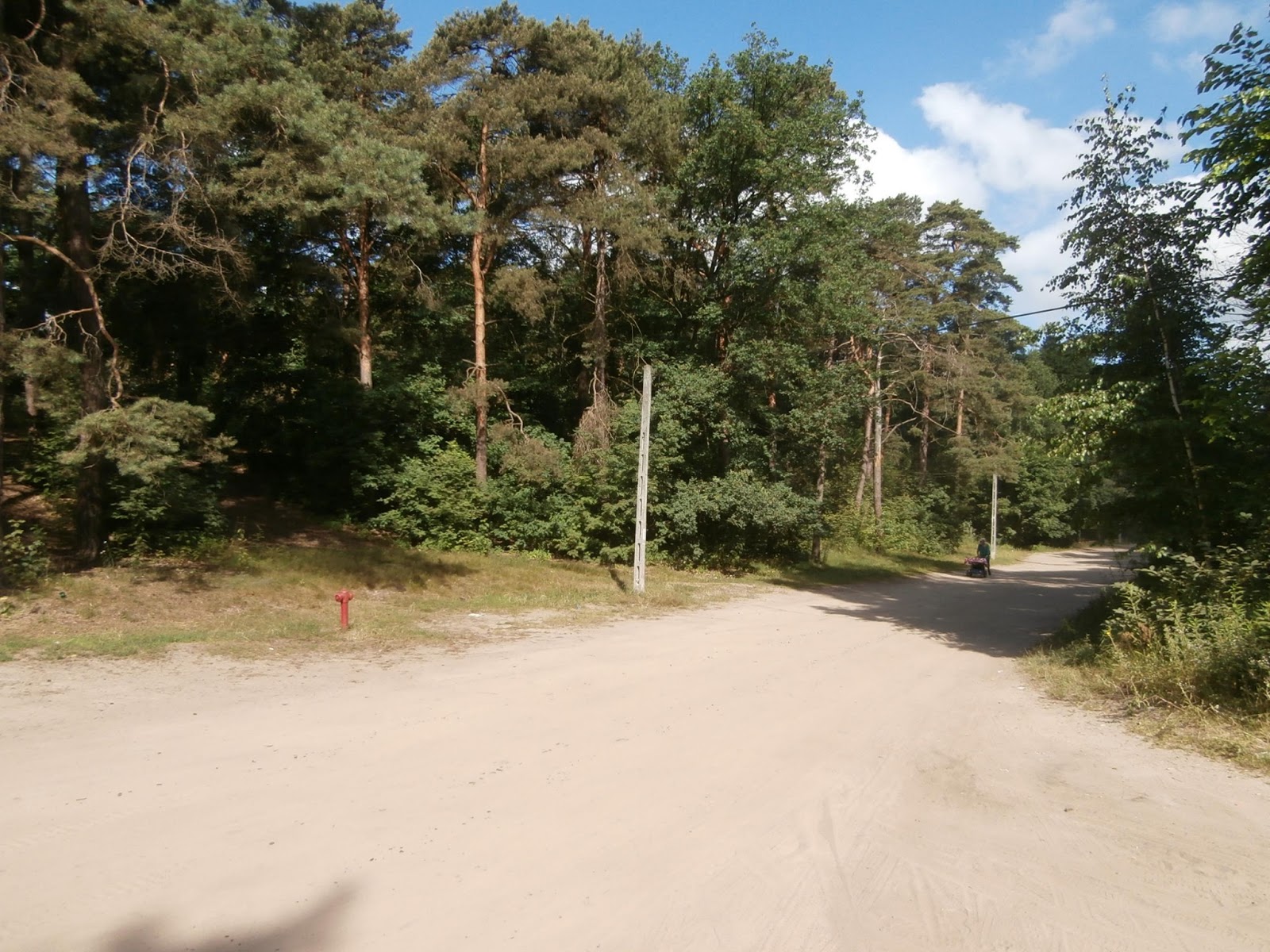
Górki Szymona – allegedly the pride and joy of Piaseczno. Maybe I am biased, but if the town in which I spent first seventeen years of my life has anything to boast about, I’m a Dutchman. I ventured there last Sunday to check out how the place where I would go with my parents some twenty years ago looks and, unsurprisingly, little has changed.

To the right – the standpipe is where it was in 1994, I recall well my father developed a habit of parking his Fiat Uno next to it. Only the trees are higher, the road running towards the place has not even been tarmacked… In the background – a chap (was not a pleasure to cycle past him, the odour could not be captured by the camera) pushing a rubbish cart – fits the place perfectly.

To the right – for a short moment I forget I am mere three miles from home and imagine I’m holidaying. There’s a lake, there’s a pier, an angler on the other side. Behind me someone has pitched a tent and its dwellers are eating breakfast.

To the right – the sand-covered hill, why and wherefore this place is named the way it is named. In my childhood it was the place most ‘tourists’ would lay their blankets and towels. Nearby was a sandy shore and swimming baths.

To the right – I tried to cycle around the pond and ride through a wide footpath. It is the only place in the whole area that seems to have a spirit. Finally I did not dare to cover the whole path by bike and turned back. I have to confess I did not feel safe there in broad daylight.

This is the essence of Piaseczno – I feel safer in Warsaw late in the evening than in Piaseczno on a Sunday afternoon. On my way to Górki Szymona I was accosted by four tanked-up hools trying to deprive me of my bike. Fortunately the incident ended just with an exchange of “pleasantries”. Local authorities also want to revitalise the area and attract not only locals by letting a private investor build a guesthouse. I doubt those ideas ever prove successful.

Key advantages: proximity (less than half an hour by bike for me to get there), there’s water out there
Key advantages: not sure if swimming there is safe, whether the water is clean, no other attractions around, no snack bar, etc., shady spot…

So if this is not the right direction, next weekend, weather permitting, I plan to check and document the progress of works on the Southern Bypass of Warsaw, from junction Puławska to so-called Grande Canale, the least advanced section of the road.

Sunday, 7 July 2013

Pension system overhaul - follow-up

The topic of pension system reform, my hobby horse, will be keeping us company in the coming weeks. The final decision on the future shape of the pension system in Poland is bound to be taken and announced around the end of summer holidays. Until then several consultations will be run in order to work out compromise on the variant which will be chosen and pursued. Meetings have kicked off and judging by what politicians and government-related economists declare, we are drifting towards the second option, i.e. freedom to choose whether to still transfer part of pension contribution which now goes to private-run pension funds there or to move it to state-run social security fund.

A week ago I mentioned the calculations presented in the government report, whose accuracy has been called into question by independent (?) economists. I took the trouble to download calculations presented by independent economists (in a spreadsheet) and set about analysing them. I can only agree with independent economists that money-weighted rate of return (actually in essence internal rate of return) is a proper and more accurate tool for assessing investment performance that geometric mean. I spent some half an hour poring over the complicated spreadsheet to work out why specific formulas are in specific cells and find causations between them. Then I began to verify assumptions on which calculation had been made. I found a factual error in decreasing fees charged by pension fund managers (not impacting substantially the upshots), but then gave up on further exploration as it was before eleven, it was dark and my mind simply began to drift away. Had I spent one more evening doing all the stuff, I would have probably been able to tell whether the independent economists’ calculations were correct. Third evening for verification of government’s calculations and I would have been home. But in the first week of July when weather is perfect, there are much more interesting things to do than taking apart the report, if it is not going to change anything…

The silver-mouthed politician of the week award goes to Leszek Miller, chief(tain) of SLD. On Tuesday in the public radio he put forward calling parliamentary investigating committee to track and bring to the light irregularities in setting up and running pension funds. Having read the transcript of the interview I can say that:
1) There is no need to call any committee to find out pension fund managing companies charged over 17 billion PLN in fees from contributions paid by future pensioners. They did it within the letter of law (because politicians allowed them to do so), extensive reports on profitability and solvency of pension fund industry are available on Polish Financial Services Authority’s website and everyone (computer-literate) can easily find the numbers,
2) Personal tie-ups of reform-authors with beneficiaries of the reform are disclosed to the public. You may speak here about arrogance, lack of integrity, but not of withheld tie-ups.
3) If indeed it is true that powerful financial corporations lobbied for the reform to secure for themselves risk-free business, they surely did not spare efforts to efface all the traces of what could be found illegal and the committee would not be able to track it.
4) If Leszek Miller suggests pension fund managers were “pumping up” prices of some shares and there were investors in the know of it and benefited from this and he has evidence of such incidents, may he go to relevant supervision authorities. What Mr Miller speaks of is an example of insider trading, which is a (n easy to detect, difficult to prove) crime. Bodies which deal with such form if criminality in Poland are Financial Services Authority (KNF) and Prosecutor’s Office.

On Friday Mr Miller announced his grouping would pass a resolution condemning bygone prime minister Jerzy Buzek and bygone finance minister Leszek Balcerowicz for the pension reform. I know there are thousands or even millions of people in this country deeply convinced pension system reform, in particular creating pension funds, was the biggest scam made in Poland after 1989. Mr Miller also knows it (just as he knows there are millions of Poles hankering after Gierek’s decade) and in his cynical game wants to score a point by speaking out what those people have in minds. I shall refrain from explicit comments, this is pure politics, not policy, something that adds no value to moving Poland forward.

On Tuesday the runner-up, Jarosław Gowin reasserted he thinks “in pension funds there are Poles’ private monies” and insisted in case pension funds are scrapped, it would be best to give that money back to Poles (incidentally Mr Gowin failed to pin down what he actually meant). Last week I outlined a scenario of freeing the assets accumulated in pension funds, this week I will just paste a fictitious news item, thought out by me and posted on my wall on facebook – dedicated to philosopher Gowin.


It does not take a lawyer, nor the Supreme Court ruling, to come to the conclusion public pension fund assets are not private savings, it is a matter of logic, you just need to use your brains.

The conclusions I reached after the last week are depressing. An average Pole knows little of economics. Loads of useless stuff are taught at schools and except for short course of “entrepreneurship” run in high schools, youngsters in Poland are not educated in the workings of economy. I estimate 80% of Poles do not understand what the whose fuss about OFE is about and hence are pliable - one day can believe the government, the other they will believe Mr Balcerowicz is right. Due to lack of education they have to take what they are told on trust. Imagine how much room for misrepresentations, manipulations, populism and propaganda it leaves.

Politicians and journalists also lack proper knowledge and understanding of the topic. Let’s take the example of a sentence “oszczędzać na emeryturę w ZUS-ie”, in English ‘to save for pension in [state-run] Social Security Fund’, literally in “Social Insurance Company”. Stare-run pillar of the pension system is an insurance scheme. When you work you pay contributions and in fact take out insurance from not having subsistence when you retire. It is an example of endowment insurance policy with no payout before maturity. Get it? If not imagine you take out non-compulsory car insurance. If your car is not damaged, nor stolen, has the insurance stolen your premium. In state-run pension system you buy protection, not benefit. Had it been the other way round, the system would have collapsed, or contributions would have been raised.

The other story is poor informational quality lack of clarity in public speaking. This drawback of Polish public discourse is partly the effect of poor understanding of complicated issues. The other, very rare ability most public figures lack, is the aptitude to explain complex issue in simple words, intelligible for an ordinary recipient. Even if somebody has knowledge, difficulties in putting it across make it useless for the society!

Now let’s move a level higher. Imagine the recipient is an educated graduate of economics, who not just holds a diploma, but is familiar with the stuff and avidly interested in it. If such person needs some six hours (maybe it is little) to determine whether rates of return in the report were correctly calculated, does the whole debate not move to another universe, completely out of reach for ordinary people? Should an average citizen know whether geometric mean, or money-weighted rate of return is apposite for comparing investment results? Does this give politicians and economists right to deprive benighted people of the right to decide how to secure their retirement? Thus I moved to the realm of questions doomed to be unanswered which reminds me today’s writing has come to an end.

Sunday, 30 June 2013

Nie będę płakać po OFE - pension system overhaul

With some considerable delay, the Polish government unveiled this week the long-awaited report containing a comprehensive analysis of the Polish pension system and recommendations for coming changes into its workings. Regular readers of this blog probably know the topic and my opinion on it inside out, yet if somebody has to catch up, follow these posts. The report, in Polish, can be found here. I have not found any English-language summary of it, yet for the sake of brevity, I will not summarise it, nor repeat anything I have written before as there have been no fundamental changes that need to be underlined.

Defenders of private-run pension funds being a part of public social security system have, predictably, torn a strip off its authors, accusing government-linked experts of manipulations, lies and use of propaganda, funnily enough without pointing at any specific example. The critics also say calculations presented in the report are distorted. Due to shortage of time and data, I cannot check accuracy of calculations presented in the report, yet if the only accusation is that the government presented investment results of pension funds net-of-fees, rather than gross-of-fees, then jaw drops open helplessly. For my part, I have found the report surprisingly substantive and unbiased and see in it one of few commendable recent attainments of PO-led government.

Albeit, let’s face the truth, this overhaul is carried out not because minister Rostowski cares so much about future benefits of the Polish pensioners, but the key incentive for pursuing it is the tightness of public finances.

The report analyses inter alia the impact of private-run pension funds on capital markets. As an analyst I have seen a few examples of stock-listed companies in which pension funds were major investors and those companies, actively managed by key shareholders, have been well-run. For many companies capital provided by pension funds was indispensable for development and proved a successful investment. Pension funds also contributed to development of Warsaw Stock Exchange and helped it grow to be the biggest such institution in CEE. But there is also the other side of the coin. The processes which have had favourable impact on Polish capital market will one day, due to changes in demographic trends, reverse. Today pension funds are net buyer of securities, but in a few decades outflows from pension funds will surpass inflows, as fewer people will work and pay contributions and more will be paid benefits. Then pension funds will be putting a downward pressure on stock prices and will have to dispose of some of its assets… Due to active ownership of shares in stock-listed companies, the recklessly made decision to nationalise the pool of assets in pension funds invested in stocks as it would have detrimental impact on Polish stock market and economy.

Pension fund defenders convince pension funds have contributed to higher GDP growth rate, while the government claims the effect on economic growth has been negative. The former back their assertion by arguments I mentioned in the paragraph above, the latter point out transfers of part of pension contributions transferred to private-run pension funds, which had to be replenished by subsidies from state budget, increased government’s borrowing needs, debt-to-GDP ratio and thus debt service costs. However, the same debt was later purchased by pension funds, hence increased demand for borrowing from the government was balanced by increased demand from pension funds – those two have cancelled each other out, leaving yields on government bonds roughly unchanged, with some intermediaries (private companies managing pension funds) charging a considerable percentage of that “hollow circulation of funds” as fee for facilitating the process. Their revenues, from standpoint of future pensioners generated a loss.

The report highlights the problem of “double-tax generation”. One of the goals of the pension reform in Poland was a shift from pay-as-you-go to capital system. Under such move, one working generation had to pay contributions for benefits of current retirees and, at the same time, “save” for their own pensions. Is such burden not to heavy to carry? Authors of the reformed wanted to fill the gap by proceeds from privatisation, as the generation of current retirees, working in socialist Poland, had built many of the big state-controlled companies. Privatisation itself should be a goal, but not at any price and not to, let’s face it, meet current government expenses. The whole concept of privatisation as source of funding for the reform, resembles me a granny who sells her unnecessary jewellery to make ends meet. Whether it is wise – I am not the one to judge it…

The issue hardly anyone broaches is conditionality of state’s liabilities towards pensioners. In the Social Security Fund you have book records, while in pension funds you have government securities. Both are the government’s promise to pay, either directly a pension, either to repay bondholders. However, due to form of insurance, book records in Social Security Fund are conditional – these liabilities turn partly unconditional, when a Fund member retires; in pension funds, where assets can be inherited, the liability is conditional as long as a member does not retire. Minister Rostowski declared the part of assets transferred from pension funds to Social Security Fund will also be inheritable, hence in such way state budget would not be better off.

And the last problem, with which I have not come up – frankly speaking I hatched the idea on one of Internet forums – is the functioning of pension funds in the light of MIFID. Under investor protection regulations, if I was to pay my money into investment fund with exactly the same investment policy as a strictly regulated pension fund, I would be obliged to fill in a survey to check suitability of such investment for me, and in case of unsuitability, I would be warned against it and would have to sign a statement despite the warning I want to invest in a risky product. In the case of pension funds, nobody bothers to follow such procedure, which disproves the untrue claim that “in pension funds there are people’s money”.

The government presented for further discussion 3 variants:

1. The pool of assets in pension funds comprising of government securities is transferred to Social Security Fund and booked on accounts allocated to future pensioners. Other assets in pension funds remain intact, 2.92% out of 19.52% pension contribution goes to private-run pension funds which are not allowed to invest in government-issued securities, the rest goes to Social Security Fund. Furthermore, internal benchmark mechanism (pathological) is scrapped, but indebtedness ceiling level (currently 50%, 55%, 60% of debt-to-GDP) are accordingly decreased to prevent rise in public debt.

2. Citizens are free to choose, whether to participate in private-run pension funds, or to rely only on state-run Social Security System. The proposal, as I far as I could notice, does not pin down the split of contribution between state- and private-run parts of the system. This option is more controversial, as system participants would have to submit declarations they want to stay in a specific pension fund; not submitting a declaration would mean silent assent for transfer of assets to Social Security Fund, plus such decision would be irrevocable, while the decision to stay in a pension fund could be revoked any time in the future). Moreover, there is a problem what to do with shares of companies transferred to Social Security – this would be hard nut to crack, yet feasible, the report contains some recommendations with feasibility and drawback analyses. The idea to “write off” government bonds transferred to Social Security Fund would have to be thoroughly analysed by lawyers, as this smacks of sovereign default!

3. Extended freedom to choose – if someone chooses to stay with a pension funds, pension contribution to private-run funds would be 2 percentage points (in relation to pre-tax salary) higher. If you read between the lines, the message is “if you think private-run pension funds are so good, why not pay them more?)

The government also resolved that state-run Social Security System will be responsible for all benefit payments and assets from pension funds will be gradually transferred to Social Security Fund over last 10 years before retirement, to minimise risk of lower pension due to downturn on financial markets.

As commentators say, variant 3 is least likely to go through, while oppositional parties lean towards variant 2. I also hold the view that, despite some of its drawbacks, would be the lesser of all evils and, if amended properly (I put forward a citizen has to submit a declaration if they want to have assets allocated to them transferred to Social Security Fund and shifts between state-run and private-run funds could be done many times and in both way, of course in minimum intervals of let’s say 6 months), should be implemented.

What I did not like about the report is that private-run pension funds and their managers who have ripped over 17 billion PLN off future pensioners are presented as scapegoats. They are only a beneficiaries of legal framework created by politicians and if somebody is to blame, these are politicians, who passed such law, thanks to social support achieved thanks to several misrepresentations. Imagine you are a wife and your husband asks in his buddies to your house and lets them eat the whole content of your fridge, piss in your garden and demolish your furniture – your husband is to blame, not the buddies who were allowed to do damages.

One of my colleagues from work told me pension funds from the beginning were meant to be the scapegoat (not only the best, for reasons below, business on earth). In fact, to tackle demographic problems you only had to shift from benefit-defined to contribution-defined system, raise retirement age, scrap some privileges and create legal framework for voluntary private-run system of pension saving or insurance. At the end of the day, how high pension benefits will be depends only on standing of the economy, as investment results of pension fund in the long run depend on them. This means obligatory pension funds create little value added, and, provided calculations in the report are accurate, costs they generate are higher than value added they generate.

Now comes the time for consultancies. The debate will be fierce, as the prime minister said, big money is at stake – but for both sides of the argument. Minister Rostowski will play for more balanced budget, pension funds and its defenders will play for state-guaranteed source of profits on risk- and responsibility-free business. And I believe interests of the future pensioners are somewhere near the bottom of the list of priorities defenders are opponents of pension funds have.

I only fear the pension funds will draw another divide line in the Polish society. We have Poles who believe Martial Law in 1981 prevented a disaster and Poles who believes general Jaruzelski (turning 90 next Saturday) declared it despite there was no threat of Soviet intervention only to nip in the bud growing social movement. We have Poles who believe Smolensk crash was a tragic accident being aftermath of human errors and Poles who believe it was an assassination. From now we will have Poles praising government for dismantling the biggest scam in over 20 years of Third Republic of Poland and Poles believing the government wants to take over their money.

For the very end, I was deeply astonished by press conference on Friday by Mr. Balcerowicz, one of leading defenders of pension funds. When I looked at his wrathful face when he avidly spoke of “lies, misrepresentations and propaganda” I feared he would kick the bucket. He did not, but I am curious to find out why he failed to mention a single, specific lie and disprove it. Is it so difficult to say “the statement you can find on page X, paragraph X of the report, i.e. “quote” is untrue, because this and that”? Why has he not done it?

The release of the report coincides also with congress of the Civic Platform, held this weekend. It made me realise if I were to choose, I would opt for Donald Tusk’s platform, not Jarosław Gowin’s one. I opt for moderate economic and social liberalism, not conservatism. But above all, I opt for sound mind and common sense!

Sunday, 23 June 2013

Too much filth will kill you...

Back from holidays again – experienced a total logout from work and tomorrow the first thing I’ll need will be a password reset to access my computer. Even the weather diffidently signals time to return to corpo-world has come – the recent heat wave gave way to a downpour and temperatures plunged by 10C, giving a blissful relief from the heat. And may it stay so…

Got some time to catch up with film watching and finally watched Drogówka, the fourth film by Wojtek Smarzowski which went on the silver screens in February this year.

Mr Smarzowski’s film-directing attainment is definitely incomparable to any other contemporary film-maker in Poland. To put it briefly, in Smarzowski’s world there’s no choice between good and evil, the best option is only the lesser of tow evils… In his (in)famous four films he deftly depicts the darkest side of life, pouring the filth into the audience, making you want to take a shower and wash away all the dirt that has stuck to you while watching.

For many people I know even his first film, Wesele, released in 2004 and favourably received by critics, was intolerable. The film is actually a very ‘light’ depiction of the dark side of Polish mentality, showed in the background of a provincial wedding. The story of pregnant bride coerced to marry a groom bought-off by his would-be father-in-law sheds light on the worst traits of provincial duplicity: caring more about “what people say” (keeping up appearances) and money than about relatives’ happiness. Striking shady business is more important than grandpa’s sudden death, stolen Audi TT is more important than just-married wife and a child she will give birth to. Well-done and well-balanced art…

Dom Zły (especially with English subtitles, Jamie, are you still with us?) takes you back to the days of Martial Law and, in retrospections, to late 1970s. The picture is dirty, at times vulgar and explicit, yet taking into account the purport of the film, suitable. Form should fit the content and in this case the balance is still struck.

I’m ashamed to admit I haven’t found time, even in the last days (when still I was kind of busy doing some overdue refurbishment works around the house), to watch Róża. My mother, who watched it (but refused to watch it with me), told me cruelty and filth was dosed out moderately. The film, set in post-war reality of “regained lands” shows the dark side of events that actually took place and the depiction simply lacks censorship that would erase the ugliest parts. Yet, as critics say, given the historical background, use of abhorrent content is justifiable.

Compared to the newest Smarzowski’s film, the three previous could be classified as late-afternoon cartoons for polite children. In Drogówka, subsidised by State Film Art Institute and favourably reviewed by critics, the batty director has gone over the top and I will stand up for this view despite by general insensitivity to filth. The film was meant to over-expose all the pathologies plaguing the Polish police, in particular its road traffic forces. In fact only some of the pathologies showed in the film are the daily bread – these are mainly use of foul language or offensive jokes. Other alleged afflictions depicted in the film are simply marginal problems – gone are the days of wide-spread corruption, hardly ever can you find policemen gaining fortunes on bribery, regularly visiting brothels and raping accidentally met women. When the film was released I found the police representative’s statement, claiming the film discredits police, exaggerated and unfounded. Upon watching this and sticking it out (which I consider a success, as the plot is anything but gripping) I have to take back my words. As three previous film showed actual dark side of life, were waspish and cruel, yet fair, this one is a one massive distortion. The amount of obscene content is also fairly overdosed. The film could have done without explicit scenes of anal sex in the escort agency and one of the last scenes – oral sex on the back seat of a car, tragically ended by rear-ending could have also been edited out and without those two shots the film would have soaked with filth anyway. I have nothing against showing moral downfall, as I believe when it exists in fact, as such eye-popping naturalism showed to the public may help eradicate evil. In Drogówka intensity of filth might be unbearable even for the toughest audience.

I only wonder whether Mr Smarzowski takes pleasure in shooting such films. With each next film his exploration of dirt gets deeper, naturalism grows into over-naturalism and I don’t feel like watching his next attempt, no matter how many stars it receives in review in “Co jest grane”…