Showing posts with label construction. Show all posts

Sunday, 7 September 2025

Climate-friendly buildings

Summer 2025 by many has been perceived as cool and wet. Sadly, when such observations were shared in public, they fuelled claims global warming is a hoax, despite numerous figures giving lie to flat-earth believers and other wackos. In fact, in Warsaw this summer was thermally normal and dry (benchmark period: 1991 – 2020).

June 2025 with mean temperature of +18.5C and total precipitation of 47.7 millimetres was slightly warmer and drier than long-term average (respectively: +17.7C and 63.9 millimetres).

July 2025 with mean temperature of ++20.0C and total precipitation of 53.8 millimetres was normal and markedly drier than long-term average (respectively: +19.7C and 82.2 millimetres).

August 2025 with mean temperature of +19.3C and total precipitation of 9.2 millimetres was slightly warmer and extremely dry in comparison to long-term average (respectively: +17.7C and 60.6 millimetres).

The first week of September brought temperatures a few degrees above long-term averages and little rainfall. The summer-like weather is foreseen to continue at least for the next two weeks.

The total number of hot days (defined as those with maximum temperature above +30C) has reached 11 so far (the last one on Friday, 5 September) and in line with weather forecasts it stands a little chance to still go up. It is conceivable, as in the past the capital of Poland saw three incidences of heat in second decades of September in Warsaw: 14 September 1951, 11 September 2012 and 13 September 2023. On top we have had so far 8 days with highs between +28C and +30C, which formally do not meet the definition of a "hot day".

Not everyone is fond of such weather. I belong to those whose bodies don't feel well in high summer and hence I have highly appreciated moderate weather, milder than in recent years.

Hot summers in Poland are still colder than what residents of southern Europe had to endure decades ago, when air-conditioning was not widespread. Since central heating was also a missing installation in most dwellings, walls were thick and windows were tiny. Window shutters gave shelter both from the heat and the cold. Roofed terraces did not let sunrays reach windows in when the sun was shining high. The price to pay were dark interiors.

I last recalled how old-style architecture protected from heat, when I entered a several-century old monastery in Święty Krzyż. With +29C and full sunshine outside, the edifice gave great shelter from heat, despite no air-condition inside.

On Friday I strolled around the centre of Warsaw and stared at modern skyscrapers. They all had walls made entirely from glass, with each storey having windows from floor to ceiling. I realise window panes these days need to meet stringent energy efficiency requirements, but glass will never be as energy-efficient as a 40-centimetre-thick brick wall. All those modern buildings can boast of fancy eco-certificates, while their architecture boosts their energy demand. The same applies to modern premium properties, with large windows being a housing equivalent of SUVs in motoring.

No energy is fully green. Generating electricity from solar panels involves carbon footprint 95% lower than from burning black coal, while for wind turbines it is 99% lower. The calculations take into account total life cycle of specific installations (source: ChatGPT).

In the office building where I work, radiators blowing in hot air and air-conditioning blowing in cold air were working at full blast all summer round. No matter how green the energy is, such waste of energy in a building which boasts of being energy-efficient is unacceptable. Same as a defunct fire alarm which has failed to inform of two small fires in the underground garage this year...

Old, energy-inefficient buildings are torn down and new, energy-efficient ones are constructed on the same plots. Has anyone calculated how many years of lower energy usage it takes to make up for carbon footprint in the demolition and subsequent construction? ChatGPT needed 4 minutes to come up with an answer: 30 years for a typical energy-efficient building, 15 years for an ultra-energy-efficient building. I have not verified it, but if it is true, business and money matters much more than actual care for environment. Much better for the planet would be to modernise existing buildings.

No matter how green the electricity that powers air-conditioning is, detrimental effects of prevalent aircon in city centres persist. Masses if hot air are blown outside several buildings and along with excessive concrete areas, exacerbate the urban heat island effect, making living conditions in city centres unbearable, especially for elderly residents.

Sunday, 28 March 2021

S7 expressway - progress check

Decided to make the most of yesterday’s first whiff of spring in March (in late February temperature topped over +18C twice, more on this in the annual Winter timeline, due in a fortnight), lugged my bike out of the basement, donned a thin face mask, a helmet and rode to inspect the progress on nearby S7 expressway construction site. Cycling note – this year instead of having my bike serviced at Decathlon, I did the brake adjustments, screwdriving, tyre change and chain lubricating and other stuff on my own. It spared me some 100 zlotys, saved not for a rainy day, but for time more conducive to living it up.

Having cycled through Las Kabacki, crossed ul. Puławska and cut across the cemetery in Pyry I find myself by ul. Baletowa. Here the road has been routed into a tunnel, wide enough to fit two lanes and pavements on both sides. It is around 11:00 a.m., traffic quite sparse so far.

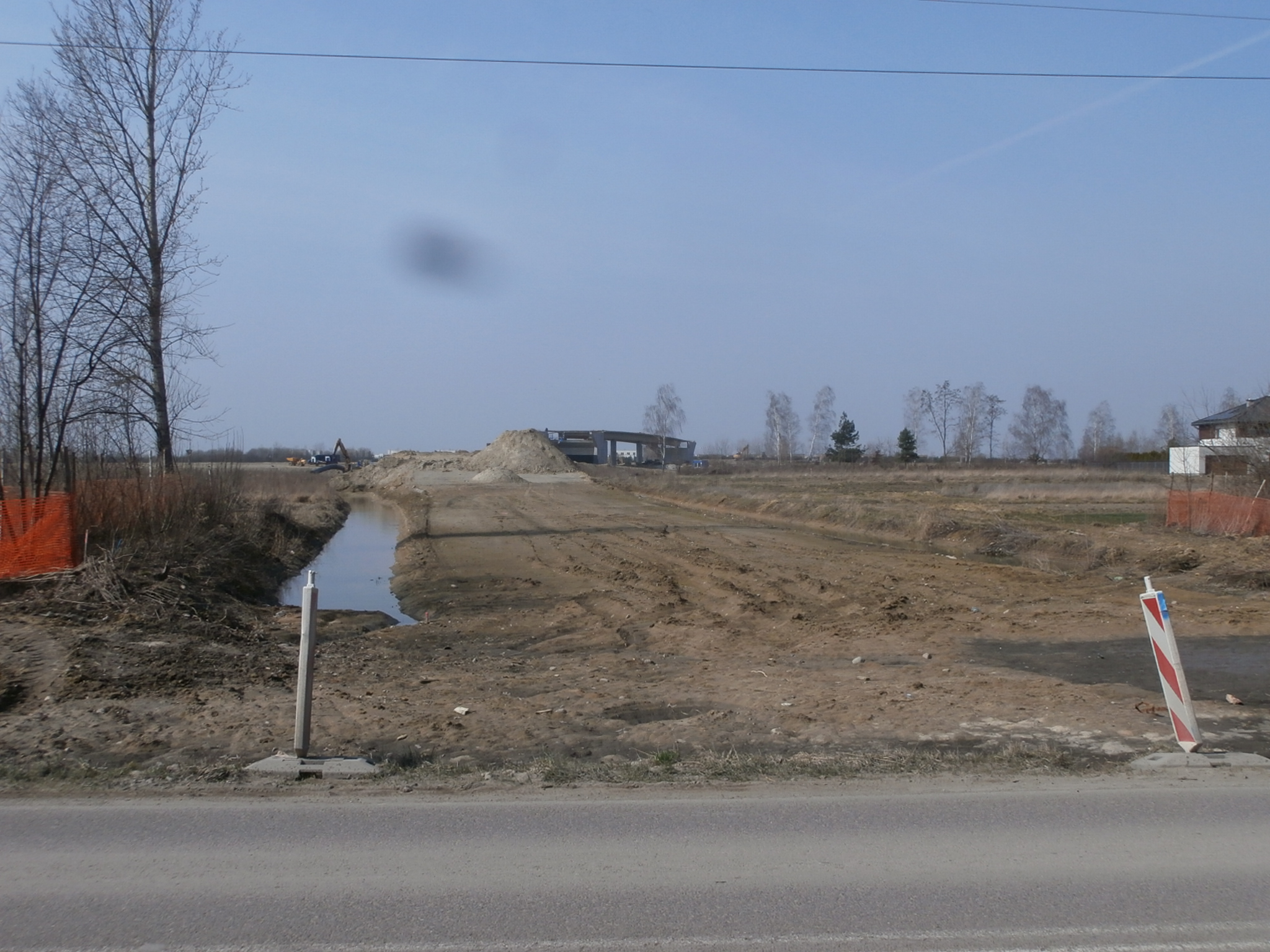
On the western side of the tunnel, looking north towards Warszawa Południe junction (lamp posts in the distance are at the end of the finished, yet closed section of the expressway). Except for the excavator and the truck, no machinery nor workers on site. Feel kind of sorry for dwellers of nearby houses who have lived here for decades and soon they will need to put up with the neighbourhood of a noisy and fume-producing fast traffic.

Then I cycle south through Dawidy Bankowe. A shot taken from a bus stop by ul. Starzyńskiego, looking east towards the railway tracks. The sandy bottom layer of the expressway’s foundation is well visible. Watch out for the spot which has blotted all zoomed pictures taken with my 2012 compact Olympus camera since early 2018. I have got used to that mark, the bigger the higher optical zoom I set.

Down in Zgorzała, standing by ul. Dawidowska, looking north. The viaduct in the distance seems to be a part of the Zamienie junction, currently having no link to the existing road infrastructure.

Standing nearly in the same spot, looking south. The pylons suggest ul. Dawidowska will run beneath the expressway in a tunnel. For no apparent reason, this venue does not exhibit a high progress of works.

Still in Zgorzała, looking west towards housing estates in Zamienie whose dwellers will also find the expressway audible (despite noise barriers, humming can be heard within half a mile from a fast-traffic carriageway).

The viaduct marked on the map of the project as WD-4 is now in the middle of a field, but it is bound to link ul. Raszyńska in Zamienie with ul. Postępu in Zgorzała (i.e. the place from which the snap was taken).

On to Nowa Wola where ul. Krasickiego also has been put into a tunnel. If you zoom in, you should see lighting installed inside it. Inside the tunnel actually everything seems to be nearly ready, while outside there is no point in doing any finishing works, as construction machines would spoil the effects of tidying up.

I was quite astonished to behold two flyovers built over ul. Postępu in Nowa Wola. As it turns out, they are a part of a bigger junction connecting the designed DW721 and S7. The viaduct will carry slip roads – the north will take westbound traffic from Piaseczno to Warsaw, the south one will take all northbound traffic from S7 towards both Piaseczno and Lesznowola.

The last shot comes from ul. Słoneczna in Kolonia Lesznowola, where the current DW721 runs into the tunnel. All 3 tunnels I photographed are quite similar. Less than a mile south from here the section A has its end. Further works are not carried out after the National Road Authority has terminated agreement with the general contractor of section B. If the section A is completed within the deadline, first drivers should be able to get from Warszawa Południe junction to Lesznowola, and no further, in November 2022.

Cycled home through Piaseczno. Traffic was quite dense given several types of shops are shut down since today. Then through Las Kabacki again. As I approach home, I run across a scene customary on ul. Moczydłowska on Saturdays and Sundays – a Straż Miejska patrol putting wheel blockers to drivers who illegally parked their cars in a residential zone. I am all into this. Feel like strolling into the forest – take a longer walk and leave your car (if public transport or bike are not an option) where it is permitted, instead of almost driving into the very woodland!

Sunday, 22 November 2020

Southern Bypass of Warsaw - mid-November 2020 update

It had been nearly half a year since my last trip to inspect the progress of Warsaw’s bypass construction east of ul. Puławska, but west of Vistula. Back in late May, I could venture there on bike without covering my face. On previous Saturday I had to put on a thin face mask, to protect myself from a PLN 500 fine, rather than from people I passed by swiftly in the open air.

The weather was quite fine then, with around +9C on thermometer. I had dug up thermal vest and long johns purchased in 2018 before the winter tripbeyond the polar circle, donned a tracksuit, gloves and a chimney and set off. Sadly, after photographing documents on preceding days, I forgot to switch the macro off in my camera, hence pardon the acuity of the first shots. To the right, work at full blast at the intersection of ul. Rosoła and ul. Płaskowickiej being rebuilt. The roads straight ahead will take drivers towards and from Ursynów Wschód junction.

Having descended down ul. Orszady and through Wilanów I reached Przyczółkowa junction which was nearly ready. The construction site was sadly fenced off with workers onsite and security guards looking out for trespassers. I did not venture to see the road nearly or fully completed.

From the afore-mentioned junction I cycled east along the southern road of S2, through a partly finished, partly unmade cycling path. As one can see, barriers, lamp posts and signage were all in place, lanes had been marked out. Note the curve in the distance which seems badly profiled, just as the one on Konotopa junction which takes the traffic from S2 to S8.

I cycled an oval around fields of rural Wilanów to get onto a viaduct which carries ul. Syta above S2. A view westwards, the expressway seems to await administrative procedures necessary before opening. Note the concrete slabs from which it is made, more durable than asphalt.

To the right – looking towards the Vistula from the same viaduct. In the distance plenty of construction machinery on the bridge taking the bypass over the river. On Saturday afternoon the work was in overdrive.

On my was back, I made a stopover on a muddy meadow which should be an extension of ul. Branickiego, linking it to slip roads from and into Ursynów Wschód junction. Nothing had been and the spot (missing 150 metres of road) has been dubbed the section of disgrace.

To reach the goal of cycling 25 kilometres, I rode around Ursynów instead of heading straight for home. On my way, I spotted speed bumps on ul. Roentgena, put in recently. Speeding drivers (I confess I used to drove there at 70 kmph in times when I took that street to reach P&R Stokłosy) now need to slow down to 30 kmph, yet judging by comments on local forums, locals seem disgruntled with the solution.

The last snap, taken, while being caught out by the rain. The extension of ul. Indiry Gandhi, running to Ursynów Zachód junction, which would remain useless until the U-turn at the end of current S2 is converted into a regular extension.

I wonder whether the section of S2 between Przyczółkowa junction and Lubelska junction (where it joins existing A2 motorway) is opened this year. Administrative procedures last around a month, but if completed before the end of December, a trip there by car would be one of those few signs that things are moving on despite the pandemic; hopefully towards normalcy.