Sunday, 8 March 2015

Winter timeline 2014/2015

Just for the record – the recent winter was preceded by an abnormally warm autumn. Key milestones in the run-up to the proper winter were:

24 September 2014
When the morning was cold enough (below +10C) to wear a coat for the first time since early May.

4 October 2014
First ground frost on the suburbs of Warsaw, official reading from Okęcie weather station however, reported day-time low of +1.5C.

14 October 2014
The last time I could go to work in a suit only (day-time low of +12.9C), hardly ever possible in October.

23 October 2014
Temperature drop compels me take out an overcoat from the closet (+3C in the morning).

24 October 2014
A mass of Arctic air comes over. First proper frost (-2.6C). Mornings are frosty until 30 October.

5 November 2014 and 6 November 2014
Two extraordinarily balmy and clement days with day-time highs of respectively +18.5C and +18.6C, 0.3C short of Warsaw’s temperature record for November set on 1 November 2001.

19 November 2014 – 22 November 2014
First whiff of winter in north-eastern Poland. Warsaw is intact by snowfalls (I have not witnessed a single snowflake), but 200 km from the capital of Poland snow cover reached almost 20 centimetres.

25 November 2014
Overnight sleet / snow blizzard brings… less than a centimetre of wet snow, which by late morning melts, since the temperature is above freezing. I would not call it a proper winter. I believe it is a freak of late autumn; gloomy, foggy late autumn.

26 November 2014 – 27 November 2014
Chilly, gloomy, wet (but almost without precipitation, except for some little sleet and few snowflakes), temperature near zero.

28 November 2014 – 30November 2014
Not a full blown, yet it’s winter. Below-freezing temperatures all time round are amplified by easterly gusty winds, so while –5C is normally bearable, it feels like below –15C. Not a single snowflake falls on the ground, yet we could do with some snow to protect earth from freezing deep.

November 2014 stood a chance of being the warmest since records began (it would have to beat the +7.5C record of November 1926). However the extraordinarily hot first half was followed by chilly second half and the last days brought temperature several degrees below long-term averages. All in all, the temperature over the whole month averaged out +4.8C, vs. long-term mean of +3.2, so November 2014 was categorised as warm. Stats:
- month-time high: +18.6C on 6 November 2014
- month-time low: –8.0C on 30 November 2014 (cold, but on 30 November 2010 temperature dropped to –11.5C)
- the warmest day: 6 November 2014 (daily average of +13.7C)
- the coldest day: 30 November 2014 (daily average of –6.7C)

1 December 2014 – 3 December 2014
Three snow-free, yet frosty days, with the middle one enriched with magnificent sunshine. Between –7C and 0C.

4 December 2014 – 5 December 2014
Getting warmer, light frost at night, slightly above freezing during the day. No proper winter in sight.

6 December 2014 – 7 December 2014
Dull weekend. Cloudy, with freezing drizzle at times, temperature very close to +1C. Worth noting freezing precipitation hinders lives of motorists and pedestrians in most parts of Poland, leaving the capital nearly unaffected.

8 December 2014 – 9 December 2014
Temperature swings up and down, cutting across freezing point. Damp, yet without noteworthy precipitation.

Night brings thick fogs which, when temperature drops to –5C set hard rime and make roads treacherously slippery. Drivers have to watch out…
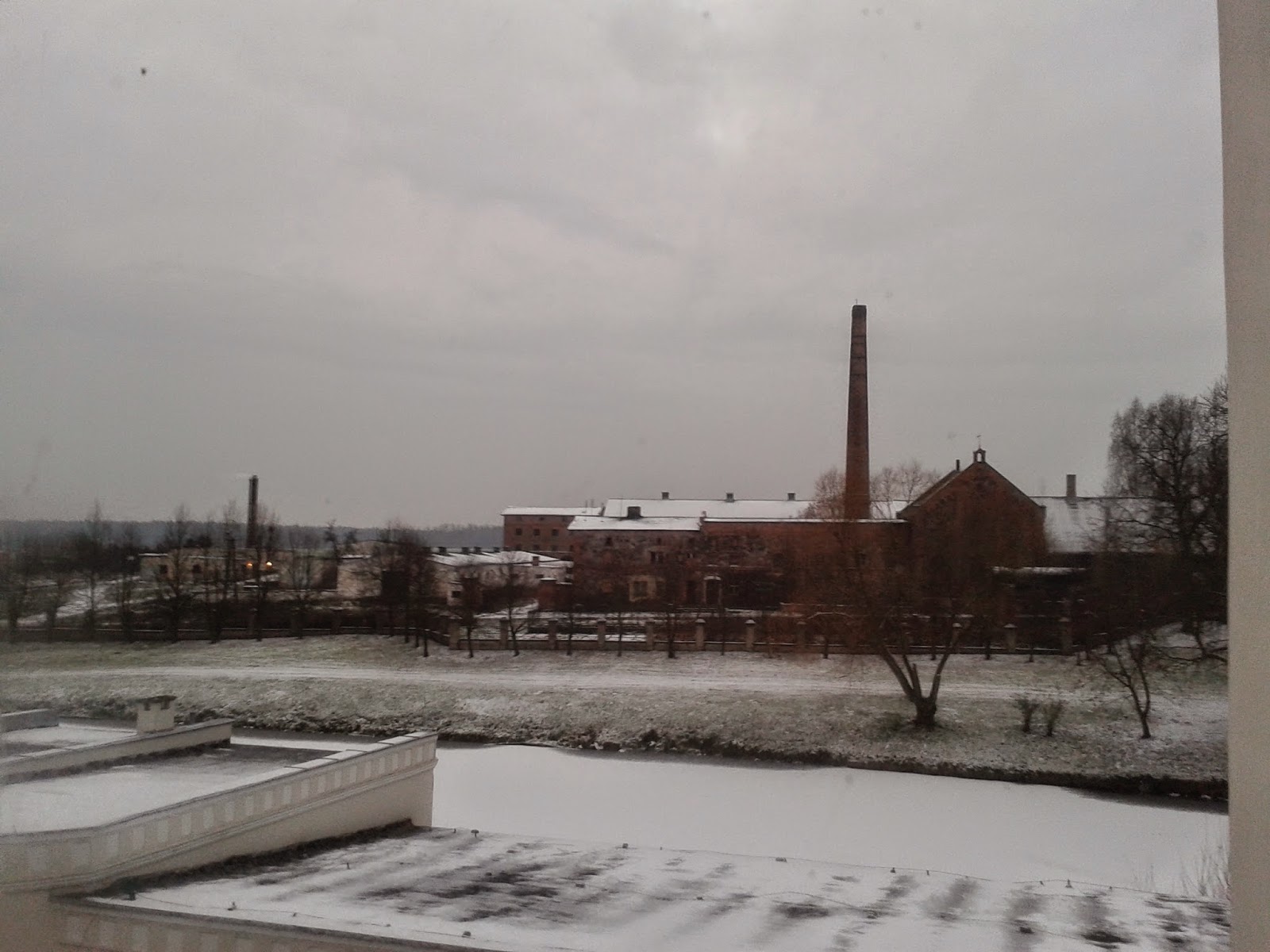
11 December 2014 – 12 December 2014
Thaw takes over… Brought be southerly wind, blowing more gustily hour by hour.

13 December 2014
Southerly winds do not ease up, but keep temperature higher than +5C all over the day… No forecast mentions any sign of proper winter by the end of the year.

14 December 2014 – 25 December 2014
Warm (up to +12C, all the time above freezing), windy (speed up to 90 kmph) and rainy (on 22 and 23 December Warsaw got more drenching than in September, October and November in total). Actually no sign of winter

26 December 2014
Winter gently marks its presence. Overnight rain turns into heavy snow, yet little of it lingers on the ground. Alas, some of the precipitation turns into ice. Around noon skies clear up and Warsaw enjoys a few hours of sunshine. –4C in the afternoon.

27 December 2014 – 29 December 2014
Forecasters get it wrong. On each consecutive day it is supposed to be –5C over the day and sunny, in fact the temperature fails to rise above –7C and skies are overcast. To boot it snows a bit. Yet 1 or 2 centimetres of snow do not give sufficient protection from freezing up to soil and plants.

30 December 2014
Finally skier clear over and scarce sunbeams brighten up the day. The drawback is temperature, –11C in the morning and no higher than –8C in early afternoon and dropping to –10C after sunset.

31 December 2014
Last days of the year lay bare very poor performance of meteorologists. Mere two days earlier they predicted double-digit frost on New Year’s night. For the last day of the year they predicted freezing drizzle and fortunately got it wrong as well. The outturn is that winter falls back to give way to late autumn (or is it pre-spring?).

December 2014 was slightly warm. Average temperature in Warsaw was +0.8C (vs. long-term average of –0.7C) and exactly as high as in December 2008. Temperature tended to go into both extreme, snow was seen seldom and in scarce amounts. Stats:
- month-time high: +11.9C on 19 December 2014
- month-time low: –11.0C on 30 December 2014 (could have been worse)
- the warmest day: 19 December 2014 (daily average of +9.5C)
- the coldest day: 30 December 2014 (daily average of –8.4C)

1 January 2015 – 3 January 2015
Thaw comes over. Ugly, rainy and particularly windy, hence warmth cannot be even felt.

4 January 2015
After a relatively sunny day, a snow blizzard hits around 4 p.m. It brings little snow, but the white powder lingers despite +2C temperature. Winds have waned a bit, but still are gusty.

5 January 2015
Yesterday’s snow is gone. Between –1C and +1C, rather sunny, winds further wane. At 9:20 p.m. a veritable blizzard hits Warsaw and brings some three centimetres of snow within half an hour. Some of it melts since it’s still +1C. Despite evening hour and long weekend, snow plays havoc with the traffic.

6 January 2015
Perfect winter. Light dusting of snow, cloudless skies from dawn to dusk, still air, day-time high of –6C. This short-lasting winter incident has been brought in by anti-cyclone, drawing in continental air to Poland. Why we enjoy single-digit frost, temperature in Eastern Ukraine drops well below –20C at nights.

7 January 2015
Indeed, –12C at the crack of dawn. Skies cloud over around midday, but it doesn’t snow. No warmer than –6C, but thaw’s in the offing.

8 January 2015
-4C in the morning, but +1C in late afternoon. Winter incident lasted two and a half days…

9 January 2015
Overnight snow and freezing rain falling in positive temperature on frozen ground make several ice rinks. Besides, thaw is in overdrive. In rains, the wind blows… Late autumn returns.

10 January 2015
+4C and rainy. Another winter storm draws in. After sunset gusts of wind get more intense, rain pours down and temperatures shoots up to +12C…

11 January 2015 – 18 January 2015
Big thaw. Above zero all the time, with short exceptions of tiny morning frosts, temperatures reaching up to +10C, sometimes sunny, sometimes cloudy, odd drizzle, at times windy.

19 January 2015
After eight days with no trace of winter freezing for in the morning (-2C) seems noteworthy.

20 January 2015
Little flurry in the morning, 0C. Over the day temperature goes up and within a few hours the snow melts… Just another gentle whiff of winter.

21 January 2015 – 22 January 2015
If in the brightest moments of the previous week it felt like early spring, these days it feels like the third decade of November…

23 January 2015 – 24 January 2015
Occasional sleet and freezing drizzle. Near 0C. Temperature has actually settled near 0C and in the coming day is unlikely to deviate from the point of freezing.

25 January 2015
It snowed all night but little of the white powder lingered since temperature was just above 0C. It snows all day but snow cover begins to accumulate in late afternoon when temperature reaches –1C. By evening some one centimetre of snow lies on the ground.

26 January 2015 – 30 January 2015
Temperature hovering around zero, deviating by no more than 4 degrees upward nor downward. Occasional flurry, however they tend to occur when it is above freezing, hence snowflakes do not catch eye for more than two or three hours.

I dare to say this has not been foreseen. Temperature typical: 0C, thick, wet snow falls from the sky. Slush on the roads. By 9 a.m. it ceases to snow, by midday some of it melts, but white cover linger till late evening.

January 2015 was warm. Average temperature in Warsaw was +1.4C (vs. long-term average of –1.9C). Weather in that month could be described as mild winter (note month-time low was remarkably high) with one episode of abnormal warmth in the second decade. Still it failed to beat January 1983 and January 2007, when mean temperatures stood above +3.0C. Stats:
- month-time high: +11.5C on 10 January 2015
- month-time low: –12.5C on 7 January 2015 (within 3 days temperature rose by 24 degrees!)
- the warmest day: 13 January 2015 (daily average of +7.2C)
- the coldest day: 7 January 2015 (daily average of –8.5C)

1 February 2015
Spirit lifting-weather. Cloud-free sky from dawn to dusk, nine hours of sunshine a temperature reaching up to +4C… First whiff of spring in the air, but it’s just a short spell of fine weather. Mild winter about to return soon.

2 February 2015 – 4 February 2015
Weather having a tilt at winter, since average daily temperatures are below zero, yet since fine weather continues, sunbeams warm up air in afternoons up to +3C. All snows melt…

5 February 2015
Overnight supply of fresh snow brings some one centimetre of flurry. Worth noting we haven’t seen a proper snowfall playing havoc with the traffic this winter. Below zero this time…

6 February 2015
Quite nice light winter. Not above zero even during the sunny afternoon, short of new snow…

7 February 2015
Little snow has fallen overnight, some snowflakes fly around before midday as well, most of it melts. In the afternoon wind picks up speed and its gusts become audible. Before long more white powder is to come.

8 February 2015
Forecasters warned of snow blizzard bringing up to 10 centimetres of fresh snow. In fact sunny intervals take turns with intermittent snow showers… Because temperature oscillates around freezing, snow disappears quickly.

9 February 2015
Snow shower commences shortly before 6 a.m. and continues incessantly until midday. At times precipitation is quite intense and snow cover reaches record-high (this winter) level of 4 (four) centimetres. In the afternoon when temperatures rises to +1C it turns into slush. Drizzle in the evening.

10 February 2015 – 12 February 2015
Grey, miserable, yet dry and relatively warm (not a moment with sub-zero temperature)… Pre-spring?

13 February 2015 – 14 February 2015
First whiff of veritable spring. Not a single cloud occluding clear, blue skies means large temperature fluctuations – mornings bring frost of some –4C, but sunbeams quickly warm the air up to almost double digits in afternoons.

15 February 2015
Marvellous weather was forecast to continued, while the actual weather is a huge letdown. Low-lying clouds make the day dull, temperature does not rise above 0C, chilly wind makes being in the open air unpleasant…

16 February 2015 – 18 February 2015
Again sunny, yet these days chilly. Around –5C shortly before sunrise, slightly above zero during afternoon hours…

19 February 2015
Morning brings +1C, but beware. Before dawn rain has fallen on cold ground and froze up. Roads and pavements which have not been salted are not just slippery, they are dangerously slippery. And then it gets warmer…

20 February 2015 – 28 February 2015
Just like in the same period in 2014. Not a sign of winter in sight, yet not a proper spring. Sunny days commence with frosty mornings, while if the weather is dull, it can well above zero all the time. But during the whole period temperature never reached double digits...

February 2015 was slightly warm. Average temperature in Warsaw was +1.1C (vs. long-term average of –1.0C), it might come as surprise this February turned out to have been colder than +1.8C measured in February 2014, and was far from +3.6C reported in 2002 or +3.1C in 2008, not to mention record-high +4.6C measured in 1990. Stats:
- month-time high: +9.4C on 20 February 2015
- month-time low: –6.0C on 17 February 2015
- the warmest day: 26 February 2015 (daily average of +5.6C)
- the coldest day: 6 February 2015 (daily average of –2.5C)

Almost -4C before dawn, but then temperature shoots up to +10C. Worth mentioning dry spells continues and we could do with some precipitation as dried-up soil longs for rain.

2 March 2015
A noteworthy event is the first storm this year which breaks out over Warsaw in the afternoon when temperature reaches +6C. The last day when it's balmy before a short relapse of near-winter.

3 March 2015
Light frost in the morning, sunshine before midday, two snow blizzards in the afternoon. +4C so the snow doesn't linger.

4 March 2015
Morning greets Warsaw with sleet, then thick, wet snowflakes which later turn into drizzle. +1C in the morning and warmer over the day, so whatever falls quickly disappears.

5 March 2015 – 6 March 2015
Frosty, foggy mornings, dull and chilly days. Drifting between winter and spring.

7 March 2015
Morning brings positive temperature which goes up to almost double digits in the afternoon, yet sky remains overcast...

8 March 2015
Enough is enough (+13C, but sky is overcast, at odds with weather forecasts predicting clear-blue skies). Time to declare the winter is over. Long-term forecasts in unison foresee above-average temperature in the coming two weeks, sub-zero temperatures might sometimes appear in the mornings, yet I'm pretty sure the winter will not return for one simple reason: it has nowhere to come from. In Russia and in Scandinavia winter has fallen back.

Winter of 2014/15 was beyond all doubt the mildest documented on the series of winter timelines. Two figures best prove its mildness: the lowest temperature was only -12.5C (in warm winter 2007/08 it was around -13C, a year earlier temperature once dropped to -15C), the highest snow cover: mere 4 centimetres. So in short: almost snow-free, warm, but with steady temperature far from heat records. Looking forward to witnessing more such winters.

Sunday, 1 March 2015

Ul. Mleczarska – some progress visible

Over three months since my recent posting on modernisation of ul. Mleczarska little was going on in the site. Despite mild winter pace of works was sluggish until mid-February, when temperature crept above zero for good and works grew apace. The completion deadline of 30 June 2015 seems achievable.

Much has been done on the southern end of the development, between intersection with ul. Syrenki and intersection with ul. Sękocińska (on Piaseczno side) and ul. Słoneczna (in Stara Iwiczna) – curbs have been laid on both sides and new pavement put up. The very road is formally open for drivers and apart ripping the old tarmac, no steps have been taken towards building a brand new road.

I have no idea what the ditch on the western side on the road has been dug for. The posts for more than sure carry telephone wires, the out-of-ark infrastructure of Telekompromitacja Polska. In the background – a recently modernised natural gas pumping station. Gmina Lesznowola keep moving ahead!

A Marian shrine (whose presence in this place could be traced back to pre-WW2 decades) at the corner of ul. Mleczarska and ul. Sękocińska has been covered with protective foil and moved a few metres further west. If works are carried on swiftly, in May local grannies might gather here to pray.

The ditch extends further north. If I were to bet what its purpose is, my two guesses would be either sewerage, or, more probably, putting underground electricity wires. Given how overhead electricity wires are prone to freaks of weather, possibly many low-voltage line should run beneath the ground to ensure continuity of supplies during storms or heavy snowfalls. Note amount of rubbished scattered around... Shame!

The pavement on the eastern side of the street is an absolute novelty on the section north of ul. Sękocińska and its appearance probably is going to be the biggest upside of the modernisation. Pedestrians will finally be able to walk there safely, without having to dodge sideways when a vehicle comes near. To the left – a fine example of Polish squalor. What makes people keep so much gratuitous “wealth” on their properties?

In the foreground – railway crossing, where tracks running to Siekierki power plant cut across ul. Mleczarska. The crossing is to be refit somehow as well. In the background – two mammoth (and some littler) mounds of earth amassed to raise terrain under the newly built street, especially in the vicinity of the crossing where ascent is to be less steep.

Further up the road little has moved on since my visit in late November. Again I wonder what makes people in cars worth several thousand zlotys take such bumpy paths and risk damage of suspensions of their cars. Is saving a few minutes, a few zlotys and a few kilometres really worth it?

A closer look at earth mounds reveals the one in the distance has been already depleted. Lots of soil however still awaits being used up. I'd be curious to find out who the land west of ul. Mleczarska belongs. Given its superior location, millions of zlotys lie here, so why no one bother to bow down and pick it up by selling these plots. Zoning plans for this area have been enacted and the only drawback is the vicinity of railway tracks, however this should be bearable, given how infrequently coal trains run here.

Apart from ripping the asphalt and stocking up mounds of earth or sand, little has been done on the intersection of ul. Mleczarska and ul. Energetyczna where a sizeable roundabout is to be built. I appreciate some infrastructure solutions in gmina Lesznowola are well ahead of their times, even if at first glance they seem absurd.

The north-most section between ul. Energetyczna and ul. Raszyńska exhibits the lowest progress of works. Some pipes have been left on a field west of the street, tarmac has been ripped halfway and reaching terraced houses to the right is still possible without having to flounder in mud (but from the other end).

Next photo coverage expected around Easter.

Sunday, 22 February 2015

Miasto 44 - film review

A long-belated post… I should have written it some four months ago, when I watched the film and took down my reflections worth sharing on the blog, but each week some more important stuff came into the foreground. Poor timing of many posts (i.e. commenting on many events with a delay of at least a few days) is in my view the biggest drawback of this blog. If I am to resolve to mend my ways, realistically it will not happen before 6 June 2015…

The first question about the film that naturally comes to mind concerns accuracy of depiction of the Warsaw Uprising. Virtually all films focusing on the theme of the uprising touched upon values associated with that historical event: patriotism, heroism, sacrifice, etc. All previous films played a part in shaping the “proper” picture of the Warsaw Uprising in minds of young people, while Miasto 44 is dissimilar to what audience have got used to. The picture is naturalistic and niftily illustrates what summer of 1944 in Warsaw was. It takes just a single word to describe it: a carnage.

The uprising is seen from a young generation’s perspective, hence instead of patriotism and sacrifices, the film dwells on ordinary lives of juvenile insurgents and things of central importance for people in their late teens. Thus the war intertwines with love (and sometimes making love), hatred, family lives, friendships and common human instincts, such as survival instinct. Moral dilemmas of characters are in the forefront, yet hardly ever they are shown in the broader context of the whole uprising or future of post-war Poland. Their choices relate to personal lives of specific persons, not their homeland. Personally, I favour such picture, ruthless and cruel, yet closer to the truth than fairy tales of women ceasing to menstruate during the uprising.

The cruelty and naturalism of the film were one of the reasons why film director, Jan Komasa, faced a barrage of accusations from insurgents. Youngsters definitely have to be taught what the Warsaw Uprising was really about and despite not being wholeheartedly enchanted by the film, I appreciate the director’s intention to shoot a film which would truthfully show wretchedness of those days. Some insurgents claim the brutality in the film tarnishes the memory of their valiant battle. Faced with such arguments, we must ask ourselves whether we want to rewrite the history. Making ten-year-old boys wear helmets, handing them dummy guns and telling them to run around and play the uprising is for me an actual slap on the face and a blatant distortion of the carnage, since wiping out Warsaw from the map of Europe and death of 200,000 people was nothing else but a gruesome carnage. I prefer repulsive sights of heaps of corpses and disfigured bodies of the alive to plain cult of brave insurgents.

The film selectively shows historical background of the uprising, however the selection of facts, adroitly highlighted between the lines, deserves commendation. It is underlined when the uprising broke out, Poles hoped it would last two or three days, before Soviet army came and cracked down on the Nazi occupier. Hopes for aid from Soviets was the main reason why most mutineers were unprepared and too often unarmed. On the other hand at the beginning of the film the viewer is told after five years of being humiliated and put down by Germans, lust for fight among inhabitants of Warsaw was too strong to be tempered. The march of Soviet army was by all characters treated with proper reserve. Advance of Red army gave hope for liberation from one occupier and relief from hardships of war, yet by no means Soviet were our friends. Tactic alliance in that situation was the lesser of two evils, but everyone knew Soviets did not give a damn about Warsaw… The film also reminds some soldiers from the Berling Army seeped to the left shore of Vistula and attempted to fight in the Warsaw uprising, yet given their inexperience in fighting in the city, they dropped like flies.

Special effects come in abundance in the film, most probably to appeal to younger audience. Nonetheless, I have found plenty of them gratuitous and detracting from authenticity of the picture. Some scenes in the film are totally out of place, with two taking the biscuit: one showing intercourse in the rhythm of techno music and the other of massive slaughter taking place when a slow-tempo ich liebe dich German ditty resounds in the background. I have found the former scene most misplaced in the film, not because I have something against sexual scenes, but because sight of two emaciated, unwashed for many days and wounded young people, who all of the sudden indulge in passionate intercourse which requires some fitness, simply does not fit the story. The scene was hailed controversial, since many uprising participants claimed nobody in that time thought about any closer relationships with representatives of the opposite sex, not to mention making love…

Miasto 44 inexorably prompts ponderings upon how human psyche can be affected by such traumatic event as the Warsaw Uprising. Each of the young people who spent almost two months in Warsaw Uprising witnessed scores of human deceases and tremendous suffering. Many times their survival instinct telling them to save their lives at expense of other people’s lives, conflicted with decency telling them to make sacrifices to rescue fellow men… Human psyche combats trauma by increasing resilience. Thus, in such extreme situations, in order to not to go insane, human beings naturally grow indifferent and insensitive to what they should be sensitive under normal circumstances… The question how humans cope with traumas of such kind is unlikely to be fully answered, since most people who lived through such slaughter unconsciously try to erase memories of distress. My maternal grandmother who spent almost the whole Warsaw Uprising hidden in a basement with her sister (their mother was killed in bombardment when she ventured above ground to come by some nutrition on 6 August 1944) and was driven away to Pruszkow by Germans, refused to talk about the uprising.

Despite not being a masterpiece, the film is worth spending two hours to watch it. You may be captivated by it or not, but it does a great job of giving testimony of one of the biggest humanitarian disasters in the history of mankind without resorting to disproportionate martyrdom. And finally, although during the last thirty minutes the depiction of carnage is grisly, the last scene, with special effects falling into place, makes up for all previous flaws of the film and renders without a glitch how the last days of the Warsaw Uprising looked like. As my grandparents confirm, the glow of burning capital was visible in late September 1944 even thirty kilometres away from the blaze.

Sunday, 15 February 2015

Six years into PES

Today, instead of a comprehensive note on one topic, a jumble of thoughts on manifold issues…

1. The coming Tuesday will mark the sixth anniversary of my first post on this blog. Having ridden out several crises I’m now back on the right track and not plan to give up on blogging, although increasing posting frequency is out of question. There’s life to live beyond the blog and despite drawing lots of pleasure from writing, blogging involves solitude and that’s the main reason why overindulgence in this hobby is something I shy away from.

2. In my first job, I developed a habit of starting a conversation with a fellow employee with a polite question, such as “how are you (doing)?”, “how’s life?”, “how are things going?”, etc. (to be precise, there are usually their Polish equivalents), rather than coming straight to the point in the first sentence. I also got accustomed to cheerful, yet more of less often insincere replies that everything is alright. At the New Factory such courteous question is an open invitation to an interlocutor to churn out a litany of woes. Such habits indicate my fellow colleagues are typical Poles, who’d feel uncomfortably if they didn’t have a cause to grumble. In Anglo-Saxon culture if you ask your acquaintance how they are doing, they would smile and respond “great”, even if their house has just burnt down, their car has been stolen and their animal has just popped off (it’s a simplification, I realise, but illustrates some general differences). The whole issue is about striking the balance between being straightforward and keeping a proper distance. If I ask someone how they are, should they assume I really care about their well-being or should they recognise I want to behave politely or break the ice, but deep down I don’t give a damn about their well-being? From my perspective it looks as follows: whenever someone who I don’t judge a friend asks me how I am, I smile and reply I’m doing fine. Quite often my assertions have little in common with truth, but I consider these white lies, since sincere answers would have negative value added. On the other hand, maybe I should appreciate people trust me and tell the home truth, instead of pretending everything is alright? All in all, I feel ill at ease, when I hear someone has a headache, someone else has not gotten enough sleep, feels sick, their car has broken down again, etc.

3. After yesterday’s bridge blaze, I’m strongly tempted to ask at what level of competence a journalist passes master. Headlines conveying information that “structure of the bridge is in fire” instantaneously brought out malicious comments from Internet users. Several commentators asked since when the Łazienkowski bridge is wooden, while they’d thought its structure was made up of steel and concrete which generally do not catch fire. A bridge in flames is generally a rare event and takes journalists aback, plus in such situation there’s a huge potential for disinformation as the story unfolds, but shouldn’t journalists learn more about the bridge’s structure and what actually burns before delivering a piece of information to its recipients? This is just one odd example, the more glaring from my perspective are those laying bare incompetence of economic journalists. In the context of expertise, should a journalist dealing with economic topic should be a graduate of economics (or finance or similar discipline of studies) with post-graduate diploma in journalism, or the other way round? Many times it seems to be the notion of economics is confined to cursory reading on a topic, without grasping its intricacies…

Sunday, 8 February 2015

Facing the music

In late-2014 moans on life, I avowed to wait until one year since taking up a new job passes by, before confronting benefits and drawbacks of the job change. Mere half a year into the New Factory (current employer) have gone by, but I feel overly tempted to get some matters off my chest, therefore I will indulge in sharing my thoughts on the blog…

Fully grasping why and wherefore I have decided to quit the job with the (previous) Employer involves going back in time and recalling the run-up to theday I handed in my notice. Then and now I can confess I drew a lot of pleasure from the previous job. I worked with wonderful people and although in the last months of my almost four-year stint there quite often people threw me off balance, from the current perspective I see there was really little to complain about… Just to quickly remind (also to myself) what drove my decision to move to the New Company:
(1) the Employer was in the phase of continuous downsizing – it kept losing good customers and kept laying off staff to cut by costs, however cost reduction failed to catch up with dwindling revenues,
(2) the Employer had no strategy and no ambition to grow; while competitors reported higher market share and profits, the Employer bucked that trend; I could not stand the lack of vision and motivation to outperform other players in the industry – how can a respectable CEO claim market will grow by 10% next year, but the company he is in charge of will shrink by 5% and feel comfortable with this…?,
(3) I feared if I would not have been redundant (with hindsight – I was on the informal list of employees to be retained), I would have been assigned repetitive tasks below my competencies,
(4) I totally did not identify with how the strategic investor and executives hired by it ran the company and (just like many other employees) considered with ill-running as mismanagement,
(5) given all the above, I felt my job was dead-end and despite hard work, my outcomes of my work had no chance to translate, in the long term, into my salary, in other words, money I was paid there was unsustainable.

For the next nine month the Employer has been drifting without direction (one announcement which appeared in the meantime is not meaningful in that context), but in the coming months, it should come to the crunch… Course of actions after 30 April 2014 proved had I stayed, I would not have been laid off, but tens of other employees, working in regional offices across Poland, were affected by the on-going downsizing. I pre-empted the prospective redundancy and decided to pursue my career outside the corporate structures of the Employer, having at the back of my mind the job change could be a nasty experience.

First weeks, or even months in the job are hardly ever a bed of roses. The worst shake-down period is gone, which means I do not need to rely on my colleagues’ support in getting around the new organisation. I believe it is also long enough for the first summary.

As for the upsides, no doubt there are plenty of them…
(+) Unlike the Employer, the New Factory has a clear strategy, ambition and vision how it wants develop and grow. Its senior executive are “right men for the job”. Whenever a problem is identified, solution to it is sought immediately.
(+) The New Factory is client-oriented and these are not only hollow words. Unlike most corporations whose employees can be busy all day doing presentations, analyses and reports, without having to focus on clients’ needs, the New Factory centres around its clients, who simply constitute its source of income, while reporting is whittled down to bare minimum.
(+) There is little tolerance for loafing about, incompetence, unreliability – in contrast to how the Employer put up with employees lazing away (this also contributed to me being worn down by that job), the New Factory enforces work efficiency.
(+) There is no culture of staying overtime – you are expected to work smart and efficiently during your working hours. Of course from time to time it is necessary to stay longer to close the deal, but this happens in every private company.
(+) The New Factory invests in its employees and their development – so far I have participated in more trainings than the Employer sent me to over almost four years.
(+) From financial perspective only, the improvement is visible. Not only earnings are above-market, but job security seems higher and perks are more generous.

Yet the benefits are counter-balanced by downsides…
(-) People…
(-) People…
(-) And once again people. To be fair it has to be stressed most people I work with are quite decent, but the atmosphere in the organisation is spoilt by the ‘less decent’ minority and the majority of decent folks re suppressed by overwhelming skurwienie (I have coined the term to describe with one word the state of mind of some employees and  relationships between people).
(-) Skurwienie can manifest itself in several ways:
- a new employee cannot reckon on much support from fellow colleagues and for sure not for voluntary support and I mean early days of new job, not to mention later,
- whenever you go on holiday or are sick do not expect someone will look after your stuff,
- if you generally are helpful to other people, colleagues perceive it as not as genuine help, but as an attempt to show your manager you can do something better than the person you want to lend a helping hand to,
- the atmosphere of rat race is devastating, one’s success is frequently pursued at the expense of other team members,
- your slip-up is a reason for your colleagues to be cheerful,
- all in all, end justifies the means,
- actually you can have a frank conversation with a person, but this only can be an eye-to-eye talk. If three people gather around, atmosphere of mistrust creeps in.
(-) The relationship with the boss is nowhere as good as with my boss at the Employer’s. With my previous boss, we were exactly on the same wavelength and I would not overstate if I said we understood each other without words. Here, it is exactly the other way round. Even if my boss and I communicate in plain Polish, communication is poor. The other story is that my boss is kind of dim-witted, she fails to comprehend many straightforward issues (other team members encounter the same problem) and whenever she does not understand something, she flies off the handle quickly and the situation gets only worse. If she has to deal with really intricate issues, I suppose she only pretends she understand what she is being told, since asking any question would only lay bare her glaring incompetence. Fortunately, since the beginning of February, a line manager has stepped in between my boss and me, so my interactions with the boss will be less frequent. I consider this change positive. The relationship with my line manager is even better than correct, however she still keeps her distance and seems to be wary of me.
(-) Overall contempt to other people displayed by my boss and some of team members. All other people are stupid, can do nothing right, their work is worth nothing, etc. Only their performance and outcomes of their work are superior.
What I described above does not afflict the whole New Factory. Skurwienie is characteristic to the team I have landed in. From my sounding ahead of the decision to change the job I learnt it would be nasty and it is. Since early August two people have left my team and continue their careers in other units of the New Factory. Efforts to hire new ones go in vain, since either candidates do not live up to my boss’ exorbitant expectations, or if they somehow pass muster, eventually they refuse to take up the new job, because it is known on the market this place (this team) ‘stinks’.
(-) Mutual control mechanism… Back at the Employer’s there was a unit dedicated to control the quality of your work. Once in a quarter they picked up sample of what has been produced by a specific team, put it under a microscope to look out for the tiniest errors employees made and produced merciless reports. Nobody liked them, but it was their function in the company. Here control and audit functions are kept within the team which means in regular time intervals you have to inspect what your colleagues do and pick over their mistakes. It is all done in order to ensure superior work quality. Needless to say such practices definitely enhance good atmosphere…
(-) The general disorder. Maybe it is because the strategic investor of the New Factory is from Southern Europe, maybe also because of people. There are details that wind up me such as lack of templates for frequently used documents, lack of neatness in document layouts, etc., too flexible procedures and inadequate enforcement of them. I try to combat this stuff and in my own work I have set myself higher standards and recently it has even been appreciated.

Despite more than getting by and with prospects of getting ahead, I do not see myself in the New Factory in the long-term. I can do my bit well, I will not fit in with the atmosphere of skurwienie, in which I will never feel comfortably. Being a misfit and working in unfriendly atmosphere, in unhealthy relationships lowers an employee’s motivation and leads to faster burnout. With thicker skin and having grown somewhat immune to skurwienie, I will soldier on here for a year or two more. What dissuades me from taking hasty decisions, apart from short stints looking bad in a CV, is that finding a satisfying job in the industry is a challenging task – people hold on to places where it is good, while job openings appear for positions in places where it stinks and staff turnover is high. Faced with a choice to stay in a shitty (in terms of atmosphere) place with which I am already familiar or swapping it for another place with a possibly shitty atmosphere, having to work overtime and for less money, I reasonably opt for the former…

Sunday, 1 February 2015

What causes creativity crises?

Michael’s last week’s only seemingly dull posting prompted a jumble of comments not seen under other actually content-richer posts. Sympathetic readers rushed to gee up the crestfallen blogger, a gesture being a splendid symbol of appreciation of his efforts in writing. Hats off to Michael for exhibiting first symptoms of any crisis after nearly eight years of blogging. My track record of blogging is two years shorter and I have had to overcome crises several times.

Whenever people set up blogs, they are full of passion to run it, but usually after several months they lose heart. At first they post less frequently or notes are shorter. With time a blog no longer classifies as ‘regular’ (the generally agreed definition of ‘regularly kept blog’ is the one updated at least once a week), finally they give it up all along. Polish-English blogosphere, whose best days are apparently gone, has seen many demises of blogs, while there are ones still thriving.

So what makes people cease blogging? My first and foremost guess is running out of inspiration. It may sound like an insult, but the stuff an individual has to convey to the world is finite. It takes paying continuous attention to nuances of the surrounding world and passion to commit them to the blog. The other reason is being pre-occupied with mundane aspects of life. As time goes by, one often becomes overwhelmed by family and work duties and gets too tired or has too little time to keep up the blog. It happened to me when I took up a full-time job in July 2010. Before that I had some 20 hours a week of university classes and lots of time to write. Thereafter I found time for writing a longer note only during weekends, as in the most dreadful period of combing studies and work, in late 2010, I would leave home at 6:30 a.m. and returned home at 9:30 p.m. most days of the working week. Several times I thought of quitting, but I have always soldiered on and good form would sooner or later return and again I could draw pleasure from blogging.

Initially I also thought monotony and repetitiveness of life puts people off blogging. Having mulled it over and over again, I consider this guess wrong. At some stage of life monotony is inevitable, since it simply goes together with stability, being a part of an adult’s life. Blogging, as each and every other hobby, gives a chance to break away from monotony. Moreover, brilliant blogging will not do without eliciting the extraordinary out of the ordinary. It often takes sensitivity to small stuff most people fail to discern and it does not matter whether you take delight in a beauty of winter sunrise or dissect implications of a central bank’s policy. A smart blogger has broad horizons thanks to which they will easily find a topic to comment on…

And why have I written all the above? Shortage of time is to blame for failing to share my insight on another topic (six months into the new job), but I will try to catch up next Sunday… As my I have accustomed the readership to posting in regular intervals, always on Sundays, these brief reflections on blogging are meant to fill a gap that otherwise would have shattered my credentials ;-)

Roll on spring!

Sunday, 25 January 2015

Swiss Franc going bonkers

Disclaimers:
1. I am employed by one of financial institutions involved in mortgage lending denominated in CHF, my financial well-being might be negatively affected by aftermaths of sudden appreciation of CHF.
2. I do not possess any substantial (in equivalent of more than 1,000 PLN) liabilities nor assets in or denominated to any foreign currency.

With hindsight it sinks in to me the decision of Swiss monetary authorities from 15 January 2015 deserve some more attention. The Swiss National Bank, apart from discontinuing its policy of warding off appreciation of the country’s currency, decided also to slash interest rates by 50 basis points, pushing policy rate further down into negative territory…

This move calls into questions one of economic paradigms I would take for granted during five years of studies and four years of banking career. Until recently in the economic theory the “floor” for interest rates was zero. Whenever the range of a central bank’s instruments in monetary loosening was described, one mentioned decreasing interest rates to zero and if this turned out to be insufficient, enlarging monetary base. Whenever I asked chaps from market risk department to estimate maximum negative valuation of an interest rate swap, it went without saying the scenario to analyse was an overnight drop in interest rate in a given currency to zero. Time and central bankers proved us wrong…

Interest rate is cost of money. Because as a matter of principle money cannot be bought or sold, the price is paid for temporary transfer of money, i.e. for borrowing or lending it. Theoretically, the cost of money can be negative, but in practice it seemed irrational. Recent goings-on have disproved economic theory. Thus we witness theory of economics is still in the making.

Negative interest rates have serious implications for stability of financial system. We already see the first apparently eerie effects of SNB’s move. Yields of Swiss governments bonds have entered negative territory, not only on secondary market, but also on debt auctions. In practice if yield on a10-year bond is –0.09%, you pay now 100.91 units of a currency to be paid back 100.00 units in ten years. At first glance it such investment makes little sense and the negative yield can be interpreted as safekeeping fee. Nonetheless, investors snap up on such bonds. Why? “The Economist” has beaten it to me in providing a comprehensive answer.

Government bond market naturally crops up as the first illustration of how central bank’s policy impinges on financial system. Let’s examine the outcomes for other economic actors.

Interest rates at which commercial banks lend or borrow money are strongly tied to rates set by a central bank shaping monetary policy of a currency in which those banks lend and borrow. On the lending side the situation is at first sight straight-forward. Components of cost of credit are a variable rate taken from inter-bank market (LIBOR) which is the cost of funding for a bank and the bank’s margin over LIBOR, standing for reward for credit risk borne by the bank. Whenever positive margin is higher than negative LIBOR, the cost of credit remains positive. If the margin, however, was low enough not to fully cover negative LIBOR, we would be faced with a situation when a borrower would have to repay less than they had borrowed. Consider a 1Y 10,000,000 CHF overdraft with cost of 1M LIBOR + 100 bps a Swiss company takes out. The principal is to be repaid at maturity, interest to be paid monthly. But if 1M LIBOR is –1.12%, then what? My first answer would be that no interest payments would occur, but how to handle loan principal? Should the net cost of –0.12% per annum be amortised over time and decrease outstanding loan by 1,000 CHF? If so, what if within a year 1M LIBOR rises above –1.00%? Loan administration staff and finance staff at some banks should begin to scratch their heads now!

From the borrowers’ (no matter if talk of individuals or enterprises) perspective the loan with negative cost is a veritable bargain. Probably the SNB intended to spur borrowing, thus increase monetary base and trigger inflation that would result in currency depreciation. The side effect of this action is that the break-even point for borrowers has been set too low, i.e. some entities that would not be eligible for a loan if LIBOR ran at 1% are now creditworthy. This pool of borrowers will likely default on their debts when interest rates increase, threatening economic growth in the future.

From the depositors’ perspective negative interest rates make horrible news. If commercial banks are to get funding on market conditions, they should pay depositors LIBOR. Businesses have no choice and will need to accept the negative rate. No one would imagine companies switching from bank transfer to handling payments in cash. Individuals, however, might choose to withdraw money from banks and decide to keep their savings in cash in a piggy bank / in a drawer / under the carpet. Of course if you keep cash at home, you are exposed to risk of physical damage or theft, but I presume some depositors would be willing to take those risks. A sudden outflow of cash from the banking system could pose a threat to banks’ liquidity. The effects could be comparable to a regular bank run.

In Poland, the Banks’ association and the Ministry of finance have worked out and agreed on measures to ease the pain of over half a million CHF mortgage borrowers. The proposals are modest and require banks to make some concessions that will somewhat decrease their profits, but in return should fend off provisions for past due debts. The measures will include:
1. lower or no FX spread on instalments – directly hits banks’ earnings, however gives a relief of up to 4% to borrowers,
2. using negative LIBOR as a base rate, however the total sum of base rate and margin might not fall below zero – at best a borrower would not pay any interest on the loan,
3. banks will refrain from calling for additional collateral – it has to be underlined in extreme cases LTV ratio, measure relation of outstanding debt to property market value, might be reaching even 200% (e.g. a borrower owns a flat which could be sold for 500,000 PLN but their debt in PLN is 1,000,000 PLN), the concession is a violation of one of Financial Supervision’s recommendations on mortgage lending, but given the current market situation, it is the best possible solution,
4. extension of lending periods, which would result in lower monthly instalments – given record-low credit cost in CHF and prospects of CHF/PLN returning to levels seen before 15 January 2015, it is a reasonable to wait out the period of ultra-strong CHF.
The compromise is very wise, since both banks and borrowers will share responsibility for the event which has taken both sides aback. That being said, one must not forget during the lending spree which reached in climax between 2006 and 2008 banks aggressively foisted upon their customers loans denominated in foreign currencies, particularly to those mortgage applicants who could not afford to service mortgage loans in PLN, but in CHF, in which interest rates were lower, were creditworthy.

For those with shorter memory, a short reminder, how in July 2006 the same politicians who today bleat how evil CHF lending was, expressed their disapproval of Financial Watchdog’s efforts to curb mortgage lending in foreign currencies.

The Polish Financial Supervision has also come out with another proposal that seems to hold water. The distressed borrowers could be given the option to convert their loans into PLN at the CHF/PLN rate from the day the loan was taken out, however they would need to return to banks difference between lower interest paid in CHF and PLN. The CHF appreciated rapidly in late 2008 and despite staying around or above 3.00 since then, a monthly instalment of a rate in CHF was lower than a monthly instalment in PLN until the first quarter of 2013. This was due to interest rate differential between CHF and PLN that offset CHF appreciation. This proposal should remind CHF borrowers for many years they benefited from their decision, however the reward was accompanied by FX risk… Impact for banks is very hard to estimate, in depends on so many technical assumption of the operation that any attempts to give a ballpark figure are doomed to fail.

The proposal, apart from questions of legal nature, gives rise to several technical / mathematical questions, e.g.:
1. how the current outstanding debt in PLN would be determined (not only FX rate but also loan amortisation needs to be taken into account),
2. how the difference is interest base and effects of loan amortization and changing time value of money would be accounted for,
3. would the borrowers have to return the difference in interest paid in cash, or would banks be willing to add it to the outstanding debt, if yes, would breach of currently binding Recommendation S in terms of max. LTV ratio be allowed,
and many other, proving this idea makes sense, but is on account a quick fix.

Many accuse banks of reaping profits from CHF appreciation. Had it worked like this, we would see enormous profits of institutions involved in CHF-denominated lending in their 1Q2015 financial reports. But we will not. CHF-denominated loans are banks’ assets, but they are effectively funded by liabilities. Because Polish banks do not take deposits in CHF, rarely issue bonds in CHF and generally do not take out loans in CHF (there are exceptions when funding is secured by parent companies), they have to replace funding in PLN by funding in CHF. This is done with use of FX swaps, derivatives which compose of FX spot and FX forward. For example, in order to replace a 3M deposit in PLN with a 3M deposit in CHF, a Polish bank sells PLN and buys CHF at a current date at spot CHF/PLN rate and agrees to conclude a reserve transaction in 3 months, at pre-agreed CHF/PLN rate which reflects interest rate differential between PLN and CHF. Thus effective cost of funding is LIBOR rather than WIBOR. Such operations are risky, because long-term assets are matched by short-term liabilities which needs to rolled over frequently. The roll-over risk materialised in late 2008 when access to FX swap virtually dried out and intermediation of Polish and Swiss central banks was requisite to match positions on Polish banks’ balance sheets.

Banks’ earnings on loans denominated in foreign currencies are made up of spreads. When such loan was disbursed, a bank earned profit on a spread between market FX rate and bid rate (i.e. if NBP CHF/PLN rate was 2.30 PLN, a bank would convert CHF into PLN at 2.20). Then banks earned on spread between market FX rate and ask rate each time an instalment was repaid. This practice was curbed in 2011 thanks to anti-spread law. I dare to claim as of today portfolios of FX-denominated loans, after costs of hedging and provisions for bad debts, generate negative income for the banks.

My own guess is that the period of negative interest rates and ultra-high CHF will not last long. Negative cost of money will lead to distortions in financial system, while strong CHF will send the Swiss economy into deep recession. Bright future is not ahead though. Just three days ago ECB announced it would launch out into quantitative easing. If without near-zero interest rate and expanding money supply economies of the Euro zone are unable to grow, it means they are still on their knees, almost seven years since the outbreak of full-blown crisis in early autumn of 2008. This time there will be more than seven lean years…

Sunday, 18 January 2015

Polish mining industry on the edge

If you believe a more appropriate subject for this week’s posting would be the decision of the Swiss National Bank to effectively float the CHF, I advise you revisit this post, especially in the light of some politicians’ proposals to help out over half a million mortgage borrowers (and also currency speculators who have shorted the CHF) thumped by skyrocketing Swiss currency.

If not, I suggest we go back in time by 30 years, to bring back backdrop of miners’ strike in the UK in 1984 – 1985 which led to closures of several unprofitable mines. The atmosphere in the UK those days was in some aspects similar to what is happening in the Polish mining industry. Some commentators have attempted to equate Polish prime minister, Mrs Kopacz, to Mrs Thatcher, a comparison for many out of place. Needless to say, just as British mining industry was in deep need of turnaround, the Polish one also calls for it, while the treatment it receives might be named overhaul at best.

The current situation has deep historical roots. Back in PRL the mining industry, one of focal points of heavily industrialised socialist economy, was pampered. Miners, the pride and joy of comrades were granted numerous privileges then. Mines were developed regardless of economic legitimacy, actually in the same manner as all companies in the socialist economy were managed. In the wake of the shift into free-market economy rules of the game have changed, but not for everyone. Most mines have remained a stronghold of the PRL. In late 1990s one programme of winding down unprofitable mines was launched. Later on no comprehensive strategy for the Polish mining has been pursued. In the meantime, miners excelled at defending their fulsome privileges (at the expense of Polish taxpayers), thus decreasing competitiveness of Polish mines. Fluctuating coal prices for some time allowed the government to sweep the problem under the carpet. Coal market slumped severely in 2009, but quickly bottomed up and mines had enough capital and cash reserves to ride out the short crisis. Coal prices rebounded in early 2010 and despite well-blown-out costs Polish mines remained profitable until late 2012. Since mid-2012 coal prices gradually declined and according to market forecasts, are unlikely to substantially recover in the foreseeable future…

To examine the distress of Polish mining industry, let’s have a glance at some facts:
1. Mining is a commodity business, thus above-average volatile and exposed to price fluctuations. Each mine, with quite rigid costs (little flexibility on technological and human resources sides) is a price-taker. It means when good times roll in, a mine swims in cash, but faced with a downturn, it can go under quickly. A prudent financial manager should run a company in such way that effects of price movements are smoothed out.
2. Environmental policies, including those imposed by the EU, hit the coal industry. Preferences for low-CO2 emission energy sources bring down global demand for coal.
3. Despite EU regulations, Polish energy sector is doomed to use coal and key fossil fuel, given scarcity and prices of other resources. Therefore, power and heating plants will remain the key off-takers of Polish coal mines.
4. Mining is one of most heavily unionised industries in Poland. Trade unions in some of the mines have sprawled into pathological size. Their power must not be under-appreciated, since they are capable of bringing most of the mines into standstill. Their bargaining power in negotiations is amazing, given track record of consecutive governments of giving in and subsequently maintaining status quo in the industry.

One could reasonably ask why some mines are profitable, some not and why mining companies are profitable and others incur sizeable losses. All companies in the industry are affected by falling coal prices, but for some market environment means much lower profits, for others barely breaking even and for the worst, threat of going bust. I have taken the trouble to unravel the puzzle of why some companies fare much better than others, found several factors, but no comprehensive answer. Just to name a few reasons for varying incomes between companies:
1. poor corporate governance in state-owned companies; this includes incompetent, too quickly turning over management, lack of clear-cut strategy, strategic decisions made on the basis of political influences rather than business analyses,
2. different technology-related cost of coal extraction (in some mines drilling and extracting is much more costly than in others) and different calorie-count of extracted coal which impinges on its price – for this reason the same number of people may produce fewer tonnes of coal of worse energetic quality,
3. low work efficiency and overmanning, both underground as well as in overground administration,
4. one-side linkage between profitability of mines and remuneration of miners. Personnel costs account for about 50% of mines’ operating expenses, therefore the item has crucial impact on break-even point for mining companies. While miners demanded to quickly privatise profits of companies when coal prices were running high (bonuses, profit-sharing schemes), when market went down, they reach out for the state aid and refuse to give up on their privileges,
5. miners’ privileges which appear excessive in comparison to what other workers enjoy. Most hard-working people in this country of course do not have to work underground in heavy conditions, but also do not enjoy guaranteed 13th and 14th pay and several allowances and fringe benefits.

The current slump on coal market has forced the government to take steps to bail out the ailing industry. The restructuring programme is much belated and therefore has to be implemented in haste. A long-sighted manager (a rarity in the public sector) would gently launch such programmes when coal prices were high and industry was capable of absorbing restructuring costs from cash surpluses. For obvious reasons, such move would have been inconvenient for everyone… It must be underlined, the originally proposed restructuring programme treated the distressed industry really mildly.

After several attempts to defer insolvency of 100% state-owned Kompania Weglowa, the biggest mining company in Poland, running 14 mines and employing almost 50,000 people, the government was driven up against the wall. Either they had throw a lifeboat to it, or let it go under, with all consequences. The determination of the government to avert the bankruptcy of KW served as water to the mill of protesting miners… The insolvency of Kompania Węglowa would actually benefit nobody. In the scenario of mine liquidation the Polish energy sector would lose the biggest supplier, more than 100,000 people would be affected by redundancies. Economic consequences would include lower proceeds for the government from personal income taxes and social security contributions and higher social security spending. It could actually benefit predator investors who would buy single mines after asset-stripping and turn them around (maybe not the worst scenario)…

In some media reports I read some 70% of Poles support miners fighting to save their jobs and blame the government for collapse of mining industry. In contrast, when I look at comments under articles on the issue in the Internet, I notice growing anger and discontent towards privileges miners enjoy, blackmailing methods they resort to and meekness of the government. No wonder ordinary people feel disgruntled. If their employer had to be downsized, they could not count on generous severance packages. Most of them would get what they must be paid (salary for their notice period plus severance pay in the equivalent of one or two monthly salaries) and could not dream of two-year salary. Most of them would not boast about above-average earnings and for most of them, bankruptcy of their employer would be their, not government’s problem… In the market economy if your employer goes bust or downsizes and you are laid off, you have to go it alone! It seems miners are totally detached from the market economy. For them it does not matter whether anyone wants to buy the coal they extract, regardless of what invisible hand of free market shows, their jobs must be saved… Who is going to pay for it is beyond their interest.

Here comes the question about the dissimilarity between Poland today and Great Britain in mid 1980s. Mrs Thatcher had social support for her crackdown on unprofitable mines. But does Mrs Kopacz have support of Poles for closure of loss-making mines?

Yesterday the government and representatives of trade unions nailed down an agreement on mining recovery. The government succumbed to trade unionists and amended some of the provisions of restructuring plan:
1. there would be significant reshuffles in the ownership structure: merges, purchases, buyout, all designed to inject the cash to mines from wherever cash surpluses can be found,
2. instead of 4,000 job cuts, no one will be made redundant, however some salary cuts will have to be accepted,
3. severance packages for those employees who will voluntarily come forward to quit have been raised.
If somebody’s impression is that the government has just buggered it up, well… some things sound better left unsaid.

During a long discussion on how to turn around the Polish mines one modest proposal stood out. It was mentioned by former prime minister, Mr Marcinkiewicz, who put forward to hand over the unprofitable mines to trade unions and let them take charge of the business. Representatives of the trade unions quickly agreed to accept such gift, provided on top of mines they receive 3.2 billion PLN the government intends to spend on restructuring of the taken over mines! Some things sound better left unsaid…

Time will tell whether government’s turnaround strategy for the Polish mining proves successful. For the time being even the weather seems to be against the industry. For more than a week temperatures have not dropped below zero and a few times nudged to +10C.

Sunday, 11 January 2015

Speechless, all of a sudden

Stand-up comedy is still a niche type of entertainment in Poland. Polish audience, used to low-brow cabaret programmes shot repeatedly on TV, would probably find it as a challenge to embrace as demanding performance as stand-up is. Despite this, stand-up turns out to thrive in Poland, although you should not expect to watch it on TV or hear about it in commercial radio. Fans of this comic style will nonetheless find it easy and inexpensive to buy tickets for live performances of stand-up comedians…

I have learnt it all since for some reason I did a research on stand-up in Poland. While doing this self-assigned task, I also decided to find out who the most prominent stand-up comedians in Poland are…

Uncle Google always helps in such instances and the search engine did the job without reproach. Only my jaw dropped open at the sight of outcomes. I kept opening each next search result and my mouth refused to shut…

Recall the Short story about the price of trust? I have totally put the hapless loan out of my mind and with hindsight had to read over all my postings labelled lent 1,000 to refresh my memories of how I had been duped by my middle-school classmate. Karol, as it turns out, is one of the up-and-coming stand-up comedians in Poland. Back when we were in our teens he exhibited inclination and talent for stage career. His first performances available on youtube are from 2011 when he would show off his skills during open mic sessions. At that time, according to blog records (keeping some stuff for posterity now pays off) he underwent gambling rehab therapy and did his sentence for unpaid debts. As the (alleged?) sentence was suspended and partly swapped for public works, one does not conflict with the other. Internet contains some evidence of his 2012 performances, but his stand-up career began to speed up in 2014. These days probably everyone familiar with stand-up in Poland knows his (real) name. He is not one of most famous comics, however critics and more experienced fellow stand-up comedians claim he is one the most promising young artists, has his unique, individual style and huge potential to grow into an outstanding stand-up comedian. Nothing more about, since I still do not want to reveal his identity.

The reading also reminded me Karol had borrowed money, much more money, from our fellow classmate, Marek. Without further ado I logged on to fejsbuk to find Marek is online and I started off a chat. Marek’s jaw probably also dropped open at the news of our ex-friend being a rising star of stand-up comedy. Sadly, Marek did not recover full 8,000 PLN he had lent. Having been paid off 6,000 PLN and having wrangled too much to get back the remainder (it would require taking the case to the court, as some of Karol’s creditors did), he had given it a rest. Interestingly, Marek knew a bit more about Karol’s tribulations than I did. Up to that moment, I had only been stunned, from that moment I was incensed. I could get over he had deceived me and many of his other former friends, but I cannot get over Karol turning his back on his family who got financially and emotionally ruined getting him out of troubles several times, despite this being none of my businesses, I feel damn sorry for Karol’s parents and brother.

I do not wish badly on anyone, including Karol. As Marek rightly said, maybe it is better he pursues his career as comedian than if he was to engage in massive scams as a lawyer (he had been expelled from the Faculty of Law for embezzlement of money from the student union’s account). But if once he rises to stardom and I happen to see him on TV, I will look at him with disdain and contempt. A man of honour might stumble and fall, but once a man of honour mends his ways, he makes up for the wrong he did. Karol, as the Internet shows, has got up of his knees, but does not think about apologising to his primary-school friends, middle-school friends, high-school friends and university friends (all of whom he still owes money). He will remain in their bad books so maybe his efforts to fix once broken friendships should be spared. Yet, first and foremost he should beg his family for forgiveness. Based on what I know, he has cut off, they renounced him and therefore even if for many he will be a celebrity, for me he will remain a liar and a thief.

Sunday, 4 January 2015

Jakie piękne samobójstwo - book review

Barely stepped into the new year and right away I cannot be ranked among majority of Poles who will have claimed not to have read a single book in 2015. Hope the reading statistics in Poland improve this year. A shame 60% of Poles declare not to read books at all…

Before setting up the blog I read two other books by Rafał Aleksander Ziemkiewicz (hereinafter: RAZ); Polactwo and Michnikowszczyzna, zapis choroby. A few years passed by since my reading, therefore my memory of those books is a bit blurred, yet I remember well I was not impressed by RAZ’s style and his bias was at times sickening. On Thursday I grabbed his latest book, literally “What a beautiful suicide”, in which he (again) examines and slates some shortcomings of Polishness that preclude our nation from rising into well-deserved potency.

The book draws on the hackneyed concept of Poland being a peculiar country (Polska to ciekawy kraj). Not a mould-breaking discovery to discern Poles are distinct from almost all other nations in terms of building their national identity on martyrdom, glorifying defeats and extolling heroic bloodshed, regardless of its outcomes. RAZ cites January Uprising and defence against German invasion in September 1939 as best examples of thoughtless, spontaneous spurts resulting in full-blown military debacle. The former, instigated by wet-behind-ears lads in their twenties ended up with nothing but repercussions against Poles imposed in the wake of the rising and not lifted for half of century. The latter found Poles insufficiently prepared for stand up against Germany and with totally otherworldly hopes that Poland would be capable of fending off the German assault for months and that France and Great Britain would rush to aid Poland. RAZ also dedicates a few paragraphs to the Warsaw Uprising which (kind of startlingly) he sees as another example of irresponsibility of army commanders and their absolute lack of foresight, however in this case his criticism seems muted. Nevertheless, as RAZ underlines, all those national tragedies are glorified (note ‘glorify’ is dissimilar to ‘commemorate’ which appears some appropriate bearing in mind aftermaths of those events) and their fatalities fighting for Poland’s independence are hailed as heroes… Quite unexpectedly, by dissenting the official policy line, RAZ undercuts historical policies pursued mostly by right-wing governments in Poland since 1989 and… broadly falls into line with what my parents were taught at schools in 1960s and speaks one voice with today’s down-to-earth leftist journalists.

RAZ contrasts Poland to other nations in two dimensions. Firstly, other nations much more adroitly run their historical policies. They intently erase shameful events (author cites the example of Belgian genocide in Congo), while highlight episodes from their history they should be proud of. After decades, in terms of perception by other nations, they are better off. Poland in turn not only glorifies failures, but also overly apologises (vide example of murder of Jews in Jedwabne) and fails to claim historical truth when it is due (see how the issue of genocide committed by Ukrainian Nationalists on Poles in 1943-1994 was swept under the carpet just not to shatter Poland’s relations with Ukraine). Secondly, other countries are more practical in their policies. France barely resisted the Nazi invasion during WW2 and the country and its elites survived the war almost intact. Czech Republic (Czech part of Czechoslovakia) was incorporated into the Nazi Germany without a single battle, a fine example of line-toeing submission. Then the Czechs once tried to rise up against communist regime in 1968, but once their mutiny was brutally put down, they obediently conformed to the role of being a part of Soviet bloc until 1989. In the meantime economically they fared better than Poland and generally have prospered better after 1989. As RAZ argues, when faced with threat of war, other countries performed a cost-benefit analysis to work out whether it would pay off to fight in the long term. Poles, in turn, would blindly fight for the very idea of fighting, without clear vision what then and without taking heed of all aspects of costs. Thus both defence war in September 1939 and the Warsaw Uprising resulting not only in material destruction (what is level with the ground might be rebuilt), but also in thousands of lives lost, in particular with Poland’s elite being effectively liquidated (an irreparable loss). Oddly enough the same mechanism was visible in 2014 when Poland spoke the loudest on the Russian-Ukrainian conflict, while other European countries were rather restraint and preferred not to stick their necks out, with a view to foster their own interest, i.e. not to spoil economic relations with Russia.

RAZ then asks whether it was worth to make all those sacrifices. He challenges the idea of fighting losing battles just to die in honour and go down in history as a valiant warrior. Was saving several human lives not a preferable alternative? Today this question is hard to answer, when course of history cannot be reversed. It easy to claim both that preventing the outbreak of Warsaw Uprising would save much part of the city and save lives of almost two hundred thousand civilians, as well as easy to claim the resistance put up by inhabitants of the capital stemmed the advance of Soviet army into the Western Europe. Maybe if so many representatives of the Polish elite had not died in WW2, many of them would have helped rebuild post-war Poland? But had it not been for our fortitude and rough ride given by Polish militants, Poland would have become the seventeenth Soviet republic, rather than a satellite, yet separate country?

This is the cynical question, whether it makes sense to fight under any circumstances and RAZ tentatively attempts to give the answer: it makes sense to fight when the fight makes sense…

RAZ’s books tend to arouse controversy. This one is no different. RAZ gripes about bias in Polish historical policy towards martyrdom, cult of sacrifices and heroism at all cost, the bias making it untrue, but a few pages later he calls on such shape of historical policy that also departs from the truth, yet in a different direction. Thus, he does not advocate history as a source of true and fair knowledge of a nation’s past, but urges on using it to shape a nation’s mindset and the only fault he notices is the choice of historical events, but not the very method of pursuing the historical policy.

RAZ several times points out it was not unreasonable to enter into an alliance with the Nazi Germany before WW2, before Poland’s relationships with the Western neighbours were tattered as in the summer of 1939. In his line of reasoning he stresses communism was superior in terms of cruelty to fascism (at least measured by number of fatalities of each totalitarianism, Stalin beats Hitler) and if Poles joined Hitler, Polish army could fight with the Germany military forces against the Soviets… A polite Englishman would call it “a quaint theory”. The other story is because the Soviet Union was a vital part of alliance against fascism, the United States and Great Britain instrumentally had to turn a blind eye on the atrocity of communism and had to make concessions in order to keep Stalin on their side. One of such concessions was pushing Poland into the Soviet sphere of influences.

I should have written it earlier, but three-fourth of the book does not deal with issues I discussed above. The book essentially is a bitterly critical assessment of Poland’s internal and foreign policies from 1918 until 1944. I must admit cursory (or just general) knowledge of Poland’s history in that period (even if better than average for the Polish society) is not enough to judiciously evaluate the book in terms of its content. I have taken the trouble to check some of the facts the book mentions and indeed, uncle Google knows about all of them, so credit to RAZ for citing reliable sources. The book, however has a drawback of failing to clearly distinguish facts from opinions. Because this is not an academic dissertation, but rather a loose essay, such form is acceptable, albeit I have not been fond of it.

The reading has left me with mixed feelings. I will not conceal I generally dislike RAZ, not for his (right-wing) views, far from mine, but for the bias he exhibits and lout-like writing style he tends to boast about (because it distinguishes him from self-styled elites). Despite my aversion towards RAZ, I appreciate the chap has guts to write or speak out what he thinks (sometimes no matter how stupid or controversial it is), is uncompromising and does not know such word as self-censorship. Even though his writing does not take my fancy, I hold dear its straightforward character.