Sunday, 3 February 2013

President’s death / Thaw in Warsaw

I remember my promise to review the film which appeared last Sunday in NGC. I remember and deliberately go back on it, by keeping my impressions brief and concise rather than going on about the documentary.

The film, not unsurprisingly, was a letdown for me. I expected a rather one-sided picture of the disaster, based merely on the official reports, but the outcome was more distorted than I had expected. To make it clear, I am not in favour of conspiracy theories, I accept findings of the Polish parliamentary commission which had investigated causes of the crash and realise film-makers, as in every case, based their coverage only on official reports (there were two in the case), but the bad taste remains.

The depiction of Smolensk crash should not be described as ‘biased’, the better word is ‘selective’ and, at some points, ‘distorted’. In fact, as nobody survived the impact, there is no chance to accurately present what was going on aboard before the crash, black boxes reveal only what was said in the cockpit and tell nothing about other circumstances, including mindset of the crew.

The message from the film is quite clear – Polish pilots’ errors in conjunction with bad weather and indirect pressure on them were the major cause of the crash. I believe these indeed were most likely reasons why the plane shattered before runway, but in fact circumstances were much more complex and going beyond what happened on the hapless day and analysis of other factors should not be confined to mentioning incident from August 2008 when the lead pilot was the second pilot on the plane whose lead pilot refused to touch down in Tbilisi and was expelled from the regiment for disobedience. I can only repeat questions asked by the media – why filmmakers did not bother to see photos of the airport in Smolensk, tragically run-down, lacking equipment? Why nobody mentioned flight controllers were calling somebody to take instructions what to do? Why nobody mentioned the Russian plane which nearly crashed the runway in thick fog shortly before the crash? Why co-operation between Polish and Russian investigators was depicted as exemplary? Why Russians were presented as careful and attentive if every child knows this is a departure from the truth?

Predictably, the film, watched by over 2 million people, triggered public outcry. Most commentators think the remembrance of the Smolensk crash will be based on this film only. I doubt its influence is so huge and I doubt it can convince anyone who showed at least little interest in the accident to change their mind about the backdrop of the disaster. I have seen it and could describe it as ‘factual, yet inexcusably selective’. Now I am looking forward to seeing another film, shot by a Polish PiS-backing journalist, Anita Gargas. I will not make me change my mind, but it never hurts to see what the other side claims and, if possible, pick nits in their reasoning.

Having written all this, I discern how I have evolved over the last four years. In the first two years of blogging wallowing in such mire gave me a lot of pleasure. Two years ago I could argue with commentators on Toyah’s blog and stir up atmosphere there just for intellectual pleasure. Today I would not raise a finger to be get into discussion with them which often ended up with me being offended. For some time now, my interest in politics has been dwindling. Currently the headline-hitting issue are civil partnerships and rights of gays, lesbians and transsexual people. I must say as this does not affect me, I care little about this. I used to dream of ideal political, economic and social order. With time I turned into a typical lemming, focused on his own well-being. I care more about my work and personal life, while other issues recede in the background. My attention is centred on small stuff I have influence on and probably if no breakthrough which could have a serious impact on my daily life takes place, this is not going to change.

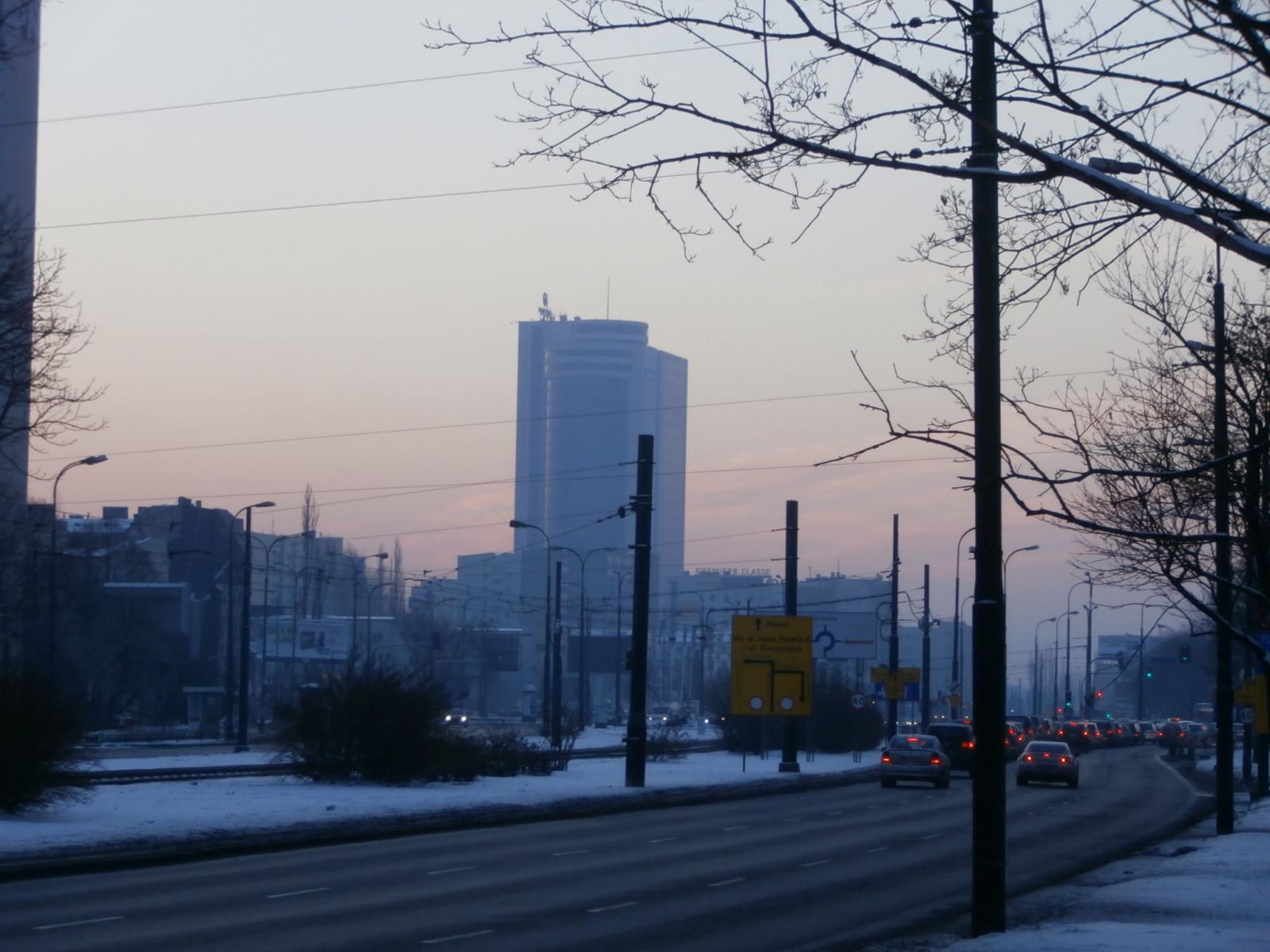
Turning to small things… Proper winter has given way to thaw and I decided to make use of warmer weather and picked up a habit of everyday walks from the underground to my office (distance of over three kilometres). Most people detest weather like this – not frosty, but chilly, gloomy, grey, miserable, while it lifts my spirit when it ensues after a frosty and snowy spell. 

To the right – Wednesday, dim morning. I walk westwards ul. Pańska. The building in the background is one of many on Osiedle Za Żelazną Bramą (literally: Behind the Iron Gate Estate), a cult and prestigious dwelling 30 years ago. Today – a home to ordinary people, immigrants from Far East and thousands of cockroaches, and an excellent example of economical housing concept put into practice – a 4-room flat here has an area of less than 50 square metres. Asking prices per sqm usually are between 8,000 and 9,000 and they reflect excellent location and numerous drawbacks of these flats. I would not move there.

To the right – snows have not melted yet, or water has frozen up overnight. Pedestrians have trampled a narrow path, there are lots of puddles and still it is very slippery so watch out! Despite some nuisances the stroll is still enjoyable.

To the right – an essence of Wola. Once a typically industrial district, for the past years it has been morphing into a modern, post-industrial area, with ramshackle factory buildings being torn down and giving way to new office and residential buildings springing up. My company’s office was one the first such developments, completed in 1998. These days the pace of construction around is impressive, seeing how quickly new office buildings are erected you would not dare to claim existence of economic crisis. And here, on ul. Łucka, some time will have to pass before these derelict buildings are demolished. Squalor, dirt and misery is what fills me when I saunter there. The inscription in the foreground without subtleties informs you Poland’s leading political party has reached the bottom. Will it bottom out?

On the other side of ul. Towarowa, just next to IPN head office, you can find this building, the closest to my office stronghold of the bygone times. I have never visited ‘Bargain Consignment’, but my ex-boss recently encouraged to venture for a lunch to the bar. Once I got in there, I immediately caught the climate of cheap bar from PRL times. When it gets warmer, I will have to go there with a camera and immortalise the interior. In the menu you can find typical Polish home-likemeals at inexpensive prices. The key drawback is the length of a wait for being served – not a recommendable venue for hurrying office workers then…

Sunday, 27 January 2013

Humility is a virtue


Mayday’s episode on Smolensk Air Crash is due to have its world premiere today at 9 p.m. in National Geographic Channel’s Polish channel. Poles will be the first audience to see the purportedly unbiased coverage of the tragic flight and reasons behind the disaster.

The film has been hailed as prejudiced many months ago by PiS-backing Polish media, as its script is based solely on findings of two official reports on the crash, one drawn up by Russian MAK, the other prepared by the Polish parliamentary commission, run by Jerzy Miller (the series’ makers as a matter of principle rely on official reports rather than on conspiracy theories). Producers of the ‘one-sided’ film, who refused to incorporate possible causes such as blast, terrorist attack, were accused of being paid by the Russians to distort the real course of events to the audience in the world. The broader discussion on the controversial documentary is going to spark off after the broadcast (although many journalists have already seen the document during a dedicated show) and I will post my review of it next weekend (today I will not make it, over the busy week it will be impossible as well).

In the meantime I am taking the opportunity to invoke another report, authored by Japanese parliamentary panel investigating causes and aftermaths of Fukushima power plant disaster. If you recall the tragic events from March 2011, you bring to your mind pictures of cruel powers of nature which destroyed the plant. You blame the earthquake and the tsunami, while authors of the report claim this was a “man-made disaster”. If the read the BBC’s summary of the report’s findings, the picture which emerges is a sharp condemnation of Japanese culture, the nation’s shortcomings and stance of people responsible of overseeing maintenance of the plant and handling mitigating effect of the disaster. Actually the nation is pulled into pieces for its “culture of deference and reluctance to question authority”. Once negligence was covered up at the top, nobody at the bottom felt entitled to bring it to the light. The report was a bitter pill to swallow for the Japanese. They had the courage to eat the humble pie…

Same could be said about the Smolensk crash, this also was a typical man-made disaster. Responsibility for it is collective and many Polish national shortcomings, brought together, contributed to the fatal accident. The list can be long: overwhelming disorganisation in prime minister’s and late president’s offices, commonly tolerated laxity in following procedures, acting on reprehensible faith that “we’ll somehow make it” (jakoś to będzie, uda się), determination to carry on, despite dangerous conditions, cutting corners (bylejakość), bravura, focus on end heedless of safety procedures. Several irregularities were found in the disbanded 36th regiment of Polish military aviation (inadequate training resulting e.g. in reading the wrong altitude meter), in prime minister’s office (responsibility for organising such visits rests with them). Media, for sake of customary refraining from speaking badly about the departed, seldom mention total chaos in the president Kaczyński’s office, but this was also the case. Same can be said about Russian airport in Smolensk, run-down, lacking fixed equipment necessary to service takeoffs and touchdowns (such was moved there for prime minister’s Tusk visit 3 days earlier and taken away immediately), but I ultimately would blame the Polish organisers who did not bother to choose a safer, properly equipped airport.

I am looking forward to seeing the film. Little in its content is likely to surprise me – newspapers in Poland have written long reviews and summaries of it. I am more curious of social potential outcry regarding the account of events depicted in the film. The documentary is not going to change anything. Those who believe this was an assassination contrived by enemies of the most outstanding statesman in the history of Poland will not be convinced this was a tragic aftermath of multitude of human errors, those who put credence into official parliamentary report, will find in it nothing new; nevertheless it is worth spending two hours in front of the TV screen.

Tuesday, 22 January 2013

EU-funded twaddle - follow-up

Just as I promised on Sunday, I made several attempts to reach a person who heads a department (one of several in Mazovian Unit of Implementing Programmes European) which runs 'Human Capital' projects. To no avail, I was only informed all calls, to ensure my safety and satisfaction, are recorded, and was not in the luck to get through. I was surely calling during a coffee break, a second breakfast break, a lunch break, an afternoon break or during a very important meeting.

So we don't know what the attitude of rubbish-producer is.

Coincidentally, Gazeta Stołeczna ran a very similar story on errors in leaflets for foreign diplomats prepared by Warsaw Town Hall. Neither at work (due to some idiotic restrictions), nor at home (didn't feel like tampering the screen resolution settings) could I enlarge the scans, so I can't assess the correctness of the original leaflets nor the proofreader's remarks. The translator who'd sent in the dreadful piece to Stołeczna's editors, was slated in the comment thread under the article. Well, in this country everyone knows best.

PS. Good news - the exam... passed :) Nice to feel hard work bears fruits.

Sunday, 20 January 2013

EU-funded twaddle in a newspaper

It has been a while (almost three years have passed by) since I last cracked down on ghastly use of English (I read it over today and found myself in stitches). Absence of the topic on PES does not directly imply the problem has disappeared. Probably after I began working for a Poland-based company in which English is used every day I simply got accustomed to Poles mangling the language and ceased to find it so appalling. But yesterday I sat back in my armchair, opened the Friday edition of Gazeta Stołeczna to find this…

I felt under my skin this announcement was noteworthy. I took a glance on it, then another one, then read it carefully, grabbed a pen, a minute later I knew I would not resist the temptation to tear it to pieces on the blog.

The heading… The man, how about replacing it with Human capital, fixed expression popular in English that often goes together with investment?

Entity name… What a peculiar word order... Implementing Programmes European. OK, in Polish you can try putting cart before the horse, in English, it is not advisable…

What the Mazovian Unit of Implementing Programmes European wants to publicly announce is squeezed into 81-word long sentence. Yes, one sentence is made up of 81 words, in line with KISS (keep it short and simple) rule. The same message could have been conveyed in 20 words I guess. But stretching it to quadrupled number for sure was meant to stress importance and erudition of the author, hence my scribble: “może k… dłuższe?”. How pompous, how turgid…

Scheduled for realisation. I have had a go at translating the Polish verb realizować twice, here and here. Third time would not be lucky. Observant readers should also note emphasis the author put on consistency – a few lines down they wrote realized. In British English you can use “s” or “z” (the former is preferred), when words end with “ise/ize”, but a good practice is to stick to one of them.

Now section 1 – Support for people … category, including:, 36 words in total. How about getting it across in merely 19 words: “Outplacement programmes for the redundant, to be made redundant or at risk of redundancy for employer-related reasons, including:”. My editorial skills fail here a bit, the to be made redundant, does not sound OK to me. Any better translation of przewidzianych do zwolnienia?

One of bullets in section 1 goes: A project participants subsidized employment with a new employer. Now finally jaw drops open. Hard to turn it around; my proposal is subsidies for employers hiring project participants – can it be any better?

Next bullet and the jaw refuses to move up. It is winter so at least I am not likely to swallow an insect. to launch economic activity sound exactly like rozpocząć działalność gospodarczą, but to start a business sounds natural… And why through using? Nine words after economic activity could be swapped for in form of.

Minimal salary – I know minimal is more similar to Polish word minimalny, but minimum has the same meaning, which should tip the scales for the former if the hapless compiler was weighing up which of the words they should use.

Within the framework, in the field of – are examples of phrases that are not purely incorrect, but in English which favours simplicity they somehow disturb natural flow of communication. Right?

Section 2 and here we go again, this could do with at least a dozen words more, as complexity or Research and analyses is still insufficient.

Januaryr? Spell-checker on?

Deadline for submission of the applications is determined by the date of submission of the application… Does it hang together at all? The intent of the author, as it later turned out, was not to write what the latest date applications can be submitted was, but… that an application is deemed to be submitted exactly when it is submitted to the Agency’s office. O terminie złożenia wniosku decyduje data złożenia wniosku. Really confused now?

Now it has been last straw, let’s speak it out straightforwardly – this announcement is a linguistic piece of shit.

localized”. Maybe it sounds dissimilar to zlokalizowany, but if there is such word in English as located, there is a likelihood that it fits better.

The next paragraph, starting with All entities may be granted – can somebody tell me what the hell they wanted to say? This is a classic example of bureaucratic drivel!

Next sentence is bolded and underlined to bring another uncanny example of word order. No comment.

Here I am running out of patience. Logos at the bottom inform me the advertisement was co-paid from EU funds. This is what zillions of money that feed EU bloated bureaucratic apparatus are spent for – let’s face it, this is, not to mince words, a load of crap.

Devastated by the content of the advertisement, I flipped the page and found… 

 
a source document in Polish, my native language. It dawned on me, everything cleared up. As usual, garbage in, garbage out. The announcement in Polish is also written in the same official puffed-up style. Load of crap in the target language is just an aftermath of load of crap in the source language.

The story behind it was also probably same as always – an inferior, mediocre clerk thought the less plain and clear the language they use, the more educated they appear. More civilised people prove their superiority by explaining complicated issues in simple words, so that everyone can grasp them. In the kingdom of Polish officialdom it goes the other way round. And then a person who is said to know English best (yes, best, meaning possibly well) in an office was told to translate it into English. It might have not been done that poorly, but the translation could have been checked by a snotty superior of the translator and “improved”. The outcome leaves an educated native speaker at least dazed.

How long before I see decent Polish to English translations? Do not think I am going to take it lying down. On Tuesday I have a day off to drive my grandfather to a doctor in the morning, but I will have a free afternoon and I will take the trouble to call the Mazovian Unit of Implementing Programmes European and tell them politely their investment in The Man fills me with anger and shame. I bet they will not understand, nor care, but such practices should not be put up with!

Sunday, 13 January 2013

Got up and tried

Sometimes to understand the present, you have to go back in time.

9 June 2010, the penultimate day of my penultimate exam period at SGH, also the day when awards in the 15th edition of “Grasz o Staż” contest were handed… Four months earlier, at the beginning of the penultimate semester of my studies, I decided to change the English class group, to attend the class run by the definitely the best teacher I’ve ever had. There I met Natalia (name, as usually, changed). We talked with each other very few times, but it could be felt there was a chemistry between us. As students we last talked on 9 June 2010, just after our final exam in English; we stared at each other’s eyes and yes, I knew what I should have done then… I felt some kind of affection for her, but I didn’t care much. I was a fool at that stupid stage of my life when career was the overriding goal. I was in a hurry for the “Grasz o Staż” banquet when she asked me to tap my phone number into her handset. I keyed in the number, but didn’t bother to press the green button to have her number displayed on my phone, and then dashed off. That’s how and why we wouldn’t see each other ever after.

I began to realise how mean it was many months later, after the internship, the hectic period of combing work and studying and shake-down at the current position. I settled down at work, achieved something and began to see the light, began to recognise different values are more important than building career, finally began to regret. But soon later I met Her and drowned out my regrets, I even thought things went the right way, otherwise I’d have hurt Natalia. Then what I’d put my faith in fell into pieces and when it was crystal clear there were even no pieces to pick up, the wasted chance began to haunt me more and more often.

You can’t turn back time and make up for the wrong you’ve once done, but whenever there’s a least little chance why not try to start over?

I was down in the dumps after my 25th birthday. The sorrow was not brought about by the very moment of passing by the quarter-of-century milestone, but on account of it being accompanied by awakening ghosts of the past months, bringing back pleasant (still, with hindsight) and unpleasant memories. Could it be the time to make an attempt to raise the dead?

I’d been talking about Natalia with my colleague several times. I’d told her Natalia vanished into the air and nobody knew what she was doing (strange, isn’t it?). My colleague suggested I should go an extra mile and harness search engine to go on a more extensive lookout with several combinations of keywords. 10 minutes later I learnt Natalia works in a small accountancy firm in a building 200 metres from away from my office. Truth be told I wasn’t particularly eager to make use of that knowledge, but my colleague insisted I marched there right away and met with her.

Life without spontaneity is… well, hollow. Ten minutes later I was putting the half-baked plan into practice. The search went very smoothly. Assistant at reception desk told me where exactly her office was located and did not make any troubles to let me in. When I entered her room, Natalia was out in a kitchen for a while. She was very positively “shocked” at the sight of me. I asked her out for a coffee, we had a nice chat, she gave me her phone number, my impression was very positive, yet slightly tainted by alertness of shock Natalia was overcoming…

Over the next days her enthusiasm was fading very quickly. She was either very busy at work or, then ill (just like me), then I decided to ease up and let her accustom to my unexpected stepping-in. Her hesitation or reluctance and shyness began to put me off. I ended up spending New Year’s Eve with someone else. With her approach this relationship had to chance to develop.

On 3 January, just like over two weeks earlier, I went to her building, called her and asked to come down. After exchange of pleasantries she began to quiver and look down. I found her behaviour kind of disturbing and realising she was trying to tell me something I encouraged her to stutter it out.

Natalia: You know, I’ve been thinking about you a lot since our meeting before Christmas and… you’ve made an enormous effort to find me, so I suppose you might have some clear expectations towards me and I don’t want you to hold out much hopes…

Bartek: After not seeing you for more than two years, I could have found you being with someone else and did consider this when trying to find you, but when we met, you told me that…

N: I remember, when you asked how I was doing, my reply started with a declaration “I don’t have a boyfriend, I don’t have a fiancé, I’m not married”…

B: So actually you have somebody…?

N: Well, formally we are not together… This is… a cupboard love

B: (the whole situation seemed kind of funny to me) It sounds serious.

N: It’s a very serious feeling towards an older, mature man.

B: (I could barely help my jaw dropping open, but responded in a serious manner) Maybe it would be worthwhile to do something about it?

Natalia just pulled a face and flushed…

During our conversation I found it all hilarious, several minutes later I found it pitiful, at the end of that day – dreadful. Natalia is turning 27 in three weeks. How can a woman of that age live on daydreams and delusions. A woman of that age if she declares she wants to have a family and bring up children should try to build a real relationship. If she doesn’t change, she stands no chance to turn her life around. I could go on about this for several paragraphs, but this is not a place to take apart someone’s broken psyche. I simply feel sorry for her.

But I don’t take pity on myself. Didn’t care, didn’t hurt (nie zależało – nie zabolało). To be frank, it did hurt a bit, as nobody likes being turned away. I could only be better off and had nothing to lose, unlike in the previous case we are fully separated from each other (no hear since the hapless meeting), so this chapter is closed. I’m glad to have seen the end before it began. And I’m particularly happy to have done something which could have been a good material for a script of a romantic film (maybe the one with a happy ending), something spontaneous and memorable. At least I won’t revert to memories of her, won’t ask myself if it could go on a different way, won’t wonder whether there is a chance to revive it.

This illustrates a recipe for living. Make sure you do whatever is possible to seize all opportunities you might have. And don’t let a situation when you regret not doing something happen.

Got up and tried. The bubble burst, I’m not on my knees, but not feel like trying, although I know I probably should (a classmate from primary school) is chasing me up to go out together and I know if I’m not about to miss it, I should get in touch with her soon, but to be honest I totally don’t feel like trying… Unsettling? Should I let some time pass?

Sunday, 6 January 2013

2012 Road construction summary

Last year has gone down in history as a year when the highest number of kilometres of new fast-traffic roads (i.e. expressway and motorway) was opened for use. In terms of road infrastructure Poland use to lag behind most EU countries, but thanks to road construction boom, largely spurred by preparations for 2012 European Football Championship, Poland has caught up. This is unlikely to repeat in my lifetime, therefore it is worthwhile to document what, where and when was opened in 2012. Hope all infrastructure zealot will find this posting useful.

Below, a concise summary, mere facts, comments seldom interspersed throughout. Each entry arranged in the same order: date / road number (A stands for motorway, S denotes expressway) / section details (length, cities connected) / optional comments.

23 May 2012 / A2 / section E of Warszawa – Łódź road, linking A2-S2-S8 junction in Konotopa to Pruszków, 5 kilometres

23 May 2012 / S8 / junction Warszawa Zachód – junction Konotopa, 2 kilometres / completed in early 2011, but closed until then, as running into nowhere.

27 May 2012 / A2 / section D of Warszawa – Łódź road, between Pruszków and Grodzisk Mazowiecki, 18 kilometres

1 June 2012 / A1 / Pyrzowice Zachód – Zabrze in Upper Silesia, 28 kilometres

1 June 2012 / S1 / junction Pyrzowice – junction Pyrzowice Lotnisko, 2 kilometres

3 June 2012 / A2 / section A and B of Warszawa – Łódź road, between Stryków and junction Skierniewice, 33 kilometres, section A had a status of passable road, with speed limit of 70 kmph and temporary closures of one of roads after Euro 2012, until 15 October 2012

3 June 2012 / S11 / Poznań Skórzewo – Poznań Zachód, 6 kilometres

4 June 2012 / S5 / Gniezno – junction Poznań Wschód, 35 kilometres

6 June 2012 / A2 / section C and part of section B of Warszawa – Łódź road, between Grodzisk Mazowiecki and junction Skierniewice, 37 kilometres / opened just two days before the Euro 2012 opening ceremony, gave the roughest ride to road builders, who worked 24 hours a day, 7 days a week to make a deadline. The whole Poland kept track of their endeavours. Section C in June lacked the top layer of tarmac and had speed limit of 100 kmph set, the road was fully completed in October 2012. The section is also infamous for bankruptcies of COVEC, Chinese general contractor of sections A and C which went bust is 2011, having undercharged for the contract, trying to get foothold on the European market. The next general contractor, inexperienced in road building Dolnośląskie Surowce Skalne filed for bankruptcy in March 2012. The fact the road was completed in time is still considered one of biggest miracle of 2012.

9 June 2012 / S7 / southern bypass of Gdańsk, 18 kilometres / salvation for anyone who wants to pass by Gdańsk on the way to the seaside

13 July 2012 / S14 / Szynkielew III – Dobroń (near Łódź), 10 kilometres

1 August 2012 / S7 / Pasłęk – Miłomłyn, 37 kilometres

29 August 2012 / A2 / bypass of Mińsk Mazowiecki east of Warsaw, 21 kilometres

10 September 2012 / A4 / Rzeszów Centralny – Rzeszów Wschód, 7 kilometres

10 September 2012 / S19 / Rzeszów – Stobierna, 15 kilometres

12 September 2012 / S8 / Białystok – Stare Jeżewo / 25 kilometres

29 September 2012 / S51 / bypass of Olsztynek, 3 kilometres

2 October 2012 / S8 / bypass of Zambrów / 11 kilometres

6 October 2012 / S8 / junction Wrocław Psie Pole – Oleśnica Zachód, 22 kilometres

17 October 2012 / A1 / junction Bytom, merely a junction, not any section

17 October 2012 / S8 / Rawa Mazowiecka – Adamowice, 23 kilometres

28 October 2012 / S8 / Piotrków Trybunalski – Rawa Mazowiecka, 61 kilometres / nightmare on Gierkówka draws to a close… Only a short section (some dozen kilometres between Adamowice and Mszczonów) awaits completion

30 October 2012 / S11 / Poznań Suchy Las – Poznań Rokietnica, length unknown

8 November 2012 / S7 / Olsztynek – Nidzica, 28 kilometres / could have been opened 3 months earlier if it had not been for total lack of roadworks…

13 November 2012 / A1/ Stryków – Kowal in central Poland, 84 kilometres / opened with delay, the longest section of the motorway linking Gdańsk, Toruń, Łódź and Silesian conurbation opened in 2012, with 5 months delay.

29 November 2012 / A4 / Szarów – Tarnów Północ, 57 kilometres / some section are fully completed, on other traffic runs on one road, while the other is being finished, full completion scheduled for spring 2013.

30 November 2012 / A1 / Mszana Dolna – Czech border, 11 kilometres

30 November 2012 / S8 / Oleśnica Wschód – Syców, 25 kilometres / this time prime minister Donald Tusk and infrastructure minister Sławomir Nowak turned up to cut the ribbon and boast about impressive achievement of recent road construction programme. According to government’s plans, Piotrków Trybunalski and Syców should be linked by S8 expressway by the end of 2012.

This adds up to 624 kilometres, slightly less than 700 kilometres GDAKA blows through its own trumpet (put it down to rounding the figures up), yet still a lot. When making this summary, do not forget about the dark side of construction boom, which contributed to bankruptcies of many companies, their subcontractors and suppliers and sent many into serious financial distress.

Key roads awaiting completion are: A4 motorway, all sections from Tarnów to Ukrainian border, missing section of A1 between Toruń and Kowal, forsaken by bankrupt PBG-run consortium and southern bypass of Warsaw which is bound to be opened with more than 1-year delay.

Source: Polish pages on each road in Wikipedia. If you happen to spot any factual error, do not hesitate to let me know promptly.

Sunday, 30 December 2012

End-year thanks to my Guardian Angel

If every time you touch heaven you find out there's nothing to grab and you fall back to earth, if every time you plunge into hell you find out instead of drowning in the abyss you bounce back and return to earth, it probably signifies a human's place is on earth.

I owe big thanks to my Guardian Angel who kept me company over the whole year and has not let me run into troubles though opportunities were ample. This was a year when for the first time since roughly setting up this blog I was touching heaven and then, to strike the balance, I was sending myself to the darkest depths of hell. Needless to say such trips are dicey as both when you fly too close to the sun and when you are licked by infernal flames you risk being burnt. Therefore I thank my Angel for not letting me kiss the sun and for lifting me up from caverns of hell.

The Angel is a metaphor, albeit last year’s ups and downs have made me believe in the existence of a supernatural creature that keeps tabs on every man. Now the mystery to be unravelled is the extent to which Guardian Angels interfere in humans’ fates. If you look at the magnitude of miseries which afflict representatives of mankind every day, no wonder you seriously doubt in the powers of shields Angels use to protect people. I discern it and thank once again, as I was lucky to have been looked after by a very patient and wise Guardian Angel and to have got off lightly from situations when my common sense was turned off.

How much joy your life gives you is roughly equal to optimism towards life you display. There is always the option to focus on the dark, yet indispensable, side of life. In November a stupid song made me realise some feelings are natural and sometimes not feeling pain would be a reason to worry. “Where there is a flame, someone’s bound to get burnt” – if so, burning at some stage of that affection was inevitable. When making a summary of 2012 I could highlight the bitter experiences; there were some, probably more than in previous years, but they happened because I felt much more than in previous years. For sake of waking up from a long-lasting spiritual numbness I deem 2012 to have been a particularly great year. Not everything turned out the way I had wanted, but every time when confronted with adversities, I emerged stronger and never lost heart. Sometimes to cope better with emotions I did turn on the ‘numb’ mode, but these were always temporary moves aimed at relieving psyche.

Maybe this is the way how we should handle life. Every time bad fate slaps your face, instead of hitting it back, give it a kiss. For those of you who have lived through some sort of severe suffering, this may sound ridiculous, but try to treat every hardship, every calamity, every blow as a chance, and as a lesson. The worst you can do is letting the pain knock you down. Such stance means letting bad luck or bad people triumph. How about spiting them? Whenever adversity hits you, put a smile on your face.

Some two weeks ago I left my car for the whole day in the open air, exposed to freezing snow and rain and in the evening I found my vehicle covered by a layer of ice and frozen snow. Try opening any door in such conditions… I beheld it and burst out laughing. After all I was facing a challenge!

Disasters strike you when you don’t take precautions to avert them. In early December I had sprayed door seals with silicon and packed a hammer and screwdriver into my briefcase. Armed in these tools I broke the ice with a smile on my face, which brought back to life central locking system and allowed me to open the door without problems. The engine, despite dampness which could have played havoc with electrics and motor starter, cranked up without a murmur, then it was all downhill. Seemingly a small trouble, but depending on your attitude and how prudent you are, it can knock you down or toughen you up.

As this year ends I think I’m richer as I’ve learnt to look adversities in their eyes. Never turn your eyes away, when your enemy sizes you up. Look at the bright side of life, there’s always such one, but it sometimes takes some effort to discern it. May the new year bring all of you many cheerful days, may troubles stay away from you, may your Guardian Angels be as merciful for you in 2013 as mine was for me in 2012. And don’t be afraid of changes in your life. Any change, although it involves taking risks, should be treated as a chance for a better life. And remember, it could always get worse...

Technical announcements:
1. Apologies for lack of posting a week ago. I was down with flu and decided to stay in bed to overcome the illness once and for good, unlike other people who get up, go to work and spread germs (we have an epidemic of flu in Poland). The strategy proved successful!
2. Next week – road construction summary – let’s look what roads were opened in Poland in 2012
3. Any hints on the direction in which the blog should drift – for aforementioned reasons posts on economy of politics have become infrequent here, while I began to focus on myself and turned the blog into a form of personal diary for posterity, against my intent at inception of blogging…

Sunday, 16 December 2012

New camera review


I’d been putting back the purchase of a new photographic equipment since the discovery of my Canon’s breakdown in early autumn this year. My first preference towards the new device was Canon Powershot SX130, which I found in Euro RTV AGD in late October. The camera could be picked up only in one of their shops in Warsaw, but due to busy and stressful period at work in the last days of October I postponed the visit to the shop for 2 November to find out owing to my procrastination they’d run out of stock. Then in November I was focusing on sitting for the exam and gave up on looking for the new camera. Last Saturday, while browsing Media Markt leaflet I found Olympus D-760. The camera took my fancy, so I checked its technical specification in the web, settled for the purchase, rushed to the car and drove to the nearest shop (Warszawa Krakowska).

The camera offers a decent trade-off between price and quality. For a device offering 12.5-fold optical zoom, 15 mpx matrix, optical picture stabiliser, HD filming and tens of useless gadgets I paid 419 PLN. Enough to have my needs met, as I wouldn’t have probably made use of a better equipment and this one is small enough to fit into inner pocket of a jacket and stay invisible. On the other hand, as any newly produced device it appears fragile and gives an impression of being designed to endure 2-year warranty period and some two days beyond it before breaking down.

I regret not taking it with me on Wednesday, when Ursynów witnessed the biggest blackout in last 15 years. I drove to P&R Stokłosy shortly after 7 a.m., it was still dark and the only lights emitters were vehicles. Reminded me of North Korean power outages and was worth documenting, but would I have taken decent-quality photos with a new camera I’d not been familiar with?

I took the camera last Friday to capture beauty of a frosty, sunny morning (-12C). To the right - having parked the car, I roam around Metro Stokłosy bus terminus. I use ‘snow’ theme to take shot of the intersection of ul. Ciszewskiego and al. KEN, it’s shortly before sunrise...

To the right – I walk out of Świętokrzyska underground station. It’s slowly getting light. Camera’s settings remain unchanged. Machines in the background belong to second underground line builders. As I’m familiarising with the new device, I’m focusing more on the quality of the photo rather than its content.

To the right – ten before eight, sauntering towards my office I turn aside to make a picture of ul. Towarowa towards Plac Zawiszy. If you enlarge, you might come to the same conclusion I’ve reached – I’d focused on the wrong object, hence key parts of the picture are not as sharp as I’d want.

To the right – another try, night-time shooting. No tripod, flashlight turned off, camera held in slightly quivering (in attempt to do my best to prevent any motion) hands. Could it have been done better?

Today I ventured to Piaseczno to play with the camera again. To the right – I focused on the Christmas tree on the town square and even forgot to cover it all and ‘cut off’ the star at the top. My old Canon used to put out more ‘granular’ photos, while shots from Olympus seem still kind of blurred…

Around half past two magnificent fog, which I’d been lingering over the whole day, began to descend and grow thicker. To the right – intersection of ul. Okulickiego, ul. Powstańców Warszawy, ul. Nowa and ul. Mleczarska. I’m standing some 100 metres from it and use optical zoom to the limits. I focused on the tree in the background, but given the acuity of other objects on the photo relative to the tree, there was some fail.

I walk homewards and cross the single-track coal line. Similar shots have been taken by me here in June 2009. I somehow adore the theme of lines converging onto the horizon. Here they disappear, swathed in the fog. I focus on the horizon.

Then I turn around and capture the view eastwards. I took several other photos today, but for sake of practising how to handle the new camera rather than to document something. Gave me much joy on this gloomy and short day.

I was used to my old camera, so using a new one means picking up new habits. The Olympus has a few features that wind me up, e.g. when it turns on it’s always in photo-taking mode and I think it can’t be set to go into photo-watching mode after switching on. The other thing is that it runs on its internal battery, rather than on AA batteries, which is good, except for the fact its battery begins to charge up every time I plug the camera to the computer to transfer photos or to the TV set to watch it. This will diminish durability of the battery, due to ‘memory effect’.

The new camera has more settings, many gadget-like, this translates into opportunities to tweak with something and more chances to screw something up = take an unsatisfactory photo due to choosing wrong settings. Unlike with my old Canon, I wouldn’t fall back on ‘automatic’ mode, which fails to properly adjust setting to the scenery. The best choice is to desist from using themes and use a ‘P-mode’, where you can change key setting manually.

The biggest challenge is sharpness adjustment. I seem to be mastering how to control it, although I’m more skilful in it in shots taken outdoor rather than indoor, some progress is made since first snap, albeit there’s still a way to go. Again I’m proven the more complex camera, the worse the photo taken by a skill-deficient photographer will likely be. To make a good use of this camera, you’d rather not just press the button…

I haven’t tried out its filming capacity. Due to much higher resolution, my new Olympus will offer much better quality than the Canon, but at the expense of film size. At the moment I have a 1GB memory card taken from my old camera and the new one says it can save up to 3 minutes 56 seconds of decent-quality footage on it, so I should consider upgrade to 8GB card.

To recap, the camera fully meets my needs of occasional documenting reality for pleasure. It has now almost 100 snaps on the counter and, as I notice, just like a brand-new car, needs running in before its capacity can be fully utilised; this process is under way. Am I right?

In the meantime, my old, defective was put up for sale on Allegro. 12 minutes before the end of the auction the highest bid is 10.28 PLN. If a new user knows how to fix it on his own, after buying a shutter flex for another 10 PLN on Allegro, they will have a decent, slightly obsolete compact for a dirt-cheap price.

Sunday, 9 December 2012

Enraged

July 1997. Prime minister Włodzimierz Cimoszewicz visits sites damaged by the flood of millennium and concludes: this is yet another incidence which bears out one should be prudent and take out insurance, alas this truth is still not common. Nothing hurts like the truth. Mr Cimoszewicz’s utterance has become a nail to the coffin of his party in the coming parliamentary elections and has gone down in history as a symbol of insensitiveness to other people’s misery.

In fact only extreme liberals have the courage to admit Mr Cimoszewicz’s statement was hitting nail in the head when speaking about lack of foresight among humans. Those words might have been out of place, if spoken out among people who had lost all their belongings in the flood, but look at it from a different perspective. One person pays insurance premiums for years and when their house is destroyed by a flood, they collect a compensation. Another person, if they have luck be one of many victims of a natural disaster, gets aid from the government = taxpayers. What is your sense of justice telling you now? Should there by any differentiation between forward-looking citizens who take out insurance and those who reckon when it comes to the crunch the government will step in and help? There are several ways out. First one – the government does not help anyone, the insured get money, those who failed to insure against flood are left out in the cold. Second one – the government gives money, but only to those who have not bought insurance policies. Those who paid insurance premiums learn they are suckers sinking money into insurance policies for years and their reckless neighbours are free-riders whose lack of prudence is rewarded. Third option – the government gives money to anyone aggrieved, no matter insured, or not. Those without insurance get relief, while when comes to the insured ones, there are two options – either they get a compensation from their insurance company and in effect are better off (counting out the hassle to rebuild their houses and arrange them) after the flood, or insurance companies refuse to pay out compensations, as benefits from the government have the same character. In both cases somebody grows richer at taxpayers’ expense – the insured flooded or insurers…

The considerations above arise from the widespread belief government is omnipotent and is capable of influencing events at its discretion. This conviction is abjectly dangerous as it implies firstly citizens are infantile creatures not capable of taking care of themselves and should be incapacitated, secondly the government can be blamed for virtually everything, since it can control everything.

When politicians of PiS blame government for everything, it is not just an element of their political strategy which assumes no matter what the PO-led government do, good or bad, must be slated right away, but also an exemplification of their view of the world. Mr Kaczyński’s advocates deeply believe if Kaczynski was in power, all the problems would disappear. They deeply believe people in power are capable of turning things around whenever they wish. And this is dreadful. This also engender claimant’s stance – a way of thinking “I deserve”, “the state is duty bound to provide for…”. “Mnie się należy”, “państwo ma dać”, “państwo ma obowiązek, dbać, zapewnić, etc.”, „co państwo zrobiło”... Rigns a bell? Makes me want to puke…

In fact how a society functions, all social plagues, shortcomings, criminality, etc. is mainly a sum of millions of individuals’ behaviours, attitudes, moral spines. Other factors shaping workings of society are formal and informal sets of rules which tell us what is acceptable and what not. There is legal system, including penal code, which deters individuals from engaging in unacceptable practices, but what really can discourage people from wrongdoing are enforceable social norms. It is not a potential punishment of let’s say ten years of imprisonment for drunk driving that should prevent us from sitting behind the wheel when intoxicated, but the strong conviction this is dangerous and will be condemned by any upright citizen.

You cannot blame government for everything. Can we blame the government for Amber Gold scandal? Partly yes, as it did not amend regulations which did not oblige prosecutors to instigate proceedings against the fraudulent company immediately upon receiving request from Financial Supervision Authority. The state should ensure all scams are detected early and their masterminds imprisoned, but the state will not prevent you from entrusting your money voluntarily to a crook.

Can we blame the government for bankruptcies in the construction sector? Terms of contracts, including payment terms, as proposed by Road Construction Agency were often unfavourable for contractors but they all in concert bid the lowest prices. They all agreed for conditions set by Gdaka, but when everyone cries about bankrupt subcontractors (doing business means taking risks), why does nobody mention millions or zlotys saved from the public purse? Intense competition among road builders has finally brought costs of road construction to a level comparable with European ones. Why does nobody mention relief to taxpayers and lower public debt?

Your fate lies in your hands. Many times people’s misery is not their fault, but many times they work hard for their predicament. As someone aptly summarised recent summer’s woes of clients of Amber Gold, OLT Express, or bankrupt travel agencies, this can be all put down to Polish greed, tight-fistedness, low level of wealth or simply dziadostwo. We chase bargains by seeking out promises of high yield, low-lost travels, without minding credentials of our counterparties. And when it falls down, we blame regulators, government, bad people, but never ourselves, our naivety, greed, lack of foresight and judgement.

If so, no wonder we posit the government should take responsibility for us, but consequently we deprive ourselves of freedom. But let’s ask whether freedom is actually desirable. Freedom is not the right to prance about in tight clothes on a gay parade (I have nothing against homosexuals, but I am not fond of flaunting sexual preferences), but freedom entails responsibility, means you are wise enough to take decisions regarding your life and suffer consequences of your deeds and this may be inconvenient for many.

My observations indicate people prefer to renounce responsibility and admit their infantilism by offloading responsibility to others. No matter if these were bankers who begged for bailout four years ago, or unemployed Poles blaming Mr Tusk for their joblessness, the trend towards giving up freedom in return from protection is disturbingly apparent…

PS. Bought a new camera today :)

Sunday, 2 December 2012

After-exam after-thoughts

Happy to leave it behind, now an almost two-month long wait to get the result begins. Given the difficulty of the exam and level of my preparation I should be quite secure about the outcome, yet far from certainty… Many questions were tricky, means to mislead candidates, so in this case, seeing is believing, albeit I believe I did well.

For sake of brevity, just a few observations…

1. I’m getting older... Most candidates I saw yesterday looked like students. Maybe I can’t properly assess people’s age by their look, maybe many didn’t look their age, but it seems I’m lagging a few years behind the most ambitious youngsters. Some of my university friends took this exam, i.e. were on the same stage of development in June 2009, yet none has reached the end of the road and many are struggling to make further steps forward. I wanted to reach this milestone before my 25th birthday and did it.

2. It’s a men’s world... I dare to estimate roughly 80% of candidates were males. I could go on about possible explanations for this, but I will only take the liberty of mentioning there are no barriers to entry to the programme and signing up is absolutely voluntary, so I believe this is women’s choice or lack of interest in the programme that keep their share in candidate structure so low.

3. I can’t stay in one place when I feel restless. Other people can stand or sit, while I need to move around. Being in motion somehow calms me down. It’s been like this for years, even when waiting on a bus stop I have to be in motion... I’m not cut out to be idle!

4. I can’t understand people reading notes until the last moment before any exam and delving into the content thereafter. I’d been studying for eight months and finished my preparations on Thursday. On Friday I put my mind at rest and didn’t think about the oncoming exam at all. I felt a bit stressed out in the evening, upon returning home and managed to ease up the next day, after I saw first questions on the exam sheet.

5. The exam doesn’t only test your knowledge. It would be too easy. It puts to the test your logistical skills and endurance.
The former as you need to strictly obey several rules, violation of any would result in termination of your candidacy to the programme. You need to check you have all permitted items and not have anything not permitted, which made me go to the test centre without keys and mobile phone. Getting to Centrum Expo XXI is a bit of a nuisance, getting out of there as well, especially if you’re not from Warsaw. Even if you live in the capital of Poland, still it is a bit of a challenge, as it is a few hundred metres away from the nearest bus stop. Therefore I’m immensely grateful to my father for insisting on dropping me off there and picking me up.
The latter as the exam consists of two sessions. The first, which last three hours and wears you out solid, is followed by an hour-long break. The break in fact lasts shorter, some 40 minutes, as you are not allowed to leave the exam room before all papers are collected. Within 40 minutes you need to queue up to a cloakroom with 300 other candidates, get your rucksack containing a packed lunch, immediately queue up to a cloakroom to give back your rucksack and in the meantime devour whatever you can (one sandwich and one apple were my only nutrition during the day), then go to the toilet and then check in for the second, three-hour long session, which ends at 5 p.m. At that time I was hungry, thirsty, felt cold (heating was off, excellent!) and virtually prostrating. At the end you’re in for to a 40-minutes-long wait to get you coat from the cloakroom…

I’m complaining a bit, indeed, but if you fork out thousands of zlotys for something, is it too much to expect good organisation and heating turned on? Nevertheless, I recognise endurance should be tested, as working environment for people working in financial industry require this and only the fittest can survive there. And after all, sacrifices must be made in a pursuit of a better life…

Needless to say, this is all an excellent example of rent-seeking. Now I financially support rent-seekers hoping to become one of them one day…