Sunday, 26 September 2021

Electric cars – a future of motoring?

Experts in green transport convince us we have no choice, but to switch to electric vehicles, if we are to hold up the global warming and save the planet. The transition is to be long-lasting and carried out in stages, but ultimately, between 2030 and 2050 many European countries are bound to ban sales of brand-new cars with traditional combustion engines. Before the strict prohibitions come into effect, milder measures will be taken, particularly traditional vehicles will be forbidden entry to central areas in bigger cities. In the transitional period, hybrid cars are gaining popularity. They prove economical in town, but do not perform well in terms of fuel consumption in motorway driving, even at moderate speeds. Nevertheless, they help their drivers feel less guilty.

To make it clear, I do not dare to call into question the necessity to drastically reduce the emission of greenhouse gases. We should go to any length to protect the planet if our children and grandchildren are to inhabit it. I only wonder, whether electric motoring is definitely the best option.

Electric buses running around town and charged at terminuses or in depots – I am all in. But electric (only) passenger cars? Potential buyers see several drawbacks of such vehicles.

The first aspect which puts many people off is the price – such cars generally cost twice as much as their counterparts with traditional engines. Given savings per 1 kilometre and decreased cost of maintenance, the payoff distance is between 100,000 and 200,000 kilometres. The only way to get around this is to have governments subsidising purchases of electric vehicles and thus redistributing wealth.

The second discouraging factor is the inconvenience. Range of the best-performing electric vehicles reaches these days around 400 kilometres and such distance is only theoretical, i.e. achievable in ideal conditions – driving at steady speed, on a flat road, with windows closed, aircon off, etc. Charging infrastructure is still way too meagre to facilitate charging of several vehicles. On top, charging up batteries takes much more time than filling up the car. These factors make longer journeys inconvenient. In fact an electric car is good for driving around town, while in fact a car is the least desirable way of moving about in a city and should not be promoted.

The electricity mains and installations in most houses lack capacity to facilitate charging many such cars overnight. My father, an electrician, has worked out that if two cars were charged simultaneously in the underground garage of my building, the energy consumption (around 7,500 Watts) will be around 100% allowed for the installation. The third car plugged in would blow fuses. Electric installations in buildings and the entire power grid (which is likely to conk out in the event of a heat wave in Poland) need to be adjusted if cars are to run on electricity.

If we are environment-conscious, we should realise where the electricity in our sockets comes from. As long as Poland burns coal in power plants, electric cars still contaminate air, but at power plant chimneys, not at exhaust pipes. In Norway they make more sense.

Besides, a motor vehicle does damage to the environment only in 60% between the moment it leaves a dealer’s showroom and its last trip to a scrapyard. Manufacturing and recycling account for approximately 20% of carbon footprint each. Therefore if a carmaker prompts you to buy a new hybrid or electric SUV to save the planet, do not do it. You should rather look after your current car (provided it is a small and relatively modern petrol-fuelled one), drive it as rarely as possible and keep it going in good condition as long as possible.

We have to face a bitter truth. A car will become again a luxury good on account of its detrimental impact on the environment. Electric cars are not a perfect solution. The solution is to drive less, avoid short journeys and traffic jams, drive economically, choose to go by bicycle or by public transport around town. And not to deceive ourselves.

Sunday, 12 September 2021

Cold, cold year?

Summer of 2021 will go down as the warmest since records began, but in Poland it was just slightly warmer than long-term average. Although June (thanks to its hot second half) and July were markedly warmer even in comparison to 1991-2020 reference period, August tilted the balance of the entire summer towards just “a bit warm” category.

With temperature averaging out +17.2C it was the coldest August in Warsaw since 2005 (+17.7C then) and the third-coldest in my lifetime, after August 1998 (mean temperature: +16.4C) and August 1993 (+16.6C). My parents remember six Augusts between 1976 and 1981 when average temperatures in Warsaw were ranging from +15.8C to +16.8C. In recent August there was no spell of exceptional cold (month-time low of +7.3C, while on average the lowest temperature in August is +7.8C), but on 12 days temperature did not top above +20C. Rainfall was also in abundance – monthly precipitation reached 166 millimetres, vs. long-term average of 61 millimetres (and was short of post-WW2 record by 13 millimetres).

September has been partly making up for the cold August, offering plenty of sunshine and day-time highs of +25C recently. Forecasters say the coming week should bring clement weather with temperatures peaking just below +20C. Preliminary forecasts for next months suggest October should bring above-average temperatures and Indian summer, while November is to be warm, but wet.

I wonder whether 2021 will be the first “cold” year since 2010. Until now, the year-to-date negative temperature deviation in Warsaw stands at some - 0.3 Celsius degree. If the trend continues, 2021 stands a chance to be the coldest since than 2010 (mean: +7.9C). So far four months (February, April, May, August) brought below-average temperatures. More than four months with below-average mean temperature in Warsaw were reported during my lifetime in 2003, 1996, 1991 and 1991. Everything depends now on the weather in the fourth quarter. But do not date to confuse weather for the climate. Just like one swallow does not make a summer, one colder year in just one part of the globe does not deny the continuing global warming.

Next post in two weeks (off for a wedding next weekend, hoping not to catch the Delta).

Sunday, 5 September 2021

Pandemic diary – August 2021 notes

Tuesday, 3 August 2021
4 million deaths officially reported worldwide. Had it been 40 million, few would have cared anyway.

Sunday, 8 August 2021
500,000 coronavirus tests per 1,000,000 citizens have been conducted in Poland, the lowest number in the EU, 15% lower than Bulgaria which is the runner-up in this nefarious ranking.

Thursday, 12 August 2021
In Greece the number of new inflection (7-day average) is the highest since the onset of the pandemic (or testing has become more widespread).

Saturday, 14 August 2021
In several European countries attacked by the delta variant, the wave seems to be over. Look at the new infection numbers in the Netherlands, Portgual, Malta, Spain. Hope the trend is sustainable.

Monday, 16 August 2021
Delta wave hits its high in France, with over 23,000 (7-day average) new confirmed infections.

Monday, 23 August 2021
The Federal Drug Agency issues an unconditional approval for the Pfizer vaccine. Looking forward to the same step being taken by the EMA.

Wednesday, 25 August 2021
50% of Poland’s population have received at least one dose of a vaccine (in my calculation I assume the population of my country is 38,160,000, therefore I declare it 4 days later than other observers do).

Friday, 27 August 2021
New inflections reach their peak in Italy. Hope they do not increase considerably, since we have booked flight to Rome in early October.

Saturday, 28 August 2021
Podkowa Leśna is the first gmina in Poland, where more than two-third of residents (including children less than 12) have been fully vaccinated. Thumbs up, hats down!

Tuesday, 31 August 2021
And a customary month-end report, of the sluggish pace of vaccinations in Poland.

1. Vaccine uptake in age groups


2. Vaccination status in the entire population of Poland

Sunday, 29 August 2021

Inflation creeping in

The inflation reading in Poland for July 2021 hit 5.0% year-on-year; the highest since May 2011 and the second-highest in the last two decades. Probably I would not gripe much about it, had the monetary policy been conducted in a proper manner. Sadly, it is not. Despite the rising price level and rapid recovery in the economy, benchmark interest rate in Poland stays at 0.10% (which in fact means the real interest rate is almost -5%, perhaps the lowest in the civilised world).

Interest rates in Poland were slashed to a record-low (by historical standards) level of 1.50% in March 2015, when Poland struggled a deflation. Then such move, with real interest rate of nearly 3%, was justified. Despite economic expansion, the central bank kept its rate level until March 2020, when it responded to the pandemic-related economic standstill by a rate cut of 50 basis points. In the next weeks the current level of 0.10% was reached. I will refrain from commenting on the legitimacy of such move in a situation of an unprecedented supply shock. I believe tools different than the cost of money should have been used to help businesses and customers out.

Customarily, I am referring you to my essay on harms inflicted by too loose monetary policy. Times have changed, economic principles have not, albeit some are intent on setting new paradigms.

Astonishingly many people realise why the Polish central bank does not react to the price growth which exceeds the statutory goal of monetary policy (i.e. inflation target of 2.50% +/- 1 p.p.). They do it to help the government finance its debt cheaply and pay negative interest on a large portion thereof. Not only the debt service spending is lower thanks to lack of monetary tightening. Higher prices mean higher tax inflows, predominantly from VAT. Inflation which spirals out of control always at least temporarily translates into negative real interest rates which facilitate transfer of wealth from creditors to debtors, including the biggest debtors in the world, i.e. governments.

Those particularly worse off are savers who now either accept a depletion of their savings kept in bank accounts by 5% yearly in real terms, or search for havens which might shield their money from inflation. Unlike me and my parents, not everyone noticed the opportunity of inflation-indexed 4Y government bonds in 2019 (which has turned out to be an excellent nearly risk-free investment making me give up on my resolution made a decade earlier). Folks with substantial savings have rushed to buy properties, as they believe tangible assets should store value. I am putting it down to Poles’ inability to invest in any other asset class than properties. Had flats purchased for investment reasons been put on the market for rent, this would have been quite okay, since thosee dwellings would meet someone’s housing needs. Horrifyingly, a growing number of flats stay vacant, as the purpose of their purchase was purely speculative, i.e. to benefit from value appreciation, despite bearing upkeep costs.

Moving back to the core topic of the post, i.e. to inflation, we should understand what drives prices up and why there is little chance the price growth decelerates.

1. Far too much hollow money has been printed during lockdowns. If goods or services are not produced, but economic actors receive a pecuniary compensation for being idle from a government, the link between a payment and goods or services offered in return is broken. A first-year student in economics would recognise it!

2. Recovery programmes run by governments to stimulate economies – they raise prices of specific goods and services, i.e. construction materials and services if a programme is aimed at such sector.

3. Broken supply chains, which have not been fully restored since early 2020. This problem affects several industries and strikes several markets off balances. These days the shortage of brand-new cars or bicycles is driven by shortage of components, without which vehicles cannot be manufactured.

4. Deferred demand – after several sectors were shut for months and as the general uncertainty seems over, customers rush to catch up on spending and business want to make up for losses incurred during lockdowns.

5. Lack of incentive to save. As people see their money evaporating on real terms from bank deposits, they are more eager to spend it, i.e. consume rather than invest.

6. Climate change and environment protection. This is the foremost reason. The time is coming to bring the price of several planet-destructive goods real and make them reflect the harm caused to the planet. For such reasons cars will have to be less affordable, prices of electricity generated from burning coal are bound to go up. Same needs to happen about rubbish collection charges, plane tickets, packaging, clothes and other goods humans thoughtlessly use in excess.

Having written that, I am happy I bought and furnished my dwelling in 2018, do not need to purchase a car, nor a bike and price growth of several goods does not affect me.

Sunday, 22 August 2021

Depression – another episode

4 years ago I wrote about depression. At that time I felt something wrong was going on with me, yet not fully realising I was in for the third episode thereof in my lifetime. The first one struck me in late 2005, a few months before high-school leaving exams, the two other ones came in summer of 2011 and around autumn of 2017. I fully recovered from the last one in early 2018, with decreasing doses of pharmaceutical support. With such track record I am at the group of risk for suffering from recurring relapses of depression.

The pandemic did it bit in increasing the odds of a recurrence. During early months I did not fully isolate (numbers of infections were 100 lower than in late March 2021) and fleeting relationships originated on Tinder were lifting my spirits (or bringing me down). I actually considered myself quite self-aware and claimed I would easily recognise the first symptoms of the illness. In November 2020 I began to wake up two hours too early and had problems to fall asleep again. I put it down to stress and shrugged it off. Then came the continuous tension and inability to relax, resulting in constant fatigue. It kept me company since early 2021, but was bearable and did not influence my daily functioning.

Things took a noticeable turn for the worse in late June 2021. I blame a combination of four factors which sparked off the fourth episode of depression:
- prolonged social isolation (staying in home for too long, too little direct contact with people),
- general grudge borne against the society, actually the noisy fraction of them who do everything to keep the pandemic going (anti-vaxxers),
- my parents’ problems with health (amplified by lack of proper access to health care since March 2020),
- ups and downs in my relationship, including three break-ups (all revoked, we are still together).

How it encroached on me? I was void of any energy, felt constant anxiety, lost appetite and drive, had troubles focusing on even simple tasks, everything appeared to make no sense, future seemed full of negative events, I had attacks of sobbing without any specific reason. Life was overwhelming, getting through each day seemed a tremendous effort. Being quite aware how this black hole works I resisted other typical symptoms such as lack of self-esteem or suicidal thoughts. I also did not withdraw from social life (although in the darkest days interactions with people were horrifically tiresome).

In mid-July I consulted a psychiatrist and was prescribed medications. Side effects thereof were the most noticeable in my lifetime, despite moderate dosage. I felt dizzy, felt dry in my mouth, broke sweat even if not moving, my heart was beating faster than normally. For nearly 2 weeks I had to give up on driving and watch out when cycling or swimming. Then my body and brain got used to the chemistry.

Currently I can function normally or even intensely at work and socialise. I have no problems with concentration nor drive, my mood is neutral, gone is the anxiety. Sadly, I feel totally indifferent to any emotions and impulses, both negative and positive, I do not consider it natural. The tension has not waned yet and I still wake up around 4 a.m. I feel on the mend, yet a long way is ahead of me. It will involve several months of taking medicines and a therapy, to learn how to take some burdens off my mind. I also worry relapses might hamper the life of my family in the next years, even despite I have learnt how to deal with it and do my best to overcome it.

Sunday, 15 August 2021

Szlachetna Paczka - edition 2021

My regular readers definitely remember my excitement about participation in Szlachetna Paczka last year, which upon learning what it is like, turned into a bitter frustration, which I vented by moaning about all drawbacks of the charity initiative after the final weekend.

In late 2020 I resolved to give myself time to think over whether I would take part in the next edition. With time bad memories faded, while the good one began to come forward. I still longed for doing something salutary for the society and hence mulled over joining Szlachetna Paczka again. At the beginning of July I learnt Piotrek, a fellow volunteer with who I co-ordinated logistics last year, had been appointed a leader of Ursynów region. I definitely have been on the same wavelength with Piotrek and have known he has all essential hard and soft competencies to become an outstanding leader. The news tipped the scales and… I applied and have been signed on.

I realise with Piotrek as the right man in the right place, several issues which got on my nerves last year would be improved, while some will not be sorted out. Volunteers will still be measuring up against families that do not deserve the wise aid and in terms of organisation and logistics much will still leave a lot to be desired.

Early in 2021 I also weighed up my decision pandemic-wise (as I had to self-isolate and fork out private money to get tested before meeting with my parents on Christmas Eve). I am fully vaccinated, the percentage of fully vaccinated residents of Warsaw reaches now nearly 65% and is likely to hit 70% by the time we begin to visit families, therefore I consider my choice not to involve excessive risk.

Despite some doubts and bitter experiences, I feel confident the decision to carry on as a volunteer is the right one and this is the role I am cut out for. I believe each man who has come into considerable wealth should share their resources with those worse off. I have decided to commit my spare time and energy, not just a fraction of the excess money I have.

Sunday, 8 August 2021

Mid-summer walk, Ursynów

Gone is the heat that kept us company since mid-June. Except for a few days of mild weather, residents of Warsaw had to endure six weeks of temperature nearing highs of +30C. Having grown weary of sultry weather, I welcomed a relief brought by early days of August. Finally, a break from sweating during days and restless sleep at nights.

So when late afternoon comes, my enjoyable neighbourhood beckons. To the right – I cross ul. Moczydłowska to find out that a section of (formally) ul. Ziemska which used to be a trampled-down path, has been hardened with gravel and widened. I wonder what reasons stand behind such decision, but hope the goal was not to make this place assessible for motorists.

As I stroll west, I pass by a cabbage field. I wonder why a farmer prefers to cultivate arable land in a location where plots could be worth zillions of zlotys. A property developer would love to turn this cabbage fields into an estate of terraced houses, each to sell for 3 millions zlotys. In the distance – a plane coming to touch down at Warszawa Okęcie.

Instead of marching towards the forest, I turn right and find myself on. ul. Gminna. The scenery, especially the pines, bring to my mind seaside roads. And this very spot lies just a quarter of mile away from my dwelling.

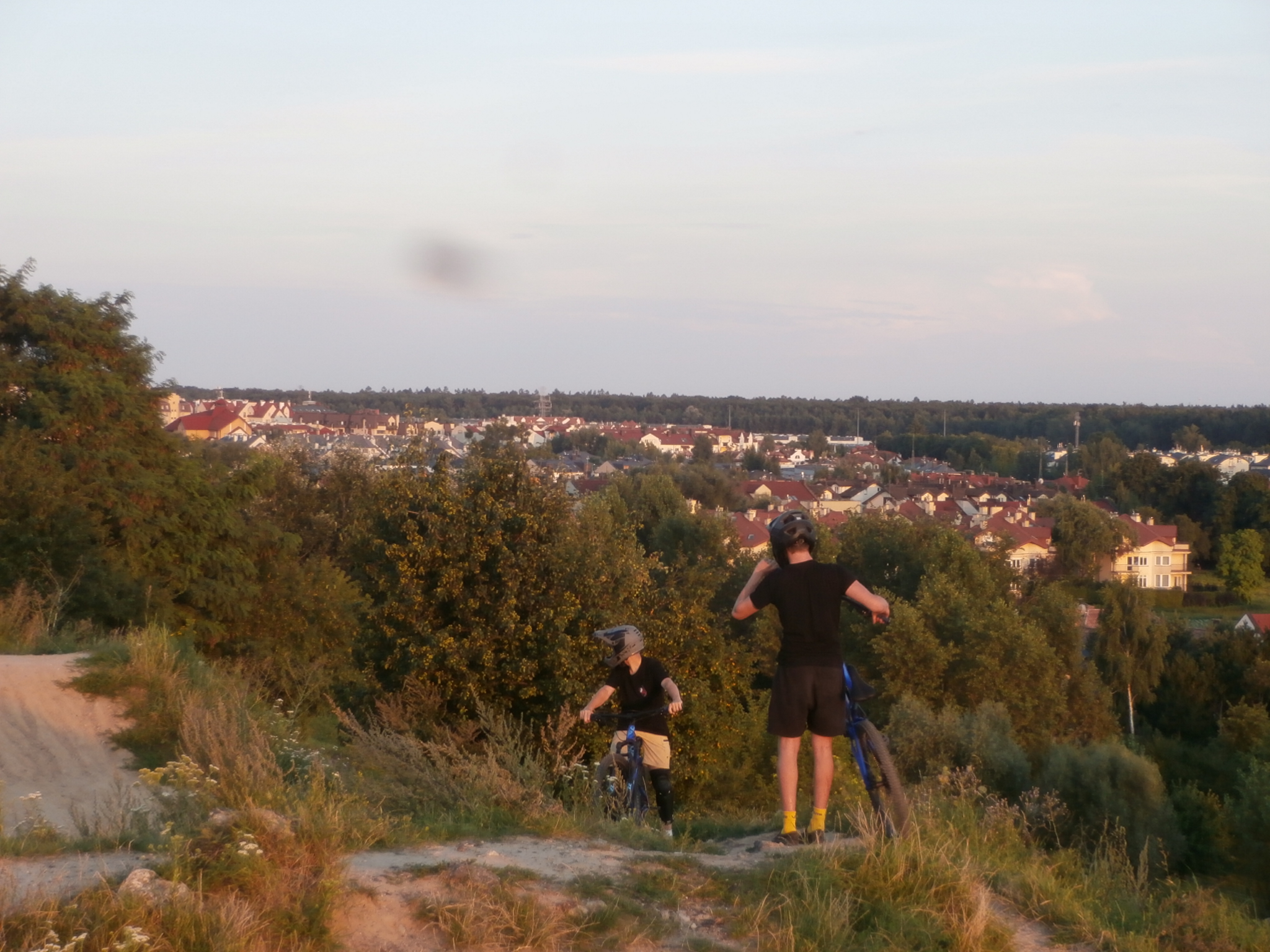
I have scrambled up the top of Górka Kazurka, one of three hills piled up during the construction of Ursynów. The peaks of the hill have been reshaped into MTB tracks. In the distance, roofs of residential Kabaty.

Having descended the hill, I head towards the forest. Mosquitos no longer bite as badly as they did in late July, so I don’t need to make off. The area in the vicinity of Las Kabacki has retained its rural character and I hope it stays so (nature and wildlife reservoir status the forest holds sees to it). Only roof of blocks of flats visible in the distance remind I am in the capital.

The snap to the right was taken from a dirt track which on a map is officially marked as ul. Perkalowa. Greenery all over, beyond the meadow, Górka Kazurka. Nothing unusual except for the proximity of that spot from the nearest underground station – less than a mile!

I approach home, walking up. ul. Moczydłowska. I wonder what the point is in snapping with a nine-year-old compact camera, if in October my phone will be upgraded into a mid-to-high-end Samsung, whose camera might be superior to my old Olympus.

A minute later I ran across my ex-girlfriend. We broke up over three years ago. It was our first conversation since the day I moved out. Cordial, yet reserved. The decision has proven right. We were bound to go separate ways. There is no way back towards any friendship, but we come across each other again, we will finally not pretend not to know each other.