Showing posts with label Piaseczno. Show all posts

Sunday, 6 July 2014

Flea market, Piaseczno

Learnt from a local newspaper last Saturday that a flea market would be held each Saturday between 10 a.m. and 2 p.m. in Piaseczno bazaar site. Being kind of fond of such events (my bygone best friend and I used to visit Bazar na Kole, the biggest flea market in Warsaw quite frequently, but since our friendship loosened and then broke off I do not feel like travelling to the other end of the capital on weekend mornings) I promptly jumped on the bike and ventured there. Before setting off from home, I grabbed the camera, but did not notice the device was suspiciously light. Indeed, after transferring photos from the trip to Germany to my laptop, with a view not to use the camera for a while, I had taken out the battery and forgot to put it in. I realised my oversight as I pitched up to the marketplace and tried to turn the camera on, unsuccessfully.

Quite eagerly, with complete and working photographic equipment, I decided to repeat the trip yesterday. To the right, flea market site – town bazaar in Piaseczno (targowisko miejskie w Piasecznie). The area, next to Radom line railway tracks, by ul. Jana Pawła II is a tad dilapidated. Looking at the pic, one could judge it was taken in 1990s, in times Polish capitalism was fledging. Indeed, you could sense the time stopped there twenty years ago… Little has changed in that part of Piaseczno since my childhood.

To the right – the only avenue in the flea market. Tuesdays and Fridays are market days here and the place is damn busy, as many older locals, shunning supermarkets, prefer to buy food produces from local farmers. On other days the area is desolated. Yesterday there were much fewer buyers and sellers than a week earlier. Maybe the commencement of holiday season and weather conditions (warmer, more humid air) lowered the number of visitors…

My inhibitions again held me back from taking photos of particulars stalls and goods put up for sale. My respect for fellow men’s privacy is stronger that willingness to document the sight of flea market for posterity. The range of goods than could be bought on the flea market covered: worn-out clothes and footwear, obsolete consumer electronics, computer games, films on DVD and CHS cassettes, music CDs, cutlery, tableware, tools, spare parts for cars, naff paintings, small pieces of furniture, much outdated newspapers and… books. I have nothing against exchange of books, especially if one wants to find a new owner for their tacky thrillers or romances, but several people were selling decent, brand new books their children had received as awards at the end of school year. Such disrespect for written word with the nation is inexcusable! And those were citizens whose offspring had passed with flying colours!

To the right – a bonus for me. A coal train heading up towards Okęcie on the electrified northbound track of the Radom line. Wagons are being hauled by two locos and their speed is much higher that the pace of trundle on Siekierki line. The photo was taken on 5 July 2014 at 11:05. Quite probably the same set of carriages, hauled by one loco only, was snapped by Michael some time later…

From the economic perspective the flea market should increase the social welfare. If a marketplace where goods can change hands is organised, it means:
- people who want to dispose of superfluous stuff can more easily get rid of it and earn some little money (and they are better off),
- people who need some stuff, not necessarily new, but cheap, or no longer available as brand new in traditional shops, can at reasonable prices buy it (and they are better off).
Supply and demand thus go up, resources in the allocated more efficiently, utility of specific market players and rises, so everyone is better off.

Entrance to the site for buyers is for free, the sellers (who are individuals, not entrepreneurs) in order to be permitted to trade, have to pay a stall charge (placowe / opłata targowa) of mere 1 PLN. Oddly enough for many the single zloty was more than daily takings from the sale and for most the single zloty was just a fraction of cost of fuel their vehicles had to consume to transport a bulk of goods to the flea market. Nevertheless, the whole initiative is not about making money. It is about pleasure; the concept is vague, you either get the feel of it, or explaining will not help…

Sunday, 14 July 2013

Looking for a summertime hangout

While being a visitor to far-flung places, I usually am enchanted by proximity of summertime leisure spots for locals. Easy to discern such places when pop by an specific area for a while, but you pass them by several times, such venues do not impress you… Why?

When summer is at its height, the weather is fine and you are staying in town, only sinners and layabouts pickle at home. Nearby places of leisure should beckon and the temptation must not be resisted. For those living in the southern suburbs of Warsaw, I prepared a short guide to local tourist attractions – places “within a stone’s throw” being a good location to spend summer afternoons.

Las Kabacki – huge forest within southern borders of Warsaw. From where I live you can get to several entries to it in several ways: by car (not recommended), by bus (also not my favourite), on foot (kind of far away, especially if you happen you walk in +30 heat), or by bike (most recommended).
Key advantages: proximity, trees give shelter from the heat.
Key disadvantages: range of activities is confined to: walking, running, cycling; the very latter is prohibited on many paths, crowds of people on Saturdays and Sundays…

Powsin – when saying this you may mean either botanic garden or leisure park. The latter is more popular among inhabitants of southern Warsaw districts and can be easily reached by 519 bus (provided the routes have not been changed), by wide and popular cycling path running from Wilanów, by car and on foot. The most preferable way of getting there is of course by bike – not only healthy and pleasurable, but also inexpensive and not time consuming and spares you the problem of “where to park my car”.
Key advantages: good place for a date ;-), gives shelter from heat, lots of bars and possibility to do sports, feels like being on holidays.
Key disadvantages: from my where I live, kind of far away, but for migrants living in their mortgaged apartments in Wilanów – ideal…

Konstancin sanatoria park – the town where my grandparents live has a specific micro-climate, making even over +30C heat more bearable. The phenomenon of slightly cooler spot is noticeable all over the year. During winter thaws snows linger there much longer than in Warsaw or Piaseczno. The park and tężnia have been refurbrished quite recently and have become popular with locals and Varsovians. The destination can be reached in same ways as previous ones (take 710 bus from Piaseczno or from Metro Wilanowska terminus).
Key advantages: good place for a date ;-), fresh, humid air, gives shelter from the heat, many cafes and restaurants around.
Key disadvantages: crowded to the limits at times, cycling in the park is not impossible, but being considerate to comfort and safety or pedestrians requires you to take off your bike, kind of expensive if you want to eat out a lot.

Pond in Mysiadło – well, the nearest spot to my home, just 1 kilometre (to the right, shot on 1 May 2012). There was a time when local authorities wanted to invest in a place and turn it around a magnificent outdoor leisure centre. The pond was meant to be cleaned up, including the floor, where you could find rubbish dumped there back when PGR Mysiadło was in operation, sand was meant to be dumped to the shore, some more benches put up… Plans were ambitious and eventually have been given up. The place is now only a hangout for local pissheads, teenagers and anglers. Actually almost everyone who sits by the pond has the same goal in mind – boozing. Not recommended. And given virtually everyone sees in the pond area a booze-up venue, plans to revitalise the place will be hard to pursue.

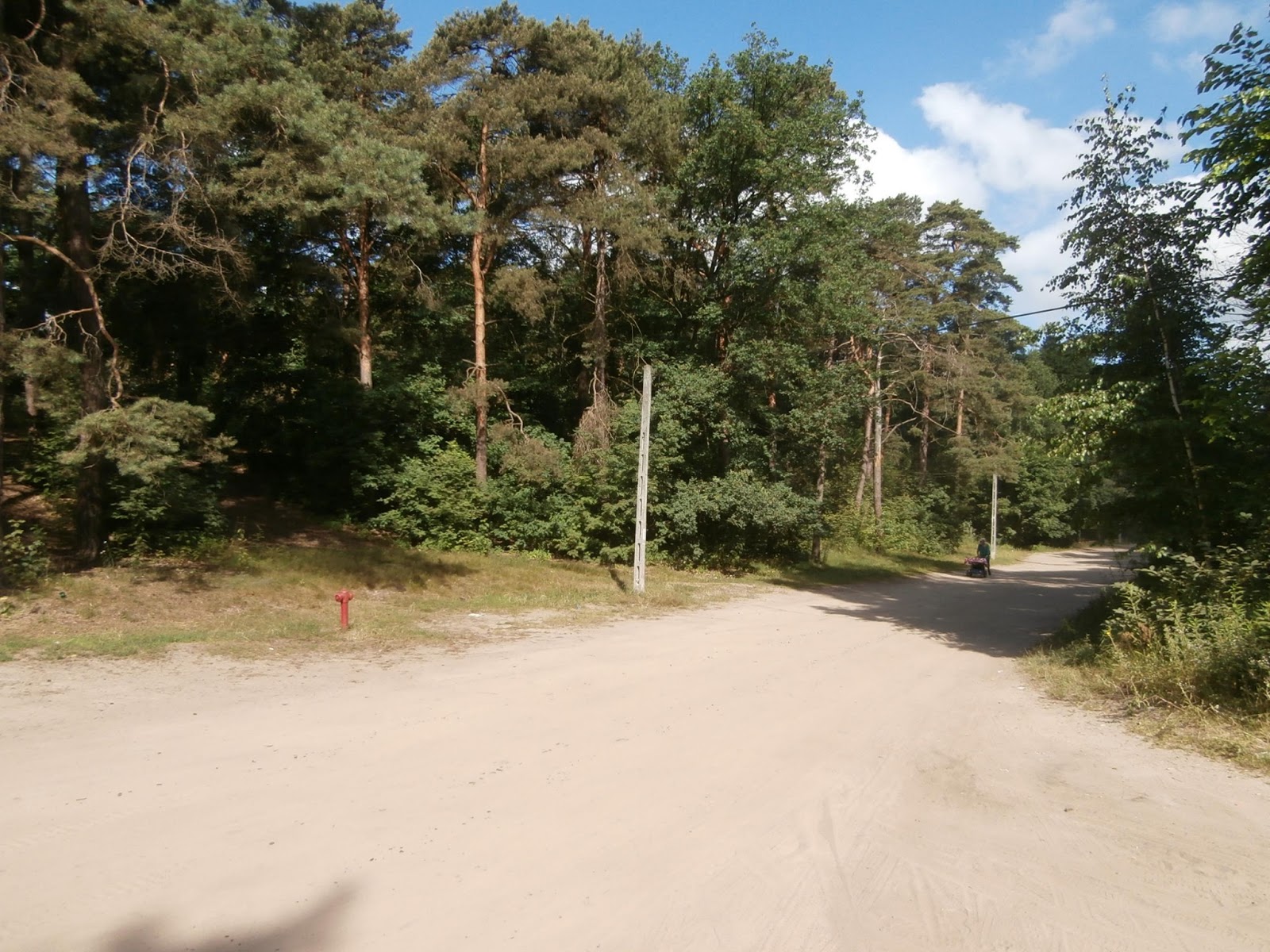
Górki Szymona – allegedly the pride and joy of Piaseczno. Maybe I am biased, but if the town in which I spent first seventeen years of my life has anything to boast about, I’m a Dutchman. I ventured there last Sunday to check out how the place where I would go with my parents some twenty years ago looks and, unsurprisingly, little has changed.

To the right – the standpipe is where it was in 1994, I recall well my father developed a habit of parking his Fiat Uno next to it. Only the trees are higher, the road running towards the place has not even been tarmacked… In the background – a chap (was not a pleasure to cycle past him, the odour could not be captured by the camera) pushing a rubbish cart – fits the place perfectly.

To the right – for a short moment I forget I am mere three miles from home and imagine I’m holidaying. There’s a lake, there’s a pier, an angler on the other side. Behind me someone has pitched a tent and its dwellers are eating breakfast.

To the right – the sand-covered hill, why and wherefore this place is named the way it is named. In my childhood it was the place most ‘tourists’ would lay their blankets and towels. Nearby was a sandy shore and swimming baths.

To the right – I tried to cycle around the pond and ride through a wide footpath. It is the only place in the whole area that seems to have a spirit. Finally I did not dare to cover the whole path by bike and turned back. I have to confess I did not feel safe there in broad daylight.

This is the essence of Piaseczno – I feel safer in Warsaw late in the evening than in Piaseczno on a Sunday afternoon. On my way to Górki Szymona I was accosted by four tanked-up hools trying to deprive me of my bike. Fortunately the incident ended just with an exchange of “pleasantries”. Local authorities also want to revitalise the area and attract not only locals by letting a private investor build a guesthouse. I doubt those ideas ever prove successful.

Key advantages: proximity (less than half an hour by bike for me to get there), there’s water out there
Key advantages: not sure if swimming there is safe, whether the water is clean, no other attractions around, no snack bar, etc., shady spot…

So if this is not the right direction, next weekend, weather permitting, I plan to check and document the progress of works on the Southern Bypass of Warsaw, from junction Puławska to so-called Grande Canale, the least advanced section of the road.

Monday, 17 January 2011

Sunday trip to Piaseczno and back

Exam period report: four down, five to go...

By the way - do you know today we have Blue Monday and I am suspiciously joyful...

So as I'm stuck in the middle of my last exam period, it might be a good idea to write something concise, approachable and upload a lot of pictures to entartain my readers (and make the post appear longer while in fact it's short).

Last Sunday I decided to make the most of sunshine (for next eight days Poland's capital suffered from deficiency of sunlight) and my new two-in-one piece of plastic (travelcard and debit card in one, issued by Citi Handlowy) with suburban ticket encoded on it and...

14:02, I approach the train station in Nowa Iwiczna. According to my estimations I should have waited for the semi-fast Radom-bound train for a few minutes. In reality, the train was running earlier and I had to run up to the platform. Instead of snapping the engine hauling three new carriages I snapped the train pulling up and the window pane leant against the shelter (above). Needless to say shelters and benches at the station are vandalised soon after the new ones are put in after a previous act of thoughtless vandalism.

Above and left: now I need some hints how to take sharp photos from a train moving at a quite high speed. I have to say travelling in double-deckers is fast and comfortable. Above: a queue of cars waiting before gates on railway crossing in Stara Iwiczna (quite busy road). Left: it's not the coal line, but a stationary coal train on a siding in Piaseczno.

To the left, another queue of cars, this time it's the railway crossing on ul. Jana Pawła II in Piaseczno. Traffic on that street is rather sparse, yet the number of cars queuing up is staggeringly high. Worth mentioning that gates on railway crossings in Poland go down long before a train comes.

Right: just five minutes after boarding the train in NI, I alighted in Piaseczno. There, before the train pulled out from the station, I managed to capture it from its splendid, grimy rear. Display at the top of last carriage shows the train's destinantion. It was the third day of thaw, then in overdrive.

Right: the station in Piaseczno, lit by mid-afternoon January sun. The building has long been due to revitalisation, now it's due in... in the future, I suppose. Mayors and councillors come and go and the station remains run-down...

Left: the same building of the station, snapped from the footpath running over the tracks. Don't expect facilities such as waiting room, toilet or ticket office. Smacks of provincial Poland - watch out for the bicycle chained to a banister or heartfelt plea of love to some Angelika...

Right: derelict sidings west to the station. I remember from early childhood those tracks have been out of use back in mid-1990s. I am baffled by the fact no one has yet ripped them. Rails and bolts could be sold for scrap and slippers could be used as input to one of incenerators, so popular in the countryside... But note that many sidings running parallel to the main line, east of it, are still in use.

Left: the platform of Piaseczno station, as dilipidated as the building of the station, yet capable of serving its purpose. On Sunday afternoon served also as a hang-out for local track-suit afficionados.

Left: looking north from the footpath, tracks run towards Warsaw and converge in the distance. Visibility on 9 January wasn't particularly good, hence a gentle mist on the horizon.

At the station I peeked at the timetable to learn a Warsaw-bound train would arrive in three minutes. After ten minutes of hanging around there to no avail I set off to the centre of Piaseczno, then caught 709 bus to Warsaw and got off the vehicle just before the border of the capital. Right: Piaseczno, ul. Raszyńska. The dismal aftermath of water freezing in crevices between the proper tarmack and new patches. When temperatures fluctuate around 0C water freezes and unfreezes and patches are blown up. Last Friday the street was patched up, but the problem remains unresolved. Come another thaw and here we go again!

Both gmina Piaseczno and gmina Lesznowola are prosperous, but Piaseczno is incredibly badly-run, especially in comparison to reasonably well-run Lesznowola. As you cross the border between them the street is properly tarmacked (no holes at all), pavement is not crooked, but apart from this the picture is not rose-coloured. Litter scatterred around the rubbish bin, butts lying in dirty snow, box belonging to Telekompromitacja Polska S.A. mangled after a car accident, crooked fence put by owners of a private nursery school...

Right: heading back home. I wonder if the place is really as dull as it sometimes seems to be. My neighbourhood is surely not the worst sort of suburbia, nevertheless, it still lacks a spirit...

Sunday, 28 February 2010

The spring pops over and beckons

I was going to write today polemics to a next article about Polish pension system, but the ongoing vernal episode has brought me on putting off the mundane things and told me to entertain you with some pictures.

The thaw began on 18 February and according to weather forecast is going to last until Wednesday, but ten days turned out to be enough to let the layer of over fifty centimetres of snow melt away, fortunately without causing a flood.

In the first days of thaw temperatures were only creeping above zero, the considerable warmth came this week. In the afternoons Warsaw saw temperatures of almost ten degrees plus sunshine.

The snows have melted quite quickly. Above – the same place, ul. Zimowa in NI on 21 February and on 27 February. The second picture looks rather bleak compared to the first one.

Above – what I observed on the snow last Sunday. On fields, where the snow had stayed intact wind or some other natural power formed beautiful ripples. The picture to the right was snapped from the same place, though in a different direction. Watch out for the turret of the church in Stara Iwiczna in the distance, strewn bottles and the puzzling mist behind the row of the trees.

I took the photos below yesterday. They generally display nothing but the fabulous riot of colours at sunset. Magnificent, isn’t it?


Today beautiful weather drew me for a morning longish meandering around Piaseczno. Right – an alley running between blocks of flats built in 1960s. The foliages of the trees have been cut down. The pavement could have not been cleared for the whole winter, almost no one around, looking towards the shining sun.

Right – a bazaar in Piaseczno. It will last a while before those piles of snow disappear. And below a tower block whose existence I discovered today. It does resemble other Polish buildings of that type. My first association Was "Canada".


Right – a mound of dirty snow, mud, grit and ground at the corner of ul. Sikorskiego and al. Róż in Piaseczno. It must have been mammoth if even despite the thaw and being exposed to sunbeams it remained that large.

And next to it… Is it abnormal to see rubbish scattered around like this in a civilised country or is it abnormal to snap it and post on a blog run in a foreign language?

Then I strolled through the estate where I used to live. I wonder how it will look in thirty or forty years. Will it turn into a shanty town dwelled only by the poor and the dregs of society? A square metre of a flat in one of such blocks costs now around 6,000 zlotys. Two times too much!

Friday, 16 October 2009

Development, but sustainable

The morning ride to school made me mull over the capacity of infrastructure as a barrier in the development. This barrier is a bit similar to a brick wall – to high to jump over it, too wide to go round it, but not heavy and not fixed to the ground so that people can push it forward, but their movement is slowed up and it wears them down along the way.

Let’s look at the example of the main roads out of Warsaw, like ul. Puławska. What’s the most effective choice for the roads users? Today the road was packed with cars, but also all buses I saw were packed with commuters. Let’s analyse a few variants…

Variant 1 – everyone who can changes the bus for a car. Buses run almost empty, those who choose to ride, travel more comfortably, but longer.

Variant 2 – some of the drivers give up their cars and decide to commute by bus. The passengers in the buses are packed like sardines, but their journey last shorter, other drivers also benefit from this.

Variant 3 – urban authorities decide to mark out a bus lane. Hard-line drivers swear like troopers, their journeys to work are fifty per cent longer. Buses are packed but run quickly.

I could come up with some more alternatives, if you want more, use your imagination, maybe leave a comment. The option 1 is undeniably the worst. The second has a certain drawback – the drivers won’t get the incentive to leave their cars because the number of buses serving the line will be too small to provide a decent standard of commuting. The third would not accelerate the journey so much. It wouldn’t last shorter off-peak, but would cause an unnecessary traffic restriction. It the rush hours it would speed it up a bit, but not as much as for instance on Trasa Łazienkowska. On ul. Puławska there are too many bus stops and too many traffic lights so the buses wouldn’t even manage to pick up speed on short sections between junctions and lay-bys.

It turns out that to ensure the decent transport link between the capital and the suburban town the authorities would have to either launch buses which would run once in two minutes in morning peak, or to widen the road to six lanes in each direction. But to unclog it would be imperative to remove most of the traffic lights and build a system of service roads (funnily enough I don’t know the Polish equivalent of the term – is it infeasible then?) along ul. Puławska to serve the residents living along the artery…

New estates spring up, the new dwellers move in, living on the suburbs inexorably evolves into a hell. The residents of my locality can be divided in three groups. The first have lived here almost since ever, like their fathers, grandfathers and so on. The second group moved out of Warsaw to run away from the city groan, fumes and noise. In return they lose two hours a day they spend in a traffic jam. Some of them already gave up and returned to Warsaw. The third group consists of people who arrived here from province in search for a better life. They settled down here cause the property prices were lower than in Warsaw. No wonder, they sought a better future for themselves and their children. We all pay the price.

When a developer builds a new estate, it’s interested in selling the flats or houses, reaping the profits. Hardly ever the developers care about the roads which link their buildings with the rest of the world. Even if they repair or modernise them it’s because the local council conditioned granting the planning permission on their contribution to the infrastructure. As far as I can observe, my locality has reached its limits of development. It should be cut back until the new infrastructure is built. Instead of quantity we should opt for a quality – quality of our lives.

Middle of the summer. I leave work, spend over an hour in stinky bus with people getting sweaty, come back home and what…? I can’t even take a shower cause the water doesn’t flow! Once again the infrastructure is overloaded. The underground water resources are scarce, the capacity of water treatment station is limited, so when a selfish jerk turns his garden watering system on, I can’t take a bath. People don’t care by their nature – they’d rather prevent their lawns and shrubs from withering than let their neighbours take an invigorating shower. In some countries (Great Britain, Sweden) it is forbidden to use water for watering the garden plants or car washing during the drought and people tend to comply to it. It someone breaks away, it’s a… Pole. Here authorities can impose bans to no effect…

Can we afford the development? Will the poor infrastructure turn the further development into an obstacle course. Will the electricity outages like the ones after the last winter attack paralyse the industry?

Look ahead, but don’t dismiss the black scenarios…

Monday, 28 September 2009

Where I used to live...

Strolling back home from the centre of Piaseczno I took a bit longer route and ventured to pop in to a place where I had spent roughly speaking over seventeen years of my life. I wandered through the typical estate of blocks of flats, constructed in a panel building technology (wielka płyta), similar to hundreds of such clusters of blocks in Poland, saw a few familiar faces, had a chat with my former geography teacher and neighbour and snapped a few pictures, not only for the blog, but for myself. Maybe I will never live in one place for such long time (it’s most likely when I retire), so I thought it would be expedient to capture the place and save the photos as the memoirs of the days which belong now to the past..

Below – a school I had attended for ten years (1993 – 2003) – I had spent there one year in pre-school class (zerówka), six years in primary school (szkoła podstawowa) and then three years in middle school (gimnazjum) – ten years of mostly joyful and carefree days I’ll be bringing back when I grow older.


The school complex was opened in 1988, just two months after I had been born, to meet the needs of new residents of Piaseczno, who had moved in to those newly built blocks. The school has been revamped, now there’s a decent pitch next to it, pupils can use facilities like gym and swimming pool, where sport classes are held. Currently it’s only a middle school, what means teenagers in their “worst” (as teachers call it) age are clustered together in one place – try to imagine eight hundred rowdy girls and boys… The school even has a draft of its English website (refrain from arduous proofreading, please…, mgr E.D. was my English teacher during first year in middle school, she was quite likeable and did her stint really well on the elementary level).

Below – the building where I lived – view to the balconies and entrance to the staircase. The block was insulated and plastered in 2000. Since then the yellow facade has been covered with mouldy-musty green stains of water leaking down the wall from the improperly laid gullets. My family lived on the first floor to the left, the nearest neighbours were rather unenviable.


The man who occupied the flat below mine would beat up his wife every Saturday after coming home under the influence, the next day they would go to the church together like if nothing had happened.
In the family living next door the husband would hit wife occasionally but once he made up his mind, he was determined to do it right. In the mid nineties they moved out to Nowa Iwiczna (my parents strictly stick to the rule “keep at least 200 metres away from the street Mr and Mrs W. live) and the flat was taken over by parents of one of the spouses. They were really affable, but had one irritating habit – they would look for interesting stuff in the rubbish bins and amass them on the balcony. The administration had to crack down on ants and other worms which hatched there. After they departed the flat was sold to a young couple who still live there, now with their children. As far as I know they still believe in an old Polish saying “Jak Bóg dał dzieci, to da i na dzieci” (If God gives children, He will also give [the money to provide] for children).
In the best times of the flat above us there were eight people packed on sixty square meters (Mrs and Mr P., their two sons with wives and children). Now the flat is occupied only by Mrs P., many of former dwellers of the flat enjoy the accommodation in the lodgings of afterlife, in the leisure time they probably swim in a tar.
For a few years my neighbour from the last floor was the current star of “Jaka To Melodia”. Now of course he doesn’t live in such dingy place. BTW – if you’ve never heard of him don’t worry, good for you! His English website is much better than the one of my school, but it could also take some beating…

And below – an alley in front of the building. From the early childhood I remember there was nothing apart from the flat and arid soil. Now there’s a row of trees, the estate is in the greenery, but the overwhelming squalor takes over. Grass has been rooted out by weeds, pavement slabs are so crooked that one could easily trip over them, the area gets more and more dilapidated.


I’m immensely happy I don’t have to live there. I got used to living in a house with a small garden, so I would find it hard in the spring to sit for the whole day between concrete walls. If I decide to move out, I’ll move to Warsaw and buy a flat there (detached or terraced house for years will be out of reach), at least I’ll replace the advantage of fresh air and greenery with another one – of having everything much nearer. There’s also another reason – Piaseczno, although said to be so modern is still very provincial – people know a lot about their neighbours, news and gossips spread quickly, the whole town can speak about one sensational event (accident, fire, etc.) for a week. There’s a sense of community which I cannot experience in the village I’m living now, but on the other hand I have much more anonymity and one good neighbour, amiable and not nosy…

Friday, 18 September 2009

To Powsin – by bike and on foot

It was nice to experience one of the last moment of permitting weather and visit the Entertainment and Culture Park in the sunny afternoon, when most of people sit in their offices. I set off at 13:30 to Julianów, where my friend lives, left the bike at his garage and on foot we strolled (or rather marched) six kilometres to Powsin. The route is so short only when covered on foot or cycled – the path runs along the coal line, (below – the level crossing in Kierszek, to my surprise this section of the track has been modernised – old wooden sleepers have been replaced with the concrete ones).


Then in the village Kierszek one has to turn left and walk, ride along the east verge of Las Kabacki. (below – east to the path there are lots of fences of big plots bought by the new-rich. Many of them are dilapidated, here the example of the compatriots’ artistic activity).


Entertainment and Culture Park itself brings to mind the holiday resort. For a moment I feel like in a typical resort. People sunbathing, cycling, pensioner playing chess, some drunkards sipping “sparkling wine”. The quiet was interrupted only by the integration party held by one of the construction companies. Below – a snack bar where we took a rest.


Heading back home I noticed the new landmark of Piaseczno in the distance. The photo below was taken somewhere around Kierszek and shows the “flagship building” of the town – “Sand City Tower” – sixteen storey high building put up just next to Piaseczno’s bypass. Its main asset was meant to be picturesque view splaying out from Landscape Park to the south up to the Warsaw’s skyline to the north. Indeed, it is visible from the distance of seven kilometres, but the view won’t beat the Warsaw skyscrapers’ panorama seen from Lesznowola.


The last snap, from bike in Józefosław – this is a new bus service which links the new estates built south of Las Kabacki with Warsaw. It runs each twenty minutes in the rush hour, to ride it one needs a ticket valid in a suburban zone. Locals already complain about high prices of tickets, bad route and frequency of shuttling…


Late afternoon at home I find – two Polish absurdities.

First from my university – the whole description (in Polish – here). Phone conversation between a student and a lady from the dean’s office.

Student: Kiedy dostaniemy dyplomy? (When will we get our diplomas?)
Lady from the dean’s office: Żle pan trafił bo dziś mamy rekrutację na uzupełniające i nikt panu nie pomoże. (You’re out of luck, today we’re dealing with the enrolment on post-grad studies and no one’s going to help you.)
Student: Chodzi mi tylko o dzień (I would only like to ask which day will it happen?)
Lady from the dean’s office: Proszę pana nie chce mi się przestawiać myślenia na to pytanie bo mam zajęcia związane z rekrutacją które wymagają skupienia (Dear sir, I don’t feel like shifting my thinking into your question, cause I’m busy with the enrolment and this requires a lot of concentration.)

The second one – the news that Play Mobile’s shareholders might wish to shove up its capital brought about a swift reaction the competitors. Jeśli Play znowu dostanie pieniądze, będzie mógł dalej psuć rynek – komentowała anonimowo osoba zbliżona do jednej z sieci stacjonarnych. (If Play gets money once again, it will be able to keep on spoiling the market – commented a person affiliated with one of landline operators). I don’t know whether that landline operator has close capital tie-ups with one of mobile operators and I have absolutely no idea if companies like Telekompromitacja Polska S.A. and Orżnąć have something in common with that statement, but I can come up with one conclusion. It shows what is the attitude towards customer among the old operator. Within last two and a half year the prices dropped by sixty percent (figures for pre-paid plans). The market from oligopoly evolved into customer’s market. All changes which took place were to the benefit of ordinary people who could pay less and use their phone more often. But maybe I should understand the anger of the company which took lower revenues, lost some clients, but one the other hand they deserved it. Serves them right, I suppose the cash injection will be earmarked for investments in infrastructure, but I hope Play will continue to spoil the market, to the benefit of customers and to the detriment of other operators.