Showing posts with label coronavirus. Show all posts

Sunday, 26 November 2023

COVID-19 is back

The long-forgotten virus apparently is in overdrive again. We cannot tell how rampant it is, since the public testing system in Poland is currently virtually non-existent and might only hint at possibly even up to 100,000 new (but usually not first) infections daily. The public reporting covers approximately 2,500 tests carried out daily, which, with positivity rate above 40%, have translated into 7-day moving average of new cases exceeding 1,000 on 17 November 2023. The hospitalisation statistics are not published, but the health service does not report a bigger strain than during a typical flu season. Weekly stats of all deaths also do not indicate increased mortality nation-wide.

As I am writing this I am far from concern or panicking. The last restrictions (face covering obligation in health centres, hospitals and pharmacies) were lifted in Poland in July 2023. The virus will stay with us forever, is generally milder and our immune systems have got accustomed to it, hence we are in the phase of learning to live with it and we are nearly getting it right.

Although the disease usually gives symptoms similar to a common cold, being infected by COVID-19 still remains a risk to whose vulnerable - elderly and with underlying health problems. Such examples are my parents who tested positive this week, but undergoing the illness relatively mildly (given their age and health issues). The outgoing Polish government has yet disregarded the issue and has not secured deliveries of Paxlovid and delayed by 2 months distrubution of new vaccines (still no idea how many will arrive), thus putting healths and lives of several million people, including my mother and father, at risk. Despite this I suppose less than 10% of the population will take the next dose, especially once many got through COVID-19 mildly and being vaccinated since months has not given any benefits.

Looking back at the pandemic, I surmise the next one will be perfectly shrugged off. If during the last one, when mortality was up by 100% vs. "normal" times, the extra efforts were not taken to save lives, then once a more severe virus attacks, the price to pay will be high. Interestingly, I see no traces of trauma of isolation and two hundred thousand excess deaths - the pandemic deprived Poland prematurely of nealy 0.5% of its population, being the biggest disaster (in terms of number of fatalities) after World War Two and... nearly everybody gets on with this.

Looking forward, take care of yourselves!

Sunday, 2 April 2023

COVID-19 timeline - 1Q2023

Friday, 13 January 2023
Despite middle of the winter, infections in Poland reach their low, with 7-day average number of infections down at 278.

Saturday, 4 February 2023

Two years and eleven months after the first registered COVID-19 case in Poland, I get a positive test result. My infection escapes the official statistics despite an attempt to get tested at GPs.

Tuesday, 14 February 2023
The 7-day average number of new infections in Poland rises above 1,000, for the first time since 25 October 2022. R(t) is around 1.40 and positivity rate close to 30%.

Friday, 24 February 2023
The 7-day average number of new infections in Poland rises above 2,000, for the first time since 13 October 2022. The positivity rate close to 35%.

Monday, 13 March 2023
There have been several infection clusters in my office. Luckily, my hybrid immunity kept my health at bay.

Wednesday, 15 March 2023
The number of people hospitalized with COVID-19 in Poland reaches 3,235 – it has not been so bad since many months, which shows the scale of infections not reported officially.

Thursday, 16 March 2023
The 7-day average number of new infections in Poland rises above 3,000, for the first time since 4 October 2022. On this day the peak of the current wave is hit, with 3,012 cases reported on average daily during the recent 7 days.

Thursday, 23 March 2023
The hot topic is the availability of Paxlovid, the medicine effective at treatment serious COVID-19 cases. In Poland, it is not reimbursed and widely available, unlike in civilised western countries.

Tuesday, 28 March 2023
The 7-day average number of new infections in Poland declines below 2,000, for the first time since 23 February 2023. Going uphill took 20 days, going downhill – only 12 days.

Tuesday, 31 March 2023
I still observe many people sick around, yet fewer with C19, more with flu type B, whose course of infections are more serious (several days in bed with high fever).

Sunday, 12 February 2023

In which I catch COVID-19

Nearly three years into the pandemic and having taken four doses of vaccine against COVID-19 (second booster on 24 October 2022) for a long time I kept escaping an infection. But if you live normally and take no other precautions that getting a jab, catching the virus is just a matter of time.

Saturday, 28 January 2023
I attend a housewarming party – over 30 people on mere 30 square metres. Mostly likely I got infected there. I am not sure, since the host claims no one reported being ill afterwards.

Thursday, 2 February 2023
I feel a bit off-colour. While attending my fitness / workout classes I get tired quite quickly, but I don’t find it disturbing.

Friday, 3 February 2023
I wake up with a fever (body temperature of +38C) which I bring down with a painkiller, then feel strangely – I have a weird headache, my stomach turns upside down, I feel dizzy. On that day a penny drops. On that day the number of confirmed infections in Poland is above 1,000 for the first time since October 2022.

Saturday, 4 February 2023
I feel quite weak, worn-down. Before leaving to my parents just in case I take a test. The outcome is positive. I repeat the test after 2 hours of not eating nor drinking and again it is positive.

Sunday, 5 February 2023
I visit a doctor, to find out my lungs are clear and my employer-paid healthcare plan does not cover testing. The doctor does not even ask if I need a sickie.

Monday, 6 February 2023
My weakness continues, I feel dizzy, but have no other symptoms. Needless to say my infection escapes official statistics.

Tuesday, 7 February 2023
I grow even weaker and work from bed most of the day. Those days I sleep 9 – 10 hours each night.

Wednesday, 8 February 2023
I think I am finally on the mend, despite testing positive in the morning. In the evening I go for a walk. I don’t get particularly tired, but feel dizzy again.

Thursday, 9 February 2023
I cannot judge whether I would have felt better, had I not worked for 11 hours. Apart from the “dizziness” which does not ease off, I recover.

Friday, 10 February 2023
Again I get tested positive. This gets slowly boring…

Saturday, 11 February 2023
Despite the ongoing infection I wear a mask, go to the shops, go the a museum for an exhibition. Nobody around cares if the virus is around, so why should I excessively care about other people. I hope to turn negative soon and to have no long-term complications after the infection.

Sunday, 8 January 2023

Pandemic diary – December 2022

Tuesday, 13 December 2022
The number of new infections is four-digit, for the first time since 26 October 2022. During the commencing winter a seasonal flu is probably going to be more dangerous than COVID-19.

Thursday, 15 December 2022
The 7-day average of new infections exceeds 500 for the first time since 5 November 2022. Forecasters claim the current wave, barely noticed by anybody, will peak in January, with on average 5,000 new infections per day.

Tuesday, 20 December 2022
China, upon lifting the zero-covid policy, is witnessing soaring numbers of infections, hospitalizations and infections which are not officially registered. The nation which used to keep the virus at bay for nearly 3 years and whose vaccines cannot boast of great efficacy, lacks proper immunity, which is the case for western societies these days.

Friday, 23 December 2022

It seems COVID-19 is now not the biggest peril to the health care system. This winter, as envisaged, the seasonal flu is taking its toll on Poles, especially on children. Par for the course after 2 years of masking and staying at home. Some time ago I was either somewhat ill or too busy to get vaccinated against flu. Currently, there is a shortage of vaccines in Medicover…

Thursday, 29 December 2022
I get my flu jab, but not in Warsaw, but in Bielsko-Biała.

Sunday, 4 December 2022

Pandemic diary – November 2022

Wednesday, 2 November 2022
Austria becomes the first country in the EU where 60.00% of population have been officially tested positive. Further rank: Slovenia (59.39% of population) and France (56.19% of population)

Saturday, 5 November 2022
Conspiracy theorist keep holding strong, though COVID-19 is nearly forgotten in the public discourse. The article about increased risk of myocarditis after vaccination against COVID-19 with patients aged below 40 is heavily cited by anti-vaxxers in Poland. They forgot to mention the risk is miniscule anyway and that risk of myocarditis as complication after the coronavirus disease is much higher

Sunday, 6 November 2022
The 7-day average number of new infections in Poland declines below 500, for the first time since 4 July 2022. Positivity rate in turn has fallen below 10%.

Thursday, 10 November 2022
Oddly enough, the number of daily death worldwide has not fallen below 1,500 for a month. This implies infections do not decrease, but more and more countries give up on testing.

Friday, 18 November 2022
The 7-day average of new infections in Poland bottoms out at 318, with positivity rate somewhat below 10%.

Saturday, 19 November 2022
I go through the most severe cold since 2012. This is not COVID-19 (tested twice), but it turns out two years of masking up, isolation and averting germs have taken their toll on immunity.

Wednesday, 23 November 2022
The number of tests carried out per 1 million citizens in Poland reaches… 1,000,000. Poland remains at the bottom of the ranking of EU27 countries which best test their citizens, although truth be told testing has been abandoned in several civilised countries.

Wednesday, 30 November 2022
The next wave apparently has begun, with week-ok-week increases in new cases above 20%. The winter is coming.

Next week comes the final weekend of Szlachetna Paczka, so the next post will appear in two weeks.

Sunday, 6 November 2022

Pandemic diary – October 2022

Tuesday, 4 October 2022
Recent days bring a decrease in the number of cases, accompanied by just a minor decline in testing – positivity rate drops well below 30%. I bet the relief will be short-lasting

Wednesday, 5 October 2022
The 7-day average number of new infections in Poland falls below 3,000.

Friday, 14 October 2022
The 7-day average number of new infections in Poland falls below 2,000, for the first time since 21 July 2022, against alleged seasonality. The downward trend is also observed in other European countries.

Monday, 17 October 2022
With nearly no media coverage, adjusted bivalent vaccines against BA.4 and BA.5 are delivered to vaccination centres in Poland. The scarcity is well-visible.

Monday, 24 October 2022
In which I get the second booster. Given the aforementioned scarcity, I had to sign up for a jab in Józefów (15 kilometres, or 21 minutes’ drive from home). With hindsight – no side effects the next day.

Wednesday, 26 October 2022
The 7-day average number of new infections in Poland falls below 1,000, for the first time since 12 July 2022. New infections fall in all European countries, defying the seasonality hypothesis.

Sunday, 2 October 2022

Pandemic diary – September 2022

Saturday, 3 September 2022
The 7-day average number of new infections in Poland declines below 3,000. It has been above that level for 32 days. This year the pandemic retreats in September.

Monday, 5 September 2022
The decline in the number of cases in Poland has not lasted low. The 7-day average bottoms out at 2,881.

Wednesday, 7 September 2022
And soon the 7-day average inclines back above 3,000 cases. Is the autumn so much in the air?

Wednesday, 14 September 2022
A week later, the 7-day average hits more than 4,000 cases and is bound to climb even higher (I am still referring to my homeland).

Thursday, 15 September 2022
All of the sudden the ministry of health announces the second booster, adjusted to Omicron variants, will be available to all 12+ triple-vaccinated Poles.

Friday, 16 September 2022
Instead of signing up for the second booster, I test myself at home for the second time this week. The result is negative again, so either I have caught a cold for the first time since more than 4 years or again, or the symptoms are the severe manifestation of allergy to my girlfriend’s dog.

Monday, 19 September 2022
New infections top out in Poland quickly, at 4,590.

Tuesday, 27 September 2022
The 7-day average number of new infections in Poland declines below 4,000. Seems the number of registered infections has settled in a sideways trend.

Sunday, 4 September 2022

Pandemic diary - August 2022

Tuesday, 2 August 2022
The 7-day average number of new infections rises above 3,000 for the first time since 4 April 2022. In 2021 the figure was crossed on 20 October, in 2020 on 10 October. Positivity rate reaches 40%, as badly as during the second wave in the autumn of 2020.

Wednesday, 3 August 2022

My parents receive the second booster shot. As it turns out, prematurely, since my mother’s immune system was still activated in response to an apparent encounter to the virus in the sanatory.

Saturday, 20 August 2022
The cumulative number of cases worldwide reaches 600,000,000. With testing being less widespread everywhere.

Tuesday, 23 August 2022
The sixth COVID-19 wave in Poland, being the first a summer one, tops out at 4,249 cases (7-day average), being the official number. Experts judge the actual number of infections could have reached between 50,000 and 100,000 a day.

Saturday, 27 August 2022
R(t), the reproduction coefficient, declines sustainably below 1.0x in Poland. If the pandemic hits again, it will be probably a minor quandary in comparison to shortages in energy resources.

Sunday, 7 August 2022

Pandemic diary – July 2022

Saturday, 2 July 2022
There are three EU countries in which on average every second citizen has been tested positive once since the beginning of the pandemic. Now comes the ranking of countries with the biggest percent of population having gone through an infection (which is a bit of a distortion, since it does not take into account reinfections, quite frequent in 2022):
1. Denmark: 51.71%,
2. Portugal: 51.01%,
3. Slovenia: 50.02%.

Tuesday, 5 July 2022
The 7-day average number of new infections rises above 500 for the first time since 11 May 2022 (with meagre testing).

Friday, 8 July 2022
The health minister Niedzielski (known also as the master of disaster / minister zagłady) proclaims mass testing (I would call it “any access to publicly funded testing) will be resumed once hospitalisations on account of COVID-19 reach 5,000 at one time. Belarus is the only other country geographically situated in Europe where the virus is swept under the carpet.

Wednesday, 13 July 2022
The 7-day average number of new infections rises above 1,000 for the first time since 26 April 2022. In 2021 the figure was crossed on 2 October, in 2020 on 26 September. On top, average testing volume is some 9 times lower than in two previous years, around the days when 1 one thousands of new infections were hit. “Autumn” has come early this year…

Saturday, 16 July 2022
In a sanatory where my mother has resided since 30 June for a 4-week recovery stay COVID-19 is rampant. Fortunately, mum remains healthy, but fewer and fewer people are around. In the absence of testing, each symptomatic patient is deported home, but sadly some of the elderly patients are taken to hospitals.

Sunday, 17 July 2022
The 7-day average number of cases worldwide inclines above 1,000,000 for the first time since early April 2022. The virus cares little about the summertime in the northern hemisphere.

Friday, 22 July 2022
The 7-day average number of new infections rises above 2,000 for the first time since 6 April 2022. In 2021 the figure was crossed on 14 October, in 2020 on 6 October. And those figures come out in the absence of mass testing, hence the estimated daily number of infections in Poland probably reaches 50,000.

Thursday, 28 July 2022
My mother returns from the sanatory which has been a hotbed of the virus for three weeks and has not been ill. Time to sign my parents up for the second booster.

Edit: off for the August long weekend into the mountains, hence next posting comes up on 21 August.

Sunday, 3 July 2022

Pandemic diary – June 2022

Sunday, 5 June 2022
Portugal has published a backward correction of its COVID-19 figures which show the country experienced another wave in May 2022. Who still claims the virus is seasonal?

Wednesday, 8 June 2022
The number of new cases bottoms out in Poland at (7-day average) 195 (much higher than 2021’s low of 77 when testing was not as scant as these days.

Friday, 10 June 2022
Poland reports the first case of monkeypox. Nearly a month after first reports of the disease spreading, it does not seem to have he potential to trigger a pandemic.

Thursday, 16 June 2022
I learn my friend and her family, as well as several people from her office had COVID-19 during last month. Needless to say none of them was officially tested.

Saturday, 18 June 2022
The second, artificial bottom of the 7-day average of new infections in Poland is reached because of scant long-weekend testing – 169 new cases.

Tuesday, 21 June 2022
Poland begins to follow the path of Western Europe, where cases are markedly rising.

Wednesday, 22 June 2022
Hospitalisations in Poland, reported weekly, reach a bottom at 287, vs. low of 271 in early august 2021.

Tuesday, 28 June 2022

In several European countries the number of new infections bottomed out sustainably, as measured by 7-day average number of new infections:

- the Netherlands: +424% since 28 May 2022,
- France: +343% since 27 May 2022,
- Austria, +311% since 30 May 2022,
- Germany: +261% since 28 May 2022,
- Italy: +242% since 3 June 2022,
- Greece: +231% since 3 June 2022.
Given that BA.4 and BA.5 variants of Omicron are spreading across Europe, it give up on switching into quarterly timeline. Monthly reporting to stay in place.

Sunday, 5 June 2022

Pandemic diary – May 2022

Monday, 2 May 2022
60% of Poland’s population vaccinated with at least 1 dose. With respect to participation in the vaccination programme, Poland ranks sixth from the bottom in the EU after:
1. Bulgaria (30.2%),
2. Romania (42.5%),
3. Slovakia (51.7%),
4. Croatia (57.3%),
5. Slovenia (58.7%).

Saturday, 7 May 2022
The total number of infections in Poland reaches 6,000,000. Given the scant testing, 7,000,000 is out of reach, officially.

Wednesday, 11 May 2022
In a weekly report the ministry of health informs the number of patients in hospitals treated from COVID-19 has fallen below 1,000.

Thursday, 12 May 2022
The 7-day average number of new infections in Poland declines below 500, it last officially stood so low in mid-September 2021.

Saturday, 14 May 2022
The 7-day average number of new deaths in Poland decreases to 10. This gives some comfort. On top, excess deaths also suggest the situation is under control. In July 2021 the figure bottomed out at 2.

Monday, 16 May 2022
Stan epidemii is lifted in Poland, but actually is downplayed into stan zagrożenia epidemicznego which is a purely legislative change. I wonder how long before the next wave hits and how badly it is going to affect the healthcare system.

Tuesday, 17 May 2022
In the United States the 7-day average number of new cases hits 100,000, after bottoming out below 30,000 in late March. Try to convince me the virus is seasonal and there is no reason to worry while it’s warm.

Friday, 20 May 2022
Exactly one week ago COVID-19 officially reach the communist North Korea. Within that time, 2.24 million citizens of the country (population of 26 million) were diagnosed with symptomatic COVID-19-like disease (the country lacks access to testing). Examples of Taiwan and North Korea show no matter how stringent precautions are taken, no country can resist the virus.

Wednesday, 25 May 2022

While the world is slowly forgetting about COVID-19, rising number of monkeypox cases becomes a concern in several countries. Several questions remain partly unanswered, including the crucial ones, about transmission mechanism and protection offered by existing vaccines.


Monday, 30 May 2022
First non-bank-holiday-related week-on-week increase in new cases is just an outlier, but the change in the trend is in the offing, my intuition tells me.

Sunday, 8 May 2022

Pandemic diary – April 2022 (actually its second and third decade)

Tuesday, 12 April 2022
500,000,000 infections worldwide. At some parts of the world do not pretend it is all over…
Worldwide, the 7-day average number of new infections drops below 1,000,000, for the first time since 27 December 2021.

Friday, 15 April 2022
In its pursuit of pretending the pandemic is over, Poland switches to weekly reporting of new cases and deaths. Worth noting hospitalizations were also be reported weekly from the beginning of April, but so far nobody bothered to prepare such a report.

Monday, 18 April 2022
The 7-day average of new infections in Poland declines below 1,000. Given scant testing and the fact data come from Easter Sunday (the reporting is continued despite the promise to cease it on daily basis), reliability of the stats is questionable.

Tuesday, 19 April 2022
The 7-day average number of new infections in Poland bottoms out (for a while) at 799.

Tuesday, 26 April 2022
The 7-day average number of new infections exceeds (due to base effect) 1,000 for a day. Dumping backlog inflates also the 7-day average of new deaths in the UK which reaches 324 (vs. 291 in the peak of Omicron wave in mid-January 2022), the highest since late February 2021.

Note: I am off for holidays next Sunday. A proper coverage due on the last Sunday of May.

Sunday, 10 April 2022

Pandemic diary – weeks 107 & 108

Monday, 28 March 2022
Isolation, quarantine and mask-wearing obligation indoors (except for health care outposts) are lifted. In my opinion, it is too early to say the pandemic is over and COVID-19 should be treated like a flu, especially if countries which have followed that strategy are paying the price.

Tuesday, 29 March 2022
I visit Lidl in the morning and the shopping mall in Janki in the evening. Around one-fourth of people, including me, continue to wear masks. It takes quite little effort, but gives reasonable protection – until the level of new infections declines to three digits per day, I will carry on covering my mouth and nose in public indoor spaces.

Wednesday, 30 March 2022
The number of hospital beds occupied by COVID-19 patients in Poland drops below 5,000, for the first time since 24 October 2021.

Thursday, 31 March 2022
The customary (and the last) month-end report of the sluggish pace of vaccinations in Poland.

1. Vaccine uptake in age groups


2. Vaccination status in the entire population of Poland

Friday, 1 April 2022
On 5 March 2022 I predicted the total number of detected cases in Poland today would reach 6,000,000. I got it wrong by 33,030 cases. With poorer access to tests and the epidemic officially called off by politicians I refrain from predicting when the seventh million is reached.
The 7-day average of new infections in Poland falls below 5,000, for the first time since 25 October 2021.

Saturday, 2 April 2022
The Polish Ministry of Health changes reporting methodology. Data on antigen testing and hospitalisations will be reported in weekly intervals. For some time new infections and deaths will be reported daily. Officially the pandemic draws to a close, but does the virus know it?

Sunday, 3 April 2022
Thanks to restricted access to testing, new infections in Poland drop by 84% week-on-week. Jaw drops open.

Monday, 4 April 2022
My workmates from the sales team went on an off-site integration event last week. Two-third have tested positive for COVID-19. Was the minister wrong, when claiming the pandemic was over?

Tuesday, 5 April 2022
The 7-day average of new infections in Poland falls below 3,000, for the first time since 19 October 2021.

Wednesday, 6 April 2022
Vaccinations for adults are not just against COVID-19. Today I got voluntarily a self-paid shot of Boostrix Polio vaccine.

Thursday, 7 April 2022
The 7-day average of new infections in Poland falls below 2,000, for the first time since 13 October 2021. Given Poland actually nearly ceased to carry out testing, hospitalisations reported weekly and excess deaths might become the only measure of the (bygone) pandemic.

Friday, 8 April 2022
The 7-day average number of deaths in Poland declines below 50. Good news!

Saturday, 9 April 2022
While in Poland COVID-19 has been called off, worth noting there are countries in Europe which have seen all-time high of new infections in the second half of March:
- Finland on 16 March,
- Austria, on 18 March,
- Germany, on 24 March,
- Cyprus on 30 March.

Sunday, 27 March 2022

Pandemic diary – weeks 105 & 106

Monday, 14 March 2022
In Warsaw first week-on-week increase in new cases since 28 January (peak of the omicron wave). One swallow does not make a summer, but the trend is to be observed.

Tuesday, 15 March 2022
Looking at statistics of new infections, the least affected region in Poland has been for a while Podkarpackie province, where less than 1 citizen in 10,000 is tested positive daily and positivity rate declined below 5%. Looks like a natural herd immunity.

Wednesday, 16 March 2022
New infections in Poland nudge up by 0.5%, still this is an outlier in a slight downward trend

Thursday, 17 March 2022
In South Korea 1 in 83 citizens tested positive. I thought the record would not be broken.

Friday, 18 March 2022
China sees the biggest COVID-19 outbreak since early 2020. The country follows zero-covid policy, hence two thousand cases per day bring the entire regions to a halt. Since strict lockdowns involve also factory closures, supply chain disruptions are expected.

Saturday, 19 March 2022
I belatedly spot a new forecast by MOCOS, whose quants foresee:
- a peak of new infections during the next wave on 1 April (7-day average of 18,320)
- deaths bottoming out at 70 on 30 March,
- hospitalisations bottoming out at 3,846 on 29 March.

Sunday, 20 March 2022
As I continue my volunteering, delivering packages for several spots collecting clothes, food and other stuff for Ukrainian refugees, I see an absolute loosening of rules, especially with respect of face covering. Only decent immunisation, either vaccine-induced or natural, prevents new infections from rising.

Monday, 21 March 2022
Vaccine uptake reporting on regional level is discontinued. Given waning post-vaccination immunity, it actually makes. For the record, the biggest percentage of population vaccinated with at least one dose on that day was in:
1. Wronki (81.21%),
2. Ustronie Morskie (80.98%),
3. Raszyn (80.06%),
4. Podkowa Leśna (79.06%),
5. Warsaw (77.73%).

Tuesday, 22 March 2022
For that day I predicted 500 million infections worldwide. Happily, I underestimated it by around 26 million.
The 7-day average of new infections declines below 10,000, where it last was on 5 November 2021. Once the figure declines below 3,800, i.e. below 1 in 10,000 citizens tested positive daily. Then I will switch back into monthly reporting (hopefully the sixth wave does not come over).

Wednesday, 23 March 2022
The United States is the first country in the world to report a round 1,000,000 of deaths due to COVID-19. In practice it is more than sure India during its delta wave in late April 2021 recorded a few million deceases, judging by excess mortality reported.

Thursday, 24 March 2022
The 7-day average of new deaths decreases below 100 in Poland. The figure was last that good on 5 November 2021. Hope it continues to decline!

Friday, 25 March 2022
The sideways trend of new infections, visible last week, has gone into a decline again. I hope it continues to go down, but wonder for how long.

Saturday, 26 March 2022
I wonder if BA.2 prompts China (and other Asian countries) to back out of the zero-covid policy. Those outbreaks cannot be contained without huge economic losses.

Sunday, 13 March 2022

Pandemic diary – weeks 103 & 104

Monday, 28 February 2022
The 7-day average of new infections declines below 15,000. If it continues to go on like this, by the end of the second decade of March it will fall below 10,000.
The customary month-end report of the sluggish pace of vaccinations in Poland.

1. Vaccine uptake in age groups

2. Vaccination status in the entire population of Poland

Given that the vaccination programme has nearly come to a standstill, is there any point in reporting its progress monthly anymore?

Tuesday, 1 March 2022
For that day, MOCOS forecast predicted that 7-day average of new infection would decline below 10,000. In practice, it reaches almost 14,000.

Wednesday, 2 March 2022
The 7-day average number of new deaths falls below 200. Hope the trend continues.

Thursday, 3 March 2022
The number of officially registered deaths caused by COVID-19 worldwide hits 6,000,000. I suppose a million more people die by 28 July 2022.

Friday, 4 March 2022
While the war is the only topic hitting the headlines, the second anniversary of first infection reported in Poland passes unnoticed. A year ago it was the topic of the day.

Saturday, 5 March 2022
On 3 February 2022 I predicted on that day the total number of reported cases in Poland would reach 6,000,000. Fortunately, I got it wrong, by 265,959. Now I bet the six million figure will be hit on 1 April 2022 (the first anniversary of the alpha wave peak last spring).
The number of hospitalisations on account of COVID-19 in Poland declines below 10,000, for the first time since 7 November 2021. Good news!

Sunday, 6 March 2022
As everybody is focused on the war in Ukraine, the pandemic is no longer a headline topic, but the virus does not let up during the warfare. Large gatherings might be conducive to spreading the virus.

Monday, 7 March 2022
After a noticeable decline in several countries in the second half of February, infections have picked up in many countries, but in some, such as the Netherlands or Austria, the incline is quite steep.

Tuesday, 8 March 2022
New infections in Poland rise week-on-week (by 1.3%) for the first time since nearly six weeks. With hindsight it will turn out it is just a one-off event, but the pace of decline gets very slow.

Wednesday, 9 March 2022
Torwar hall in Warsaw, being one of the biggest refugee shelters in Warsaw, becomes a hotbed of COVID-19, but as volunteers claim, this is just the peak of the iceberg, since people staying there are afflicted by several other diseases, which combined with the virus might get deadly. I fear a humanitarian disaster.

Thursday, 10 March 2022
In Austria the recent uptick send the level of new infections (7-day average) to all-time high. Too early to forget about COVID-19. We need to keep an eye on hospital admissions and deaths.

Friday, 11 March 2022
For me 11 March 2020, the day my employer ordered everyone to work from home and countrywide school closure was announced, marked the beginning of the pandemic. The second anniversary is barely noticed because of the war. Two years ago nobody expected it to last so long. Same might be with the warfare.

Saturday, 12 March 2022
The positivity rate has declined to around 15% - 18% in recent days, which is half of the figure witnessed in late January and early February, which implies new inflections have fallen by some 90% since the peak. Reassuringly?

Sunday, 27 February 2022

Pandemic diary – weeks 101 & 102

Monday, 14 February 2022
Omicron now accounts for more than 90% of sequences. To make stats less boring, time to come up with the distinction between BA.1 (current prevalent) and BA.2 (less than 5% of sequences these days) – more infectious and probably more deadly subvariant which already prevails in Denmark.

Tuesday, 15 February 2022
After the post-contact quarantine was lifted and less than a week before pupils return to classrooms, headmaster still do not know how to handle groups where one pupil or a teacher has been tested positive. Until recently, in such cases remote learning was compulsory. As of now, the regulations are unclear. In early March schools might become a hotbed of the virus again, as the wave has not burnt out naturally and the level of immunisation is not particularly high.

Wednesday, 16 February 2022
The 7-day average of new infections decreases below 30,000, after staying above such level for 22 days.

Thursday, 17 February 2022
75% of Warsaw’s residents fully vaccinated. The figure looks well, but with respect to curbing transmission, is useless. With respect to preventing severe course of the illness and death, vaccines still prove good, decreasing those risk by around 8 to 9 times in all age groups.

Friday, 18 February 2022
The 7-day average of new infections decreases below 25,000, after staying above such level for 27 days. The fifth wave declines as quickly as it inclined.
The 7-day average number of deaths peaks out at 251 in Poland; 4 fewer and exactly on the day predicted by MOCOS in the first week of February.

Saturday, 19 February 2022

In early February Denmark lifted all restrictions and opened up. Critics of that decision point at the record-high number of deaths in COVID-19 reports (higher than in January 2021, when the number of infections was 10 times lower, but prior to vaccine roll-out). But once you drill down the data, the surge is driven by deceases where COVID-19 was not the primary cause, but infection accompanied another disease. Looking at the chart below, I believe reporting should be amended and only if COVID-19 was the primary cause of the death, such death ought to be reported.

Sunday, 20 February 2022
Queen Elisabeth (aged 95) tested positive for COVID-19. The British queen has been triple-vaccinated (date of booster jab unknown) and is reported to have only mild symptoms. Hope she continues to feel well.

Monday, 21 February 2022
It seems that school closure on 27 January brought forward the peak in infection by one week. Nevertheless, if this wave does not burn out as it should naturally, I expect a rebound, or levelling off in early March, a few days after today’s school reopening.

Tuesday, 22 February 2022
In Iceland, more than 10% of population are active cases. Neither in Slovenia, nor in Denmark more than 10% were not isolated when inflections peak. Iceland is a quaint and only example of a country where infections have kept rising for the recent two months. The well-vaccinated nation sees however, a single-digit number of critical cases (2 out of around 35,000 in total) and reports on average less than 1 death daily.

Wednesday, 23 February 2022
The 7-day average of new infections decreases below 20,000, after staying above since 20 January. It kept ascending for 13 days, but descended for 21 days.
The Polish prime minister announces all restrictions, except for isolation, quarantine for flatmates and mask-wearing indoors obligation will be lifted as of 1 March.

Thursday, 24 February 2022
Ukraine reports 25,789 new coronavirus cases and 276 new deaths. This is the last COVID-19 report from the country.

Friday, 25 February 2022
Worth looking at South Africa, the first country which experienced a surge of infections caused by omicron. New cases (7-day average) peaked there on 17 December 2021 at 23,437, but unlike in previous waves when deaths peaked out some two weeks after infections, this time deaths kept rising until 19 February 2022 when 7-day average of new deaths reached 233. Any explanation for that?

Saturday, 26 February 2022
R(t) in Poland bottoms out at 0.67. School opening will do its bit soon.

Sunday, 13 February 2022

Pandemic diary – weeks 99 & 100

Monday, 31 January 2022
The customary month-end report of the sluggish pace of vaccinations in Poland.

1. Vaccine uptake in age groups


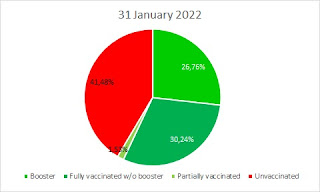
2. Vaccination status in the entire population of Poland

Tuesday, 1 February 2022
Poland is the only country in the EU to have reported less than 1,000,000 test carried out per 1one million citizens since the beginning of the pandemic. Romania, the runner-up in the nefarious ranking has made 1,001,131 test per one million citizens, while Poland only 808,195. In comparison, Denmark has tested an average citizen more than 20 times.

Wednesday, 2 February 2022
The fifth wave reaches in Poland its surprisingly low peak at 49,078 (7-day average of new infections).
In Slovenia 1 in 89 citizens tested positive. Over 35% of the country’s population (2.08 million) have been officially infected since the onset of the pandemic.

Thursday, 3 February 2022
The number of confirmed COVID-19 cases in Poland crosses 5,000,000. The last million was reached within 43 days, 8 days later than I had predicted on 22 December 2021. Even if the optimistic scenario materialises and the wave begins to decline, I bet the decline will be slow and 6,000,000 will be hit on 5 March 2022 (i.e. within 30 days).

Friday, 4 February 2022
Newspapers inform about 250,000 Poles who have been given a referral to get tested, have not shown up at testing centres. Reasons might be manifold:
1) too long queues to testing centres,
2) they feel to bad to get to a centre,
3) the fact that seven-day quarantine is shorter than ten-day isolation (in fact ten days plus the time of waiting for test result and to get tested).
The system might have clogged up, as the reported capacity is 192,000 tests per day and actual number of tests conducted is near 180,000.

Saturday, 5 February 2022
Looking at the positivity rate in Poland we it has ranged from 26% to 34% since 20 January. The steady percentage of positive test results does not confirm the hypothesis that the testing system has reached the limits of its capacity. Although in fact it has.

Sunday, 6 February 2022
European countries that definitely have gone past the peak (date of the peak in 7-day average of new infections in brackets) of omicron wave are:
- the United Kingdom (5 January),
- Ireland (12 January),
- Italy (14 January),
- Spain (17 January),
- France (25 January),
- Sweden (27 January),
- Belgium (28 January),
- Portugal (29 January).

Monday, 7 February 2022
The Polish Ministry of Health brings in reporting of reinfections. A positive change triggers chaos in reporting and prompts questions whether until now reinfections had been properly reported. With hindsight it turns out they were.

Tuesday, 8 February 2022
Number of officially detected cases worldwide hits 400,000,000, 4 days earlier than I foresaw on 5 January 2022 (when it crossed 300,000,000 mark). I predict half a billion will be exceeded on 22 March 2022.
R(t), the reproduction number declines in Poland below 1.00x. The peak in reported new infections was reached one week before most mathematical models had predicted.

Wednesday, 9 February 2022
The Polish Minister of Health announces the pandemic draws to a close (on a day when nearly 47,000 new infections and over 300 deaths are reported). To accommodate to such scenario, the government:
- lifts quarantine of people who have contacted an infected person,
- shortens quarantine for flatmates of an infected person (takes effect on 11 February),
- shortens isolation from 10 to 7 days (takes effect on 15 February),
- brings forward the end of remote learning by one week – children are to return to schools on 21 February.
But the jaw-dropping announcement is scrapping the obligation to wear mask indoors once new infections decline. For me the very latter is a step too far. Are they going to call the election? Last time the virus was retreating before the election.

Thursday, 10 February 2022
The 7-day average of new infections decreases below 40,000, after staying above such level for 14 days.

Friday, 11 February 2022
With some delay I find an updated pandemic forecast by MOCOS. Those quants a month ago predicted nearly 150,000 reported infections daily and 700 deaths daily after the wave peaked. The new forecast says:
- 7-day average of new infections will decline below 10,000 on 1 March 2022,
- 7-day average of new deaths will peak at 255 on 18 February 2022.

Saturday, 12 February 2022
Bulgaria is the first country in the UE in which 0.50% of the population officially died from COVID-19. Disregarding the virus, reluctance towards vaccines and poor health service have contributed to the dismal statistics.

Sunday, 30 January 2022

Pandemic diary – weeks 97 & 98

Monday, 17 January 2022
A week ago children returned to school and several people returned to work after holiday. I expect new cases to take off very soon.

Tuesday, 18 January 2022
The 7-day average of new infections increases above 15,000 again, after staying below such level for 24 days. New infections are now bound to soar, we will follow the path of other countries.
In France 1 in 141 citizens tested positive.

Wednesday, 19 January 2022
More than 30,000 new infections, up by 89% week-on-week, the highest number since early April 2021. The surge has started. I spend the day in the office and meet around 30 people…

Thursday, 20 January 2022
New cases up by 95% vs. last Thursday and nearly 3,000 new infections in the capital of Poland.
The 7-day average of new infections increases above 20,000, after staying below such level for 34 days.
In Israel 1 in 136 citizens tested positive.

Friday, 21 January 2022
New infections up by 128% week-on-week, with a record-breaking number of new infections. I see no point in informing about new records, since they will be reported several times a week.
In the evening I attend a party to celebrate the success of Szlachetna Paczka after which I will self-isolate. Putting the booster to the test…
1 in 133 citizens tested positive in Denmark.

Saturday, 22 January 2022
As I wake up into my self-isolation, I just see an increase in new by nearly 150% week-on-week. But the really ghastly piece of information is that the number will be going up until around 10 February 2022 and reported stats will be just the tip of the iceberg.
The 7-day average of new infections increases above 25,000, which means the fifth wave is already higher than the second and fourth one.

Sunday, 23 January 2022
The number of patients hospitalised hits its low at 13,491. Does not bode if it is the starting point for the Omicron wave. Just to remind you, the starting point for the Alpha wave were 11,962 beds occupied on 14 February 2021.
The fifth wave is already higher than the third one.
Positivity rate creeps above 30%.

Monday, 24 January 2022
New infections up by 179% week-on-week.
The 7-day average of new infections increases above 30,000. From now on hitting round number will be reported after each 10,000 more. 40,000 expected on Thursday in an optimistic scenario. In a pessimistic one – the day after tomorrow.

Tuesday, 25 January 2022
P1 system in which referrals for tests are issued clogged up yesterday and has not been lifted until today afternoon. What a mess!
My employer forbids coming to the office by the end of February.
Wronki is the first municipality in Poland where 80% of residents have had at least their first jab.
The decision to partly close schools is taken. Except for pupils up to the fourth year of the primary schools, remote learning will be in place by 27 February.
In France 1 in 131 citizens tested positive.

Wednesday, 26 January 2022
For this day:
- on 29 October 2021 I predicted new infections would hit 4,000,000,
- on 22 December 2021 I predicted new infections would hit 5,000,000.
The outturn of 4,637,776 came closer to the latter prediction. I missed it by 363,224 infections, but it will be caught up with within a week, I suppose.
In Slovenia 1 in 119 citizens tested positive.

Thursday, 27 January 2022
From today on, each individual is allowed to take a free-of-charge antigen rapid test in a pharmacy. In theory the opening lists of pharmacies has 64 such places across the country, therein 3 in Warsaw and around (1 pharmacy for 1,000,000 residents). In practice tests are not delivered to pharmacies anyway, so the efforts to boost testing are a flop.
The 7-day average of new infections increases above 40,000 – the optimistic scenario materializes.
The number of people quarantined in Poland exceeds 1,000,000 for the first time in history. To decrease the figure which has impact on absences in workplaces, the government has shortened the quarantine duration from 10 to 7 days, coming into effect on 24 January 2022 and not applying retroactively.. Add up more than half a million in isolation and you get 4% of Poland’s population stuck at homes.

Friday, 28 January 2022
I read the draft law of workplace testing which imposes potential financial penalties on employees who refuse to get tested. The law is ludicrous, but I am so underwhelmed by absurdities that I hold back from commenting on it.
In Denmark 1 in 116 citizens tested positive.

Saturday, 29 January 2022
In Warsaw as of today:
- new infections down by 13% week-on-week,
- tests carried out up by 17.5% week-on-week,
- positivity rate down by 7 p.p. from 27% to 20% week-on-week.
Hard to believe the capital has just gone past the peak. Albeit the general trend will be disrupted by school closures and school holidays just commencing.