Showing posts with label travelling. Show all posts

Sunday, 14 May 2023

S7 expressway – section between Lesznowola and Tarczyn opened

Each time when a new section of an expressway was opened for traffic in the vicinity of Warsaw, I celebrated it by driving the car to a newly opened piece of infrastructure. With the section B of S7 expressway, since 27 April 2023 accessible to motorists as “passable” with a delay of some 18 months (finishing works will continue for a year or so), I refrained from such indulgence. Sooner or later I am going to use it, but I will not take any trouble to accelerate that moment.

If I avoid unnecessary journeys by car, that one definitely ranks among them. I take pleasure in driving a vehicle (unless it comes with automatic transmission or no gearbox at all), but I realise this is not an environmentally acceptable activity, hence I hold my horses, falling back on public transport, my bicycle and my feet whenever possible. Such approach benefits not only the planet, but also my fitness and my wallet.

While spending over a week in Wisła recently, the car was parked for this entire period in the garage. We moved about to shops, to the town centre or took trips by bicycle and got on with it, despite the undulating terrain. You could say to do this we had to drive almost 400 kilometres by car and then cover the same distance on our way back to Warsaw. I refute the argument by saying if you take a dog, two bicycles, suitcases, food stocks and computers, it is a bit of nuisance to travel by train (or actually to the station, by train to Bielsko-Biała and then to Wisła).

My girlfriend thought we would need a bigger car to carry all stuff. In fact, with smart packing my Megane hatchback can carry two adults, two bicycles, two suitcases, a few smaller bags and a dog which has 1 sqm area it the boot for itself. Now try to convince me there is any practicable justification to buy a hefty SUV, if a compact car is so capacious (if you need even more space, buy an estate compact car). With respect to the environmental impact, I set tempomat at 100 kmph and my excellently reliable, 12-year-old car consumes mere six and a half litres of petrol per 100 kilometres. Not little, but given its age and kilograms on board, I believe the fuel consumption is superb anyway.

Off to London for the first time in my life next weekend. Expect a coverage in two weeks!

Sunday, 23 January 2022

Behind the wheel in 2022

The most impressive flop of early 2022 is definitely the overwhelming mess subsequent to the rollout of the Nowy Ład. What goes on around the new tax legislation is a topic for a separate posting, yet today I refuse to have my nerves frayed by it. It is no secret I am not a beneficiary of it, yet I would agree to pay higher taxes, provided the tax law is simplified and tax proceeds and spent wisely. Sadly, neither the latter not the former holds true for Poland.

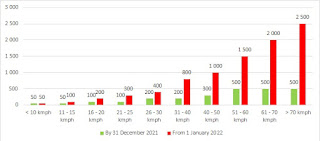
But wallets of motorists might be hit not only by higher taxes and other contributions, but also by fines for violations of the highway code. The penalty rates in Poland had not been revised since late 1990s and were laughably low in comparison to other countries. The fine rates for speeding, the most common offence on Polish roads have been revised upward, as shown on the chart. The lawmakers have turned out to be lenient for minor speeding, yet the higher the deviation of the actual speed from the limit, the more severity of the punishment increases. The point beyond speeding gets painfully expensive is 30 kmph. Besides, there is no flat fine for speeding above 50 kpmh, but fine amounts rise along with the scale of offence (or rather crime, given somebody driving 120 kmph in town where the speed limit is 50 kmph is already a criminal).

The upshot is that on the New Year’s Day Polish roads got similar to what I witness abroad. When venturing beyond the border of Poland I was always careful not to exceed speed limit, so that my holiday budgets were spared costly fines. Poles have been legendarily obedient abroad and careless in their homeland. Today it has changed for the majority of drivers, but I still see reckless idiots, usually in quite new premium-make oversized vehicles who do not give a damn about the higher fines. Nevertheless, the general tendency bears out a financial punishment serves best as a disincentive to commit offences.

Another change mentioned by some experts which should follow is the verification of speed limits on specific roads. I have no idea why the stretch of ul. Puławska along Wyścigi, with merely one intersection and no pedestrians crossing has lower speed limit (50 kmph) than the section between ul. Poleczki and the boundary of the city, where the speed limit is 60 kmph. I hold the view there are thoroughfares in Warsaw where speed limits could be increased by 10 or even 20 kmph, while traffic on minor roads should be calmed, as 50 kmph is far too much for several narrow streets.

Other pricing reshuffles which are taking place in early 2022 are:
- the increase in long-distance train ticket prices,
- the decrease in excise tax for fuel,
which given the effort to reduce carbon dioxide emissions, work the opposite way round than they should.

I have taken the trouble to compare a cost of a business trip taken in 11 days (planned yesterday for 2 February) for a six-hour workshop (which cannot be held online) in another bigger city (I have chosen 4 which have decent train connections to Warsaw – Poznań, Wrocław, Kraków and Gdańsk).

My assumptions:
- my destination is located 1 kilometre from a main train station so that I can walk there,
- start time of the workshop can be adjusted to match the train timetable,
- by car I drive door to door and pay a parking charge of 30 PLN in each city,
- I travel on my own,
- the cost of fuel is based on petrol price of 5.10 PLN per litre (envisaged after the excise tax cut) and the average consumption of petrol is 7.0 litres per 100 kilometres – this gives 0.357 PLN per kilometre,
- since I have no travelcard, I need to buy two 75-minute tickets each to get to W-wa Centralna Station,
- I travel in second class by train,
- on my way to Poznań I pay motorway charges, to Gdańsk I take S7 expressway,
- the cost of car journey increases by the cost of accelerated depreciation and higher upkeep costs on account of higher mileage – 0.10 PLN per kilometre
- journey time by car to each destination is calculated with Google Maps (mid-time for bracket) with 30 minutes added each way,
- I need to set off to the train station 55 minutes before train departure and return home 45 minutes after train arrival

Here come the results (cost and journey duration):

Poznań – still cheaper and faster by train

Wrocław – much cheaper by train, but slightly longer
Kraków – somewhat cheaper and faster by train

Gdańsk – markedly cheaper and faster by train.


I am positively surprised by the outcomes, especially with respect to the journey duration. But note with 2 passengers the journey by car gets cheaper. Is the proportion right?

Sunday, 19 January 2020

Bieguni - book review

Conspiracy theorists claim Nobel prizes are awarded to influence political choices. No matter how much truth those assertions contain, the recent Nobel prize in literature granted to the Polish writer, Olga Tokarczuk, has not been a gift to the ruling party four days ahead of the parliamentary election.

The most prestigious honour a writer can receive has sparked off interest in Mrs Tokarczuk’s books. Shelves in bookshops ran empty, publishing houses rushed to place orders to printing companies, e-queues in libraries got longer. This spurt has of course affected just part of the better educated part of the nation.

Before I set out to it (I had planned to wait out the period of the biggest demand), I received the best known book of the accoladed writer, Bieguni, as one of my birthday gifts.

It was one of 3 books I read during the nine-day-long Christmas break (three days off, nine days away from the office). I had envisaged a tough read, rather slow and requiring concentration to grasp, as Noble prize winners are not hailed as producers of literature for masses. Unexpectedly, the book with its natural flow and lightness was easy to follow, yet involved some mindfulness and ability of reading between the lines. Maybe for such reason minister Glinski could not make it to back cover of any of Mrs Tokarczuk’s books despite trying (not) hard (enough).

The book has no unified plot, yet it is a jumble of several threads (in such respect akin to a blog devoid of posting dates), drifting around a leitmotiv of travel. Characters and sub-plots are sets in different epochs and venues, come from different walks of life, some refer to actual events, some are purely fictional. The only element that brings them together is involvement in some sort of motion. The very title might be somewhat misleading, since the tribe of Bieguni does not appear even once on the pages of the book, yet their belief that motion can ward off evil serves as inspiration for the entire work.

The writer contrasts herself (she travelled as lot and visited places on several continents during her life) with her parents (who holidayed once a year, planned their journeys carefully and found them stressful). I find such contrast in people around. There are ones who cannot stay in one place for a long period, if they tried, they would suffocate (travelling is a sense of their life) and there are others who prefer to stay in one place and just visit occasionally some holiday or business destinations.

I belong the to the latter group. The settled lifestyle I have chosen, being attached to the place I feel is home gives me feelings of comfort and security. I do travel from time to time, my trips are longer or shorter, but all taken not to search for something new, but to visit new places and then return home. I could not live today here, tomorrow there, in a month somewhere else, unlike other people could not live chained to one location.

The reflections upon the book reminded me of an article on people who had not ventured beyond Warsaw for the last two decades, published in Gazeta Wyborcza several years ago, today available free of charge. From a perspective of somebody who travels around Poland several times a year and visited 8 countries over the last 3 years, a fascinating read.

Sunday, 27 October 2019

Short-distance flying

Wrocław is not just my most beloved city in Poland, but also my most frequent destination in business travels. I last ventured there on Monday, 7 October, to a participate in a workshop and I for the first time I travelled there by plane (which was the second domestic flight in my life). The workshop date had been set in August, so I could buy tickets within a limit of airplane travel expenses (a return flight set my employer back around 300 PLN).

The workshop began at 9:30 a.m., while at that time the first Pendolino train arrived at 10:03 at Wrocław Główny station, which in fact meant I would have turned up nearly an hour late (not a desirable option). I could have gone there on Sunday evening, but I had not wished to give up on my private plans to take a business trip on a weekend day. A journey by car is the fastest (door to door) option, yet I was supposed to travel on my own (mileage allowance not being allocated per more passengers) and after taking several (on average one per fortnight) long-distance trips around Poland, I thought I would not get myself tired behind the wheel.

My lame excuse for plane being more environment-friendly than car was that the plane would fly to Wrocław anyway, while my car was sitting in the garage, not emitting carbon dioxide. This assertion is as wrong as the one that one vote does not count in an election. Each individual shapes demand for short-distance flights. If masses of individuals do not choose such connections and opt for trains, airlines would be forced to reduce number of such flights, as with low seat occupancy they would be loss-making.

The morning journey went smoothly. I left home just before 6:00 a.m. (the time when Pendolino to Wrocław which would carry me too late was pulling off from W-wa Centralna), took 504 bus, changed to 148 bus and arrived at the airport at 6:30 a.m.. Touched down in (frosty) Wrocław just before 8:30 a.m., caught the 106 bus to town, arrived to my destination some 10 minutes before the workshop commenced.

The way home got more complicated. The plane which was to take me home broke down on its way from Warsaw, had to return to Warsaw, be fixed and then took off again. As a result, the plane bound to land in Warsaw at 7:20 p.m. touched down an hour and a half later. I returned home an hour later than I would have come back by Pendolino (and had to change means of transport three times: 175 bus, then 189 bus, then M1 underground, then 179 bus).

The delayed return flight has made me realise one-day travellers who were about to end their journey in Warsaw were just a tiny minority (less than 20%) of passengers. Most people flying from Wrocław to Warsaw were about to miss their another flight. As an airline representative told me, it is quite common PLL LOT sells tickets from Wrocław to a city in Europe or outside our continent and as a package offers a connecting flight to Warsaw and then a direct flight to a final destination. Hence the delay of 90 minutes ruined itinenaries of some of passengers.

The problems with trips to Wrocław are the lack of relatively fast train there and lack of connections arriving to Wrocław around the beginning of a business day (i.e. between 8:00 a.m. and 9:00 a.m.). Look at what PKP Intercity offers to passengers willing to travel for one day to a major city from Warsaw (timetable from 20 October 2019 to 14 December 2019).

Service to Wrocław: 6:00 – 9:54 (nearly four hours, late arrival)
Services to Kraków: 5:55 – 8:22 or 7:00 – 9:17 (less than two hours thirty minutes and reasonably early arrival)
Service to Poznań: 5:36 – 8:26 (less than three hours and early arrival), but then no reasonable service until 9:30 – 12:25)
Services to Katowice: 5:25 – 8:11 or 6:45 – 9:13 (the second service within less than two hours thirty minutes, reasonably early arrival)
Service to Gdańsk: 6:25 – 9:16 (less than three hours, reasonable arrival).

Am I the only one who sees morning connection to Wrocław is the worst of the five above?

Train connections to Tricity, Silesia, Kraków or now Poznań can boast of station-to-station journey duration comparable or faster than door-to-door journey by car. Because there is no straight-line railway to Wrocław, the fastest door-to-door journey by train takes around five and a half hours. Compare this to door-to-door journey to my company’s head office in Wrocław which by car takes three and a half hours if you drive at reasonable speed (around speed limits or a little (no more than 10 kmph) faster) and add lack of reasonable and fast connections (PKP Intercity, do catch up!) and you will find out why only those who do not have driving licences, are afraid of long journeys behind the wheel or refuse to use their private vehicles for business purposes even in exchange for mileage allowance, travel between Warsaw and Wrocław by train (unless they can book a flight in advance).

I have promised myself not to take any airborne trip to Wrocław, yet for abovementioned reasons, I cannot pledge to take the train. The argument that despite longer journey I could work in a train is flawed, since quality of Internet connection (muffled LTE coverage) since on most incidences leaves a lot to be desired (though I have record of positive surprises in this respect). I hope one day Wrocław will have as good train connection to Warsaw as Gdańsk (same distance, journey shorter by an hour), however this would probably necessitate construction of new tracks (maybe between Łódź and Wrocław).

Sunday, 13 January 2019

Still room for improvement

I have decided to put back publishing update on the remont front, until even bigger progress across the entire dwelling is witnessed, which I expect to come about by 27 January. Today I could only post the snaps of tiles laid in the bathroom and in the toilet. A noticeable progress, yet insufficient to assert the flat has taken its final shape.

On Wednesday I (unexpectedly) had a one-day foray in business to Kraków. After nearly a decade of working I am no longer fond of business travels, which in over 90% are a one-day tiresome trips with no time for sightseeing or enjoying the places I visit for more than one minute (this year I was lucky enough once, in Wrocław).

I got to Kraks by most convenient possible means of transport, i.e. by train. By timetable, the service between Warszawa and Kraków covers the 298-kilometre route in less than two hours and thirty minutes (beating the plane connection given boarding time and distance from the airport to the city centre), plus the station in Kraków was in the vicinity to my destination.

On my way to Kraks I sat back in a regular EIC train, with a notebook on my laps, to catch up with several minor overdue tasks. After less than an hour of the journey the carriage attendant came over to serve beverages. I asked for a coffee… Fortunately, they do not serve ready coffee or tea, but give out ingredients to passengers so that they brew it on their own. I found that peculiarity a nuisance, but on Wednesday PKP Intercity’s serving policy saved me. As the attendant was trying to hand me a mug with hot (fortunately not scalding) water, the train lurched and he spilled the water on my trousers (around my knees, not the crotch!) and the laptop. He callously uttered a simple “przepraszam” and carried on serving beverages. I was too focused on analysing how big the stain was and whether it would disappear by the time I meet the client and whether my notebook was anyhow damaged to react properly. Accidents will happen and I do not blame the attendant for harming me, such things happen, but I kick myself for not rebuking him over his disregard. My carriage was occupied in less than 50% and I doubt any of the fellow passengers noticed the incident and could react anyhow. Luckily, the water spot has left no trace on my suit trousers, nor is my company notebook damaged, but the bad taste remains…

On my way back I took a pendolino train, I lucked upon the only one in which wi-fi tests are carried out. And here, an endless gripe towards PKP Intercity for buying the overpriced no-frill trains from a foreign manufacturer (I believe Newag could have built the “premium” trains in a consortium with a more experienced partner). Why the hell they have bought tins in which mobile network signal is muffled so that normal phone conversations are disrupted and internet connection is at times too slow to use Messenger! Premium, fast trains connecting major cities in Poland should seemingly be targeted at corporate workers, some of whom like me: firstly, cannot use unprotected wi-fi networks, because firewalls or whatever other shits installed thereon protect them from doing so, secondly, have all resources to work on kept away from the hard drive so in offline mode their laptops are useless. Consequently I wasted over two hours and forty minutes in the train, as I could not work on my way to Warsaw!

Besides, the train came to Warsaw with a delay of fifteen minutes. Not a major fault, yet I bothered to keep checking punctuality of my service at Infopasażer (page was loading or refreshing for more than minute each time) and according it, my train was arriving to W-wa Centralna according to a timetable. Propaganda of success? Nobody’s perfect, but why misinforming?

Next time I will also take train if I go to Kraks, but I can’t wait to see trains as the primary vehicle of choice when travelling to all major cities in Poland. Currently Gdansk, Katowice (and the entire Górny Śląsk) are the only destinations where trains are preferable. To Szczecin and Rzeszów flights are a must, while everywhere else (predominantly to Poznań and Wrocław) I get by car, since in door-to-door travel duration, it still keeps being the fastest, though not the safest and not the most ecological…

Sunday, 10 June 2018

Eurotrip 2018 - part II

As I was looking for accommo-dation in Portoroz, to ensure the lodgings would be located near a beach. Quite easily I found one some one kilometre from the sea shore. Sadly (or not), I forgot to check the terrain shape. As it turned out, the Slovenian coast is featured with the highest cliffs by Adriatic sea and each walk to the beach or to the city centre involved a steep descent and then a steep ascent back. According to my estimations, the higher parts of Portoroz and nearby towns are close to 100 metres above sea level. The first climb was a nasty experience, however with each consecutive day we grew more and more seasoned and fitter!

Visiting the Adriatic seaside in the third decade of May has most advantages of low season. Though on Saturday and Sunday some locals and probably some visitors from central parts of Slovenia, popped over for a weekend rest, droves of sun-thirsty tourist were unseen. On Thursday the beach looked like that. The snap is somewhat misleading since we were not the only holidaymakers around. There were less than plenty but more than few tourists from Germany (judging by licence plates of cars, not only language audible) and Russia.

After a day of sunbathing and swimming in the sea (water temperature around 20C, similar to what one can enjoy in Polish lakes in July or August, so bearable, not yet comfortably warm) we marched towards Piran, the historic Italian town which in the wake of political decisions was adjoined to bygone Yugoslavia in 1954. The architecture reminds of Italian roots of this place. The town has its climate, especially near sunset (a pity we did not take an evening trip there), but when the heat reaches +30C sightseeing conditions are not at their best, yet we were in Mediterranean climate, it should not have been chilly actually. 

Each evening we took a bottle of local wine (less than 2 EUR per litre, an excellent beverage for my not refined taste) and sauntered to a promontory to observe the sun going down into the sea. Unfortunately, each day the western sky was kind of cloudy and clouds lingered above the horizon, so we missed the breathtaking sight, being out of luck just as in January we missed out on Northern Lights, but a week after we few back a massive aurora explosion was witnessed in Tromso. Yet sipping wine and staring at the smooth sea was a sheer bliss anyway.

Monday, 28 May 2018
After spending four full days in Portoroz, we headed back towards Poland. The first stop, recommended by a friend who had also travelled to Slovenia by car in 2016, was Bled lake, one of two picturesque lakes (the other is Bohinj) in the central, hilly part of the country. Out stopover there lasted just an hour, enough to catch the climate of the place and grow fond of it, yearning to come back for more one day.

On the same day we turned up to Maribor. The accommo-dation there, a three-star, just refurbished apartment one mile from the very city center set us back mere 42 EUR (cheapie!). Maribor is the second biggest city in Slovenia, yet it smacks of a bigger town and I must say one afternoon is absolutely sufficient to get about it. We roamed around town, but climbed up a hill called "pyramid" (due to its shape), from which we could lap up another city view from above. We pitched up atop more than one hour before sunset (not the most magical time of the day), yet gazing at such landscape compensates the strain ascent involves.

Tuesday, 29 May 2018
The last stop (actually the penultimate one, before spending two days in Bielsko-Biała again) was the capital of Slovakia, which was the let-down of the trip. My memories are negatively skewed as all cards were stacked against us. As we were driving in, a massive downpour hit the city, then it cleared up, but air humidity was far higher and temperature hit +30C - not a conducive temperature for sightseeing. Our hotel (Hotel Turist) turned out to not to have undergone a renovation since the split of Czechoslovakia (in Poland one would struggle hard to find hotels where time stopped before the collapse of communism), odour of cigarettes was in the air, breakfast was worse than indecent. Fortunately we just stayed one night there (but escaped on Wednesday before 8 a.m.) and the location was two miles from old town. I did not even bother to take out a camera too many times. Had I taken pictures of Bratislavia and stripped them off advertisements and modern cars, the photos would have been easily eligible for Michael's old-school photo challenge. Truth be told, I recommend visiting Bratislava to nobody.

Sunday, 3 June 2018

Eurotrip 2018 - part I

Decided to split the blog coverage of the recent holidays into two posts (expect the second chunk and snaps of the story next Sunday).

I had hatched the idea of taking longer trip by car several years ago, yet this year I managed to put it into practice. Within 12 day we covered 2,583 kilometres through four countries, visited three capitals, did not fall into troubles…

Day 1, Sunday, 20 May 2018

We set off to Bielsko-Biała where my girlfriend’s parents live. A visit there was our first stop on the way south. The drive would have been a smooth one, had it not been for being stopped by the police for speeding (ignored the 70 kmph limit somewhere between Częstochowa and Katowice and carried on with 100 kmph on cruise control) – upshot: scored 4 penalty points and the first fine in my driving career, 100 PLN down the drain, paid with credit card on the spot (traffic patrol officers had had payment terminals since February 2018). Nevertheless, I have to boast about economical driving – fuel consumption over the whole trip – mere 6.11 litres per 100 kilometres (I drove 100 – 110 kmph most of the time). Had it not been for air-con on, my Megane would have consumed less than 6 litres.

Day 2, Monday, 21 May 2018

We headed for Vienna early in the morning and pitched up to our hotel, Ibis Budget Sankt Marx, just after 1 p.m. A long afternoon is far too little to do the decent sightseeing in Austria’s capital, therefore one day I will definitely have to return there. My greetings to Bob, who has virtually kept me company and advised where to go!

Hundertwas-serhaus was the first stop of our Vienna-wide journey. The concept’s originator claimed he had designed it not to let anybody build anything uglier in such place. Actually I find the idea quaint, but rather as a tourist attraction, not as a place I would like to reside in (those who know me know I am fond of order, not chaos).

From the housing district we headed for Schoenbrunn palace. Our underground ride was impeded by railway modernisation, forcing us to take part of the route by bus. We roamed around the scene, dropped in on ticket office to learn our museum entrance time would come in an hour. We spent that time strolling around huge gardens behind the palace (this was the first hill to climb during the holidays).

After eating out a hearty dinner (was not a lunchtime anymore) we made our way towards Prater, the famous amusement park. We could not do without buying tickets for the Riesenrad wheel, from top position of which tourists can enjoy sights of Vienna’s panorama. We timed our visit there to roughly match with the sunset, yet found ourselves at the top more than half an hour before sun went down. Nevertheless, the views were memorable (even in camera’s eye).

As it was getting dark and we were already tired out, we took a short walk around the centre of Vienna, here we sauntered past Graben, but also saw from outside St. Stephen’s cathedral. Anyway, we could have done with at least a day of intensive sightseeing in Austria’s capital.

Day 3, Tuesday, 22 May 2018.

After a decent breakfast in the hotel, we set off to Ljubljana, Slovenia’s capital. That city is far less remarkable than Vienna, with less than 300,000 inhabitants, is the biggest city in Slovenia anyway. Our lodgings was mere 3 kilometres from the city centre and was surrounded by terraced houses whose dwellers grew vegetables in their gardens. The city was small enough for us to get about it on foot only (buying bus tickets is quite complicated). Here, the snap from our stroll – castle hill seen in a distance.

There was no excuse not to scramble up the steep castle hill from which a beautiful panorama of Slovenia’s capital splays out. The weather was conducive and actually this was the only day of our trip when temperature in the afternoon oscillated near pleasant +20C.

Day 4, Wednesday, 23 May 2018.

Early in the morning we spontaneously decided to take a stopover in our 130-kilometres trip to our destination, to see Postojna caves. The attraction is absolutely breath-taking and tough quite expensive (spent over 70 EUR for tickets, audio-guide and parking), worth visiting. Snaps taken with a camera without a tripod and proper light enhancement do not render beauty of the place. If you happen do visit Slovenia, Postojna cave is a must.

To be continued :)

Sunday, 1 October 2017

Malta


Never ever, have I made my way to a travel agency to have my holidays organised by a bunch of experts in trips abroad. I do not avow to never resort to enjoy the convenience of having someone else arranging flights, transport, accommodation and local sightseeing for me, but until time permits and vision of company of Janusze and Grażyny (let alone their children Karyny and Seby) puts me off, collective voyages, chartered flights and hotels with all-inclusive services are not the preferable way of holidaying.

The recent holidays in Malta were also self-organised. Finding flights via Wizzair and a room at Airbnb did not take more than two hours, while the latter resulted in savings on accommodation of some 50% compared to cheapest decent hotels found at booking.com. The rest you need to find out before leaving abroad is how to get about (local public transport and fares) and what sights are worth visiting. For a person who knows English and is not afraid of fending for themselves in a foreign country, a piece of cake.

The very Malta (and the other island, Gozo) in terms of area are of the size of Warsaw, yet a week-long stay proved too short to visit all places worth a tourist’s attention. The reason is not necessarily the high number of attractions squeezed into small area, but the travel times between them. Unless you hire a car (which apart from high costs has one tremendous drawback for me, which is steering wheel to the right and left-hand traffic), you need to fall back on public transport, namely buses. Firstly, they do not run frequently, which extend journey times, secondly their routes are winding, which means a distance of five kilometres as the crow flies is taken with a 10-kilometre-long route, which is covered within 40 minutes. Add up waiting times and bus changes and you will get the average speed of moving of 10 kilometres per hour or less.

We rented a room in Marsaskala, a city on the south-east edge of the island, less than half a mile away from a beach. Maltese beaches are hardly ever sandy (those can be found on northern and western shores), the one snapped is rocky. Besides, many beaches are out of reach since in order to get there, you would have to fall off a cliff (or fly off it, or swim, or take a boat).

Marsaskala, as most Maltese coast-side cities, has a marina with tens of yachts moored on it. In the background, architecture typical for the island, Arabic rather than European. Buildings are plain, made of yellow bricks, never insulated (what for?), but oddly enough air-conditioning is not prevalent.

The capital of Matla, Valetta, is just a small part of the bigger agglomeration and has less than 10,000 inhabitants. The city is picturesque and gives off unique climate. To the right, the main pedestrian precinct of the city, surprisingly not chock full of vacationers.

One of more marvellous sights of Malta is Blue Grotto located on the southern shore of the island. The combination of cliffs, caverns and sea is one of more breath-taking things you can see. The very place is far away from civilisation and you need to walk down a steep descent to reach a port where you can board to boat which takes you to the caverns.

Within a walking (arguable, whether an optimum way to get there in early-afternoon heat) distance from the Blue Grotto lie the restored ruins of megalithic temples which trace back to 3000 BC. The rebuilt remnants of temples are sheltered from elements of weather by giant tents, which also give shelter from heat.

To the right, on our way to St. Peter’s Pool, lying some three miles from our dwelling. The beach is overhyped (droves of people, swimming hampered by waves, long descent), yet the path from Marsaskala runs mostly along cliffs. Typically, there is no fence nor any other form of protection from falling off. On your way, just stop over and lap up the view!

During the week of our stay, there was just one day when it rained, and just until midday. Here, the snap taken from the viewing terrace in the fortress of Mdina, the former capital of Malta. Currently the city has around 200 inhabitants and the area of less than 1 square kilometre. The suburb of Mdina, Rabat, is some 10 times larger and if you venture there, do visit legendary catacombs.

Few know Maltese islands are an archipelago consists of several islands, of which the second biggest is Gozo, reachable by ferry. Because of the lousy public transport, it takes three hours to get there from the other end of Malta. The other island seems to be a bit more civilised, yet lacks significant sights or places of interest.

On top, a few curiosities for those weighing up whether to visit Malta.

1. English is the second official language, hence language barrier in day-to-day communication does not exist, but do not expect fluency in English from locals (they cherish their independence from the UK).

2. Litter is scattered all around. Sights like this one are sadly commonplace in Malta (once again I appreciate such rubbish dumps are getting less frequent in Poland). You can hear of rats running across streets (I have not seen any), and I had to kill three cockroaches (dwellers of sewage pipes) which hung about in the shower booth.

3. The island is not plagued by tourists, yet the large percentage of visitors are Poles (at some moment, while running across Poles on nearly every step, we got afflicted to allergy to our compatriots).

4. Nightlife is witnessed only in a few holiday resorts. Except for this, when it gets dark (in the second half of September after 7 p.m.) the island almost comes to a standstill.

5. Prices in restaurants and entry tickets to tourist attractions are on moderate level, comparable to Western Europe, but prices of ordinary food produces in shops (no difference in pricing between cornershops and discounters) are far higher than in Western Europe – this probably reflects the cost of transporting all goods to the island and definitely do not correspond with average yearly net-of-tax salary of around EUR 17,000 per year.

6. You will struggle to find traditional Maltese food (they have their own beverage, Kinnie and some local wines), so in most restaurants you would find typical Italian meals (pastas, pizzas, etc.)

Besides, next holiday due in 2018. Time to immerse in the corpo-world for the last quarter of the year.