Sunday, 28 August 2011

Story of my life*

Lit upon this just a moment ago, reluctant to rant over Bernanke's dithering, Poland under construction (maybe next week), independent members of monetary polic council backing a specific party or an insolent lout who said members parliament who hail from the countryside had gone bananas...

Random memories, teenage years, put into sublime words

11 September 2001
It's early fall
There's a cloud on the New York skyline
Innocence dragged across a yellow line

21 May 2011
True love can never be rent
But only true love can keep beauty innocent

20 September 2002
I took the money
I spiked your drink
You miss too much these days if you stop to think
You lead me on with those innocent eyes
You know I love the element of surprise

11 October 2002
Did I ask too much, more than a lot?
You gave me nothing, now it's all I got

12 October 2002
Three o'clock in the morning
It's quiet and there's no one around
Just the bang and the clatter
As an angel runs to ground
Just the bang and the clatter
As an angel hits the ground

5 November 2002
You say when he hits you, you don't mind
Because when he hurts you, you feel alive
Is that what it is?
Red lights, grey morning
You stumble out of a hole in the ground
A vampire or a victim
It depends on who's around

23 January 2003
Carnival
The wheels fly and the colors spin
Through alcohol
Red wine that punctures the skin
Face to face
In a dry and waterless place

14 February 2003
And if you listen I can't call
And if you jump, you just might fall
And if you shout I'll only hear you

14 April 2003
So sad to beseige your love so head on
Stay this time
Stay tonight in a lie
I'm only asking but I...
I think you know

28 June 2003
She runs through the streets
With her eyes painted red
Under black belly of cloud in the rain
In through a doorway she brings me
White gold and pearls stolen from the sea
She is raging
She is raging
And the storm blows up in her eyes
She will...

Suffer the needle chill
She's running to stand...

27 March 2004
You know he got the cure
You know he went astray
He used to stay awake
To drive the dreams he had away
He wanted to believe
In the hands of love

2 April 2004
I'm a man
I'm not a child
A man who sees
The shadow behidn your eyes

5 April 2004
You say love is a temple, love a higher law
Love is a temple, love the higher law
You ask me to enter, but then you make me crawl
And I can't be holding on to what you got, when all you got is hurt

29 June 2004
I want you to know
That you don't need me anymore
I want you to know
You don't need anyone
Or anything at all

28 September 2004
And we live by the side of the road
On the side of a hill
As the valley explode
Dislocated, suffocated
The land grows weary of its own

26 November 2004
And you feel like no-one before
You steal right under my door
And I kneel 'cause I want you some more
I want the lot of what you got
And I want nothing that you're not

18 March 2005
You were pretty as a picture
It was all there to see
Then your face caught up with your psychology
With a mouth full of teeth
You ate all your friends
And you broke every heart thinking every heart mends

You speak of signs and wonders
But I need something other
I would believe if I was able
But I'm waiting on the crumbs from your table

31 May 2005
Listen to me now
I need to let you know
You don't have to go it alone

And it's you when I look in the mirror
And it's you when I don't pick up the phone
Sometimes you can't make it on your own

11 September 2005
Oh, oh, oh...on borderland we run...
And still we run
We run and don't look back
I'll be there
I'll be there
Tonight
Tonight

14 October 2005
The glass is cut
The bottle run dry
Our love runs cold
In the caverns of the night
We're wounded by fear
Injured in doubt
I can lose myself

11 December 2005
Time? time...
Won't leave me as I am
But time won't take the boy out of this man

8 April 2006
No, nothing makes sense
Nothing seems to fit
I know you'd hit out
If you only knew who to hit

14 July 2006
You had to win
You couldn't just pass
The smartest ass
At the top of the class

27 July 2006
Desert sky
Dream beneath a desert sky
The rivers run but soon run dry
We need new dreams tonight

1 January 2007
If I could throw this
Lifeless lifeline to the wind
Leave this heart of clay
See you walk, walk away
Into the night
And through the rain
Into the half-light
And through the flame

If I could through myself
Set your spirit free
I'd lead your heart away
See you break, break away
Into the light
And to the day

To let it go
And so to fade away
To let it go
And so fade away

21 December 2007
Blinded you lost your way
Through the side streets and the alleyway
Like a star exploding in the night
Falling to the city in broad daylight

24 January 2008
It's no secret that a conscience can sometimes be a pest
It's no secret ambition bites the nails of success

7 August 2008
When I first met you girl
You had fire in your soul
What happened to you face of melting now?

25 September 2008
You're in my mind all of the time
I know that's not enough
if the sky can crack
there must be some way back
to love and only love

23 October 2008
One step closer to knowing

24 December 2008
See His mother dealing in a doorway see Father Christmas with a begging bowl
Jesus sister's eyes are a blister ... The High Street never looked so low

3 March 2009
Now this dry ground it bears no fruit at all
Only poppies laugh under the crescent moon
The road refuses strangers
The land the seeds we sow
Where might we find the land as white as snow

1 April 2009
It's not a hill, it's a mountain
As you start out the climb

24 July 2009
At the moment of surrender
I'm falling to my knees
I did not notice the passers-by
And they did not notice me

14 July 2009
You had to win
You couldn't just pass
The smartest ass
At the top of the class

24 Septmeber 2009
I must be an acrobat
To talk like this

10 April 2010
In the wind we hear their laughter
In the rain we see their tears
Hear their heartbeat
We hear their heartbeat

19 May 2010
You can dream
So dream out loud
You know that your time is coming 'round
So don't let the bastards grind you down

31 May 2010
He went deeper into black
Deeper into white
Could see the stars shining
Like nails in the night

22 August 2010
In my dream I was drowning my sorrows
But my sorrows, they learned to swim
Surrounding me, going down on me
Spilling over the brim

4 November 2010
Haven't seen you in quite a while
I was down the hold just passing time
Last time we met was a low-lit room

20 November 2010
Jesus can you take the time
To throw a drowning man a line?

19 March 2011
And it’s already gone too far
You said that if you go in hard
You won’t get hurt

30 June 2011
You had to win
You couldn't just pass
The smartest ass
At the top of the class

25 August 2011
If I could, you know I would
If I could, I would
Let it go...
This desparation
Dislocation
Separation
Condemnation
Revelation
In temptation
Isolation
Desolation
Let it go

* Compiled solely from U2 lyrics

Sunday, 21 August 2011

Recharging batteries

Probably almost everyone, counting out Scatts, has already got bored with the topic of shaky stock markets, so this undeniably exciting issue will recede into background for a while and I'll focus on more down-to-earth stuff. I've had a busy weekend, the coming ones don't appear to give respite (longing for real restful holidays), but over the long mid-August weekend I had some time to recharge batteries...

On Sunday I brought my parents on taking a trip to Konstancin. The foray was quite short, the weather was perfect (sun, not to hot, not really cool) and batteries in my camera had long been waiting for charging up - took just a few snaps. To the right - view from a path running from rebuilt bridge over river Jeziorka towards the park. Water meadows are flooded, mosquitos assault, but the place enchants.

To the right - got into the park. The signage (probably - my guess) shows distances to twin cities to Konstancin. A few second after taking this photo I had to rush quickly from the pavement, as reversing bus on military number plates was attempting to crunch me. Shouldn't such parks have status of pedestrian precincts, with bans on entry for engine-propelled vehicles?

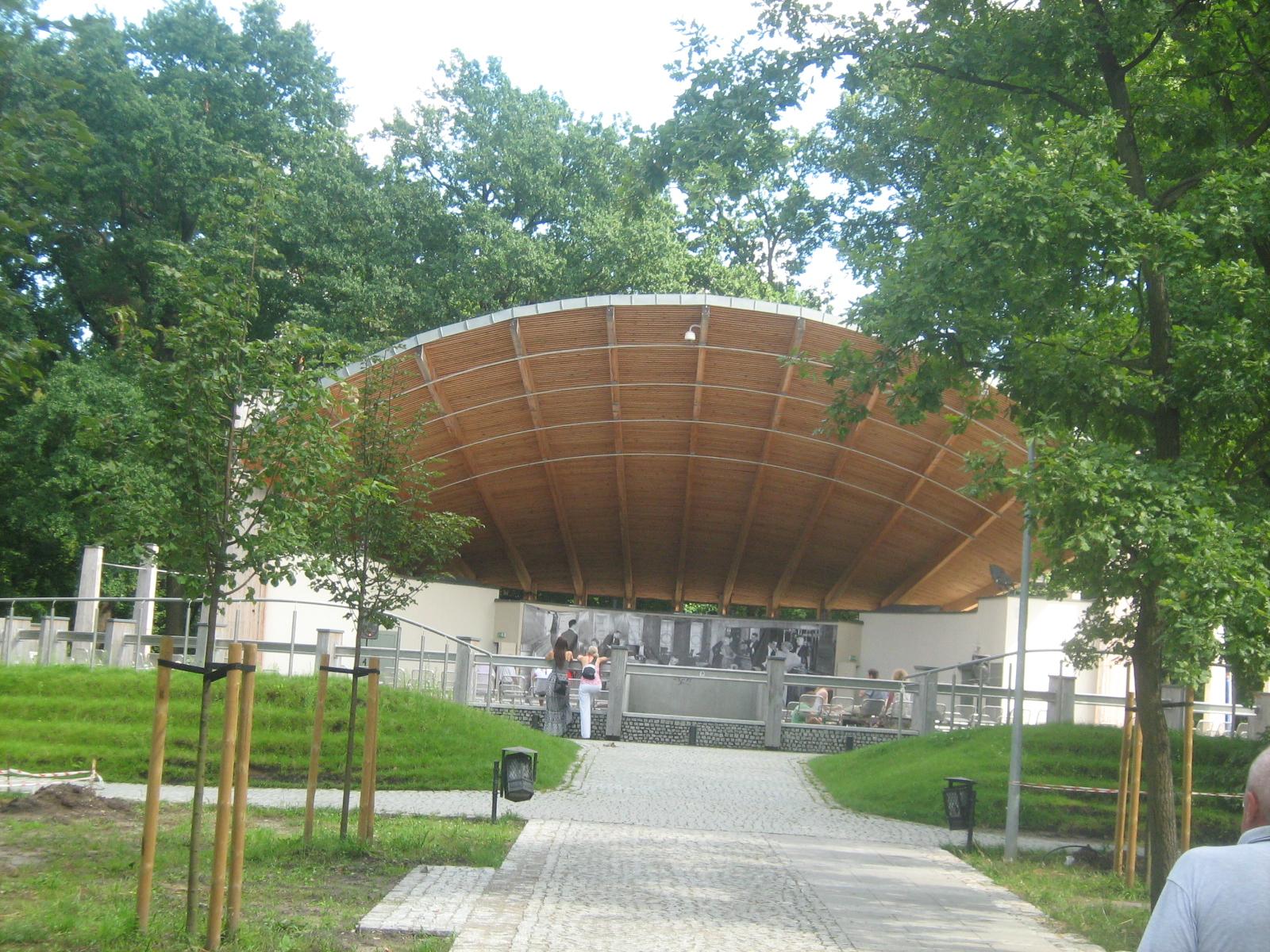
To the right - the main cultural attraction of the park in Konstancin - a bandstand, with some musicians getting ready for a performance. The stage, built recently shows some glitches in terms of technique of construction, but all in all this place should be here to offer entertainment to local residents and tourists. It has to be said it has a long tradition. My father would come here for dancing in his late teens, my paternal grandparents met here two years after WWII. May it look splendid...

On Monday morning I ventured for a bike trip around nearby villages. The weather stays perfect - +17C and sun. Warm, yet cool enough to wear a T-shirt without running a risk of breaking sweat. Bracing breeze is taking edge off heat and so off I go. To the right - empty street in Piaseczno - one can cycle safely when the traffic is so sparse - one of main advantages of riding a bike in the morning on Sundays or bank holidays.

To the right - first photo taken without stopping. Due to technical limitations of my bike and physical limitations of my legs I don't risk being fined for speeding. This is ul. Orężna in Piaseczno. One of favourite destination of walks with my mother and maternal grandfather in my childhood. Memories brought back; the place hasn't changed much since then, but unlike in 1990s this is not a dreamt-up place to live.

Why wouldn't I like to settle down here? Come to think of it. Rural landscapes, silence, no fumes, no noises, no... infrastructure. It's actually hard to get by here if you don't have a car at your disposal. Local buses run here a few times a day, you can catch one in morning rush hour, but if you happen to oversleep and come late, you're in the doghouse. The last one arrives here at 20:20 - much too early. Think of coming late from a party - you have three options: 1) don't drink and come by car on your own, 2) ask someone from your family to pick you up, 3) take a taxi. Each option has a drawback: 1) you can't draw pleasure from blissful state of intoxication, soberity is not conducive to socialising, 2) you are dependent on someone, 3) you fork out over 100 PLN for a ride from Warsaw (Metro Wilanowska)...

This time I fail to make a sharp photo without stopping a bike. This colourful building is a typical landmark of Polish rural landscape. Feels like I'm some 300 kilometres away from Warsaw, while in fact I'm less than 5 kilometres, as teh crow flies, from the city limits. As you can see, the owner did not bother to turn up and open the facility on bank holiday (according to Polish labour code, only shopowners can stand behind the counters on bank holidays).

I cycle further west to discover I don't know where I am. The signboard to the left says I'm cycling to Jazgarzewszczyzna (what a long name!), the one to the right opts for Łoziska. The truth probably lies in between, so the road must mark boundary between the two villages. As I'm snapping the signboards, symbols of Polish mistrust bark at me loudly. Suddenly one of them finds an open gate and makes me put away the camera to my pocket and test how quick I can pedal...

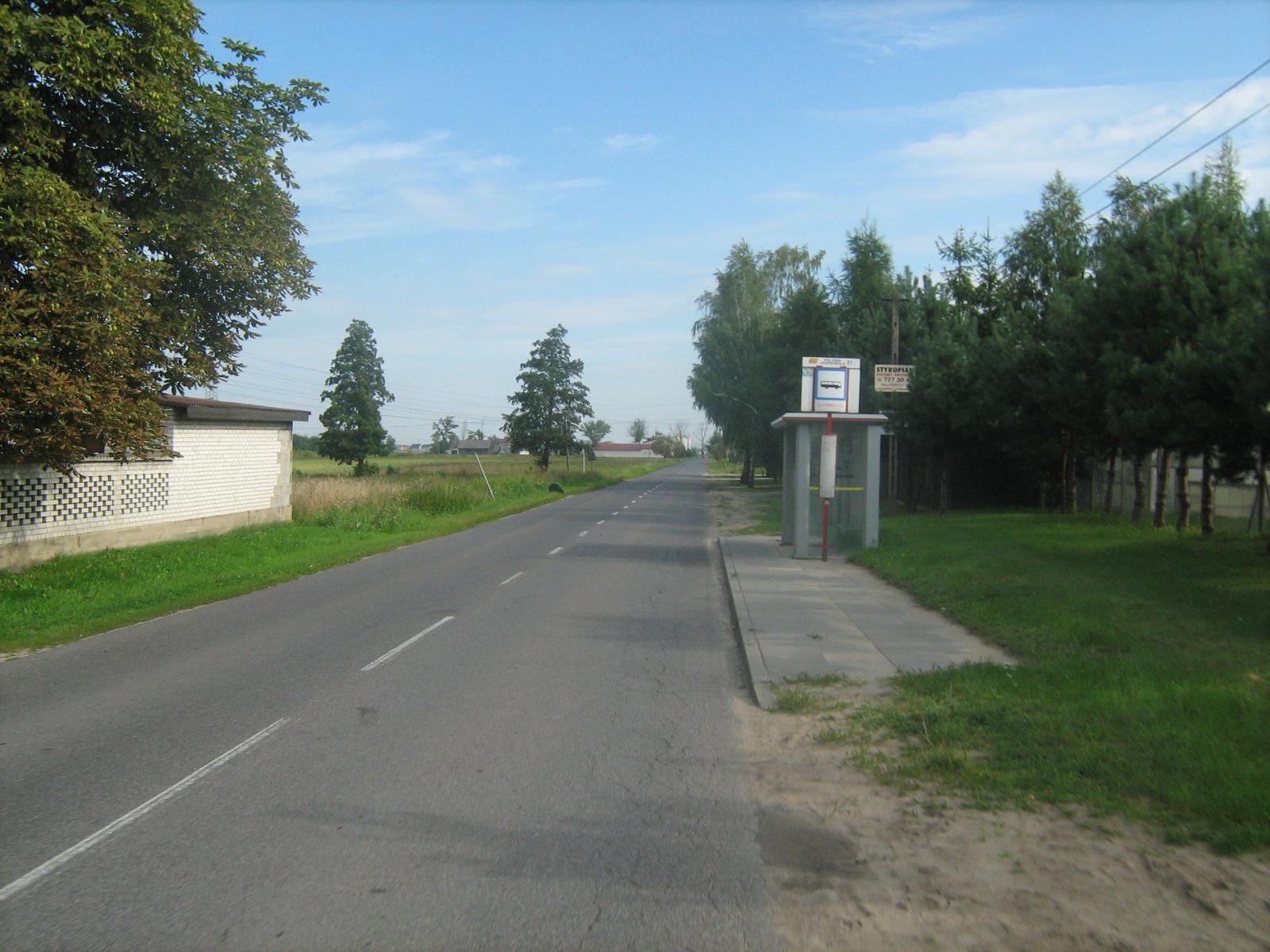
Having turned right in Bobrowiec I find myself on ul. Postępu running straight towards Warsaw, where its extension is ul. Karczunkowska. Bus stop with ZTM signage reminds me I'm still in the vicinity of Warsaw. This doesn't yet mean commuting from here is easy. Buses run just a few times a day, so if you miss one, you may have a problem. The traffic is still sparse. What a lovely day!

Crossed the intersection with road linking Piaseczno and Magdalenka and I'm heading north. I stop on the roadside to snap a beatiful field overgrown by weeds. In the distance - detached and semi-detached houses in Lesznowola. In six years S7 expressway running from Warsaw to Kraków should be here. According to plan this is also a site where a junction with local 721 road is about to be built. But these are years to come, before it happens. After Euro 2012 spurt, pace of construction is very likely to grind to a halt.

Some 500 metres up the road I again stop by to take a shot of a partly pulled down house. When I last was there in early June there was one more room on the first floor. Who used to live here? Why was it torn down in such weird way? Who administers it?

Turned right in Nowa Wola and I'm on my way towards Nowa Iwiczna. Reckless drivers tend to speed at empty ul. Krasickiego Nowa Wola, so I choose to cycle on empty pavement, built in 2008 after two tragic accident in which three pedestrians had been killed at the scene. And a classic snap - Warsaw skyline as seen from beyond the southern border of Warsaw. Skyscrapers are shrouded in a haze, as the air is wet, as it's been for a few weeks on. With dry air, the visibility would a whole lot better. Compact camera set at the highest possible resolution, maximum (4x) optical zoom in use - device is a bit too close to the low-end to rise to the occasion.

And at the very and - a photo from the archives. I wanted to put it up on Polandian, but fellow writers remonstrated me over chasing cheap sensation. Another shot of Warsaw skyline, taken on 8 August 2010 around 8:35 in the morning, from the corner of ul. Karczunkowska and ul. Raszyńska, I don't know if it is still Warsaw, Zamienie or Zgorzała. Click to enlarge, look carefully... Can you see anything strange?

Sunday, 14 August 2011

When markets go haywire

August 2011 for many will go down in history as a period of increased volatility on the markets. Stock markets all over the world, Swiss franc and gold swung up and down, markets began to resemble a rollercoaster. This is probably one of more apposite metaphors rendering goings-on on the markets over last two weeks, but if you opt for a blunt comparison, get on to New York Post cover which drew a parallel between stock price quotations and a prostitute’s pants. I thought Polish tabloid Fakt beats anything else in terms of stupidity, but again I was wrong.

Looking back on the last weeks, the recent turmoil should not haven taken us aback. In June I even had a clear inkling of an upcoming tumble, as in the light of macroeconomic situation and recurring patterns markets tend to follow, what happened was absolutely predictable.

The bull market of 2009 – 2011. Hmm, am I not going too far by claiming the bull market is over? Well, technically it is, as stock indices have fallen by more than 20% from their peaks. OK, let’s start over. The last bull market began in February 2009 when economies were in the doldrums and stocks were down some 60% - 70% down from their peaks noted in 2007. Stimulus programmes aimed at reviving economies, cheap money injected into financial markets and scale of preceding bear market conjured up an abrupt bull market that lasted until August 2009. Within six months stocks soared by some 60% - 70%, then ensued the second wave of bull market, of moderate growth of price, intermingling with periods of downbeat expectations, such as those in early February 2010 or in late spring 2010 when Greece was about to go bust for the first time. With time, and as markets were flooded by cheap money printed by the FED, speculators got immune to bad news. Markets slowly rose to reach peaks in late April 2011. WIG20, the index of Warsaw Stock Exchange covering 20 blue chips (which will later be a benchmark for me) rose between 17 February 2009 to 28 April 2011 by 123% and peaked at 2,942 points. The invisible barrier of 3,000 points was close at hand, yet out of reach, just as 4,000 in October 2007 when WIG20 hit its ever-time high of 3,941 points. Then markets behaved typically (this means there was no speculative bubble) for a cyclical downturn. Peak was reached with difficulties, then stocks retreated and a slow descent ensued. The phase of descent which usually lasts between two and three months, here lasted slightly longer, but the scale of consequent sell-off made up for the long wait. In a typical scenario after the sell-off there’s a correction upwards and then begins the longest phase of bear market, when price gradually decline and more and more people lose their hope and sell stocks with losses, until the cycle reaches its trough, i.e. the moment when it just can’t be any worse.

I did expect it. I knew debt ceiling dispute in the United States could be a spark to set the flame on the markets and even began selling stocks and putting money on bank deposits. But as the fateful 2 August was drawing nearer and markets did not discount the technical-default scenario I assumed nothing bad would happen and stocks would even shoot up when the debt ceiling deal would be struck. Indeed, by means of give and take Democrats and Republican agreed to increase the debt ceiling and bring down government expenses, but this happened at hour eleven and did not put markets at ease.

I knew sooner or later things would look really dreadfully but put back the decision to sell all stocks, but after all, as Scatts said, I learnt a valuable lesson. On 2 August 2011, in the eve of the crash around 30% of my portfolio was in stocks, share with the biggest weighting was JSW, bought in IPO in early July and sold in only 20% (with profit).

Now let’s look at the timeline of the turmoil.


2 August 2011 – WIG20 drops by over 1%, although debt ceiling is poised to be raised and problem of the US default is postponed by two years.

3 August 2011 – WIG 20 drops by 3.26% and breaks the resistance at 2,600 points which was said to open the door for a bigger correction. It seems markets should get over the news on US debt deal. I don’t buy, nor sell.

4 August 2011 – during the trading session WIG20 floats below 3 August close, only after US market open it begins to decline. At the end of the day it plummets by 3.55%. I’m livid, this was bound to happen and I didn’t get rid of all stocks, to make it worse, some of my buy orders were executed and boosted my stock holdings.

5 August 2011 – I bet on that day the market should bounce back. It does for a moment when US non-farm payroll data are announced. Some of my take-profit orders are executed, I sell more or less the same securities as bought the day before. I’m calm, panic has reached its climax, now it’ll only get better. WIG20 down by mere 1.63%.

6 August 2011 – not a trading day, but I wake up to hear the news US sovereign rating was downgraded. A tsunami on the markets is in the offing…

8 August 2011 – I decide to make two bets – either market has discounted and nothing happens, or the S&P report on the downgrade will bring about the second, bigger wave of panic. To my surprise both scenarios materialised. In the morning stocks were up and I sold some and in the afternoon when market participants in the US set out to sell stocks, I bought the same stocks back at lower prices and inadvertently became a day-trader. When markets opened I sold all crappy stocks, incurring losses, to garner more money to buy shares in solid companies. WIG20 tumbled by 2.34%. Stock indices in the US fall by over 4% (DJIA) or devilish 6.66% (S&P 500).

9 August 2011 – I say to myself nothing lasts forever and again place buy and sell orders, waiting for any of possible scenarios to materialise. Buy will be executed, if stocks really plummet (price decreasing by at least 8%), sell will go if prices rise by only 1%. Sell-off continues and I keep buying stocks, average purchase prices decline. Despite corrective rallies in the US WIG20 falls by 3.20%, but it end the day much higher than intra-day drop by over 5%.

10 August 2011 – Anna Jantar’s song Nic nie może wiecznie trwać reverberates in my head, but I need a deep breath, I don’t try to buy nor sell anything. I need to think things over and protect my psyche. I wrote MA thesis on speculative bubbles and I know adverse market conditions can severely impact one’s mental health. At the end of another harrowing day (WIG20 down by 5.16%) I count my assets. An equivalent of one and a half of my monthly salary has vanished into the air. I knew there were risks in the game, this loss is still better than giant outstanding debts in Swiss franc my colleagues have…

11 August 2011 – in the morning, before going to work I transfer an amount of money that reduces share of safe assets in my portfolio to 50% to my brokerage account and make a huge bet that stocks will plummet again and place huge buy order at levels some 7% lower than Wednesday’s close on really solid stocks. Lucky me, this materialises, blue chip stocks are very volatile and I managed to buy a lot very near troughs. Then the market skyrockets and within a day on some stocks I gained 10% This proves still too little to make up for my previous losses. My move is an example of aggressive speculation that could or even should have ended in a very painful way, but somehow I was in the luck and it didn’t. On that day WIG20 reached the intra-day low of 2,115 points. I checked and the last time it had been that low on 30 July 2009. Over two years of bull market wiped out within a week! Despite losses I draw pleasure from experiencing it. At the end of the day WIG20 rises by 4.53%

12 August 2011 – I decide to sell some stocks of JSW which hit me the most, if they rise, I do so and don’t try anything else. Everything indicates the panic is gone and stocks should make a move upwards and give me the chance to recover my losses.

Try to ask me what future holds – I won’t tell you, I’m helpless. On one hand I still hold the view that bear market is inevitable due to macroeconomic conditions. On the other hand companies are doing well and their stocks seemed very cheap recently. A rebound would be a typical scenario subsequent to the sell-off we witnessed, but what then.

My speculative strategy is not to buy anything, unless prices drop more than 10% below lows recorded on Thursday. If my stocks reach the price near my break even point, I’ll start selling them gradually. There is no other way, time of risky actions taken to win back money is over, now it’s time to stay on the safe side. If market returns to levels above 2,500 points I still won’t be buying anything, but will protect my profits by stop-loss orders and pull out of the market if it goes under again. In the long run there are too many problems to let markets go up. I think I’ll prefer a bank deposit, but hey, will I be able to live without little dose of gambling stock market offers? Safety should be then more important to me than pleasure…

In fact this is all about psychology. Normally when the market goes haywire and plummets as it did over last two weeks, people fall into panic, institutional traders sell because their stop-loss orders activate, but someone buys these stocks. Thank God I kept a cool head and didn’t panic, although there were moments I wanted to sell all stocks just to keep my head quiet and forget about the nightmare of mounting losses. I persevered, my first big sell-off when I was in the market didn’t break my back and thanks to a stupid, risky strategy of catching a falling knife I didn’t lose a lot (now my loss equals only one monthly salary). This lesson has to be learnt.

Sunday, 7 August 2011

Self-censorship

The biggest drawback of infrequent blogging is that I can't keep up with goings-on as I would like to. Last Thursday I wrote a short post, but this was just an exception that proved the rule... Last Monday I hatched the idea of writing about Mr Sikorski hapless utterance on Warsaw Uprising, but in the meantime markets crashed, Polish former deputy prime minister died and United States had their credit rating downgraded. Time to catch up...

1. Mr Sikorski's blunder...
Is an ideal starting point for a discussion on limits of free speech. Two days before the anniversary he dared to announce on Twitter (or twitted) Warsaw Uprising had been a national disaster we should learn a lesson from and linked to a webpage run by opponents of cult of Uprising. The backlash came immediately. Politicians from his party described his statement as inappropriate and politicians from PiS deemed it to be flagrant. The harsh reaction speaks volumes about state of free speech and situation of dissenters in Poland. Everyone can have their own views, but if they are not in line with generally accepted ideology, please keep quiet...

But let's take the issue apart. I wrote two years ago a post on the Warsaw Uprising and haven't changed my mind since then. There's no need to repeat what I said then, so let's just invoke the figures that should get stuck in your minds. 180,000 civilisans dead, those alive driven out of the city, capital of Poland virtually wiped off the map. Given the death toll and scale of destruction, wasn't it a disaster? Didn't Mr Sikorski have courage to say what other people are afraid to say? As I mentioned in the posting dated 1 August 2009, my own family was also affected by the uprising and my parents' and mine opinions have been shaped by what we have heard at homes. For us, the uprising was an act of not only great courage but also of great desperation. I mused about those young people who couldn't wait to get back on their oppressors and probably if I had lived then, I would take the same decision. I would fight, even if I knew it had been a losing battle. Therefore I believe we must foster rememberance of those days and commemorate those brave young people who fought to free their beloved city, pay tribute to thousands of innocent civilians who died in numerous carnages, but I refuse to speak highly about generals who masterminded the whole operation. The price to pay seems for me too high. Some would argue, it was worth doing, because Stalin's army waited until insurgents in Warsaw breathed their last and it halted advance of communist soldiers into Western Europe. Uncanny, yet logical hypothesis, but do Westerners care???

2. Andrzej Lepper's death
The news that former deputy prime minister in Jarosław Kaczyński was found hung in the head office of his party in Warsaw hit me on Saturday. Officially, he committed suicide, all evidence indicate he did it himself, only the question about reasons remains unanswered. Some speculate about family problems, some claim financial troubles pushed him to take the last step. But hang on, sex scandal problems have long been sorted out, his son was said to be terminally ill, but hasn't died yet. Grief after son's death could push him to a suicide, but not the illness. Did he know too much, was it in someone's vested interest to liquidate him? I know this sounds like conspiracy theory, yet such concepts spring up whenever there's a lot of room for doubts and an event is hardly believable. Andrzej Lepper was a strong man, he fought his way into the parliament, went through a stormy coalition that wiped his party off the policital arena. Came hell or high water, he would stay afloat, so what could cause a breakdown that allegedly made him grab a rope and kick away a stool?

3. Market crash.
Shit happens sometimes. We haven't seen such a panic since 2008 and the worst is not over. On Friday when markets opened, panic sell-off reached its climax. After a few minutes of trading stock prices bounced back and for the rest of the day stayed between 1% and 2% below Thursday's close. There was a moment, just after upbeat US pay-roll data was released, when some stocks were quoted higher than the day before. To paraphrase the old saying - what comes down, must go up. After a three-day sell-off when the panic was gone, speculators should step in and bet a rebound. Hopes for such scenario were dashed on Saturday morning when S&P agency announced it downgraded US sovereign rating from AAA to AA+ and reaffirmed negative outlook. Two other rating agencies upheld their grades of triple A. What the implications for the markets will be then? Judging by plummeting indices in Middle-East countries, another wave of panic is about to spill over and the coming week will be marked by fear and gloom. But on the other hand every man with a head screwed in has long realised United States are bankrupt and their debt service capacity is conditioned only on possibility to roll it over. So does a downgrade mean anything? From an economic point of view nothing has changed, but from technical perspective, the downgrade will force investment institutions that build their investment portfolios according to specific guidelines to reshuffle the securities they invest in. Swiss franc and gold will probably remain safe havens what will send prices of both to new record-breaking levels. The troubles must be really serious, if governors of central banks called a meeting together to map out a plan to contain turmoil on financial markets. I know they have little chance to do so. Katharsis is under way and has to last until the air is cleared (even if I am to pay the price as well)...

Now I'll take the opportunity to say goodbye to my capital gains tax for 2011. According to Polish tax law, losses can be carried forward, so this might be a good moment for a farewell with part of possible capital gains tax for 2012. I came to terms with the losses (an equivalent of my monthly salary - could have been worse), now it's time to work out a plan how to recover from this. Free fall of stocks may last a day, two, or three, but on the markets nothing lasts forever and the direction must change, as it always happens after the slump, the subsequent reversal will be abrupt. Now the goal is to catch the right moment and win something back. In the middle and long-term I would keep away from the market or stay in or out of it only for speculative purposes. That's just money, one-third of my all savings, recovery rate is still much higher than in the case of loan to my ex-friend gambler, I'm in good health, I have a job, no major problems, no debts.

Chin up! It's just the second melt-down. I hope this time we'll learn from the crisis, because as I've repeatedly claimed, the recent one, or the ongoing so far one, has taught us nothing.

Have a good week and don't panic!

Thursday, 4 August 2011

Wealth evaporating

When stock markets tumbled on Blue Monday in Janaury 2008 at the news of oncoming recession I stood aside...

When Lehman Brother went bust in September 2008 and stocks nosedived, I kept away from risky assets

When within first six weeks of 2009 stock indices fell by 25% I held my money on bank deposits and was glad to be offered high interest rate.

Even in early February 2010 when a wave of panic wreaked havoc to stockholders I was out of stocks as I had managed to pull out two weeks earlier.

So why the fuck haven't I sold out stocks this f*cking time... Par for the course. I had predicted it, I knew it was bound to happen. Greece is actually bust. Other PIIGS countries are on a brink of insolvency. USA is bankrupt, despite its prime credit rating. Macroecomomic data clearly show world economy is poised at least for a slowdown, if not for a recession. Double-dip recession. It must have happened, so why the hell did I hang back on disposing of risky assets?

No, I'm not complaining because I incurred a loss equal to my monthly salary within two days. I took a chance and this was a part of the game. I'm f*cked up just because tumbling market didn't take me aback and I did nothing to protect my assets. Tough luck...

Now cool down... This is just a panic, stock prices will rebound when greed takes over from fear and then I'll jump out of the market. Let's face the truth, this is how the bear market begins. Macroeconomic data prove the standing of more and more economies, including the Polish one, is getting worse. Also stock markets follow a recurring pattern. Indices peaked a few weeks ago, then stock prices declined slowly and yesterday and today the decline turned into a full-blown waterfall, wailing wall, free fall or whatever. Then comes the correction. When the panic is gone, speculators will begin buying up "cheap" stocks, after an uptick the prices will be going down for months, until we see the trough. There will be a moment, just as two and a half years ago when everyone could only see abyss. This is when the light in the tunnel comes up...

Cheer up... :)

Sunday, 31 July 2011

Not a good July for holidaymakers...

At least for those who decided to spend it in Poland. July 2011 has been one of the wettest Julies in my lifetime, so those who ventured to Mazury or to the seaside did not get a chance to enjoy much sunshine and warmth. If my memory serves me right, there were very few sunny days over the passing month. And a good indicator for my memory is a frequency of watering plants in the garden. I haven’t done it for weeks and this means last weeks must have been extraordinarily wet, as the soil in my garden is rather sandy and it dries up after rainfalls immediately. At least it used to, as for some five weeks it hasn’t had any chance to return to its typical dryness again.

Excellent weather reporting site, run by a Spanish organisation Ogimet, proves my memory does serve me right. Statistics for Warsaw that exclude the last day of July give clear evidence: the minimum temperature of +8.8C was recorded on 24 July, the highest of +28.1C on 14 July, average temperature reached +18.1C, so almost one degree fewer than long-term average, but this year’s July was in turn much colder than those from last years. Last time it was similarly cold in July 2004, when temperature averaged out +17.9C. In 2007 July also wasn’t particularly hot with average temperature of +18.8C, but then we had a hot spell with temperatures hitting +35C interspersed throughout cold (as for July) snaps. This year weather hasn’t been actually changeable. Daily temperature amplitudes have stayed low, weather for most of the month has been the same, even rainfalls have been distributed evenly, and despite high precipitation there has been no big flood, but many minor inundations…

Warsaw saw two days when weather gave its inhabitants particularly rough rides. On Wednesday, 20 July, in the afternoon, a huge downpour paralysed the whole city, but those were the southern districts that got the biggest drenching. I left the office at 17:30, accompanied by two colleagues. One of them looked at the sky, seized up the clouds are predicted some little rain would set in. When I left the tram in the centre I turned back to see the colour of the sky over Mokotów and slightly aghast made my way to the underground. I had had a similar situation on 3 August 2010 and had a precise inkling of an impending downpour. I was right, the rain was so heavy that it was impossible to get out of the underground station. To the right, a road out of Metro Wilanowska bus terminus and P&R at 18:40. I waited a while for the rain to ease off, observed vehicles moving through the puddle to see where it was most shallow and finally drove home. As I was fording my way through the small pond I hit a number plate that had come off another car and a guy in fiat punto who drove in front of me broke off the front bumper of his car. The rest of the road home was all downhill… On many roads in Warsaw water was knee-deep and many cars got stuck in the puddles. I have a recipe for driving through such huge muddles – slowly, but not very – first gear, speed of some 10kmph, 1,500 revolutions per minute – the engine runs smoothly and steadily. Even though, I’m always anxious when I drive and the car encounters too much water – in 1998 during a huge downpour our car then (a one-year-old Rover 214) packed up on the middle, south-bound lane of Al. Witosa in Warsaw. Visibility was low and other drivers speeded despite pouring rain. Fortunately, none rear-ended our car. The cause of that breakdown were defective ignition coils. Last year the ignition coils packed up after two days of driving in heavy rain and through numerous puddles. Mechanics from Renault garage said they had been long overdue for replacement…

The other downpour, wreaking havoc to Warsaw on Wednesday, 27 July again laid bare how badly drained some places in Warsaw are. Heavens opened before dawn and it rained dogs and cats for a few hours. The way to work was undisrupted by any traffic impediments, except for a waterlogged street in Mysiadło. Problems began when I got off the Centrum underground station. To the right – a pavement between the entrance to underground station and W-wa Śródmieście railway station. People tried to waddle through ankle-deep water, yet few risked treading through the area where puddle was the deepest. I tried to pass it by heading towards Pałac Kultury – also to no avail – here only the higher parts of paved area weren’t flooded, but rainwater was running beneath pedestrians’ shoes.

To the right – on the same day – the lasts section of the obstacle course called ‘way to work’ – this is a pedestrian passage between the fence of second underground line construction site and Rondo Daszyńskiego. Even a small precipitation leaves one big puddle between the fence and concrete crash barrier. Pedestrian have to beware – firstly they must watch out for inconsiderate drivers who can splash water from puddles on the road on them and soak them up completely, secondly, as it was many times impossible to walk there, city authorities have put up some plastic steps to let workers from nearby office buildings to tread from one step to another and get into the other side of the puddle without having shoes and socks drenched. Unfortunately, the steps are slippery, I usually don’t risk going there and take a longer route around the whole roundabout, which is not problem-free, as the terrain is anything but flat and water flows into small basins…

I could grumble about the inclement weather, but I have to say I like it. There are some nuisances, such as huge puddles and accompanying air humidity which makes me break sweat even if the temperature is only +20C. (insertion: I wish to lodge a complaint about quality of air inside Warsaw’s public vehicles. In underground carriages and in trams it’s much hotter than outside and, to boot, close. There were years when it was always cool in the summer in the underground and riding it was a pure pleasure, why did it cease?) Actually I got used to such weather and I get on with this. It’s much, much better than unbearable heat of +30C, clear sky and drought, but on the other hand I feel sorry for the holidaymakers. I remember July 2000 when rains fell even more often, average temperature was 1.5 degrees lower and spending holidays when the weather’s so bad is not an enviable experience.


On Friday I went to town by public transport only. Commuting half way by car is convenient, but exudes a feeling of some isolation. My route was not the quickest, but I decided to take a train from Jeziorki (see classic pics of converging tracks) and this involves getting to the station by two buses (no suburban-zone ticket again), to see the progress of construction of Warsaw southern bypass. Much hasn’t changed since mid-June and a fellow SGH student Jakub Warszauer is totally right to claim he hasn’t seen a road with such unequal progress of works. On some sections the road is not ready, but actually passable, on some sections nothing has been done. May the works on junctions speed up and there will be a chance that it is opened in the second half of 2012.

Leaving the office I somehow anticipated traffic will be stationary and my guess was right – see the snap of ul. Towarowa – vehicles moving in snail’s pace in both directions. The same on all streets around, in. Al. Jerozolimskie, Al. Krakowska, ul. Puławska. This is what I call „holiday Friday afternoon jam” – traffic jams on Fridays during holidays are worse than on normal working days when schools are opened. And this makes me ponder upon the factors determining traffic density. Just look – in non-holiday period ul. Puławska in the morning between 7:00 and 7:30 a.m. is totally jammed. In the summer the traffic is not sparse, yet I make it from home to P&R Wilanowska in 20 minutes and drive no faster than 80 kmph. How many car users have to give up on taking this road to make it passable? Given that in my office I observe around 30% of staff are on holiday, some car users don’t have to drop their children to school and some people who normally commute by public transport use their cars, I estimate that the traffic volume is some 35% lower than over the school year. So let’s say if number of cars is reduced by one-third, commuting by car becomes worth considering…

Oddly enough, around an hour ago the sun chased away the clouds, but it didn’t take long, as a big storm cloud is rolled in from the west and the rain lashed down a few minutes ago.

Forecasters say August should bring more sunny days and temperatures typical for summer. Personally I’d prefer the current weather to stay on, but my sympathy for hapless holidaymakers tells me to quell these thoughts and long for some summer heat. It won’t be that bothersome as August nights are shorter and even with day-time highs of over +30C, mornings should salvage us with a cooling breeze…

Sunday, 24 July 2011

Safety?

Never, ever have I had such problems finding an apposite title to a post. I've sat for some ten minutes trying to come up with a sentence that would best render the purport of the posting. 'Safety' is not an ideal title, but seems to be the closest common denominator for what I want to write about.

The initial idea for this weekend's blogging dose was to lay out my take on commuting, but after reading two other posts on it, and having left comment to one of them, there' s little to add, and another topic emerged in the meantime.

Recent weeks brought a spate of tragic events. Unwarranted tragic events...

18 June 2011 - Amy Winehouse is to kick off with her concert tour in Belgrad, but is too intoxicated to perform. After an hour of wait, she comes up to the stage, gibbers something, audience hook her down. Her other concerts are cancelled. Did anyone think over a month ago that on 23 July 2011 she would be found dead in her house in London?

29 June 2011 - two home-made bombs go off in Kraków, the people are injured,
14 July 2011 - another home-made bomb explodes in Kraków, one man is injured,
17 June 2011 - fourth home-made bomb explosion in Kraków within a month, another man injured.

Anything in common? All causualties were mullitated by home-made bombs, planted in shopping bags. All casualties run businesses. Motives of the perpetrator remain in the realm of conjectures, but as the man who quite probably is behind the explosions, was detained two days ago, residents of Kraków can finally have a sigh of relief. Can they feel safe now?

10 July 2011 Sunday - a cruise boat sinks without warning in Russia. Current findings point at human errors and bad technical condition of the ship as causes of the disaster. Death toll: 119. Could it be predicted?

Norway is an atypical country. Its residents are ranked among the happiest people in the world, the country has tremendous deposits of oil and gas, revenues from extraction of natural resources are not wasted but put aside into special ageing fund that should shield the country's finances against demographic problems. Outside European Union, yet prosperous, with society famous for its tolerance and low criminality rates. Seemed to look like a heaven on earth...

22 July 2011, aftenoon - the picture of paradise breaks apart. Firstly bombs go off in government buildings in the capital of Norway. Death toll there is considerbaly low, only 7 people died and several were injured. Later this attack turned out to be just a prelude to a bigger disaster. Some two hours later, a murderer killed almost 100 participants of a youth camp organised by the ruling party. The culprit did admit his responsible and described his deeds as "gruesome but necessary". Could it be foreseen? Did this carnage express some people's hatred towards multiculturalism, permissive societies, other religions, openess, tolerance? How will it affect the trustful and tolerant people of Norway?

Still we have more questions than answers. The post is kind of messy, as each and every note written out of duty rather than inspiration. May the next week bring some revelations on me... Before this happens, come along with some musings on the topic broached...

Sunday, 17 July 2011

To the one who debunked the myth

I am dedicating this post to Michael Wolf, who served as Deputy Head of International Corporates at BRE Bank until late 2009.

If this posting is to prove something, it surely bears evidence that I’m a master of procrastination. Actually in everyday life I don’t tend to hang back on doing things I’m supposed to do, but this time broaching the topic of teaching foreign languages at SGH was put back and back. I hatched the idea of writing this post on 30 April 2009, so almost two years and three months ago. The only drawback of such delay is that I can’t remember as good as I would like to the event of that day. The overall picture of the issue remains unchanged, or, if it did change, things could have gone only worse.

And 30 April 2009 was the day when a conference on impact of economic crisis on German economy was held. The organiser of the event was one of student organisations focusing on economies of German-speaking countries (Studenckie Koło Naukowe Gospodarek Krajów Niemieckojęzycznych, not to grapple with the translation), so the debate was held in German. In the first part of the discussion participants had a 50-minutes long conversation on the main issue of the debate. Later students, till then being only audience to the discussion, were encouraged by moderators to ask questions. A few students pluck up courage and somehow strung together some questions in German. After one student particularly struggled to put his question into words, Mr Wolf decided to put us out of misery and offered in impeccable Polish that if we wished, we could ask questions in Polish, the he’d interpret them into German, reply in German, and once again in Polish. Thus he dealt a blow to everyone (students, teacher, organisers). The debate was meant to show students of Warsaw School of Economics can speak German and students… buggered up. In the meantime a German chap who just spent a few years in Poland brought a shame on them by showing off his fluency in Polish. But this is not the case, the case is that SGH for years has been famous for high level of teaching foreign languages. But has it deserved it.

In times of socialism, Warsaw School of Planning and Statistics (former name of SGH) was one of sparse places and the only one other than linguistics faculties, where students could learn foreign languages on a decent level. I don’t know how to define what a “decent level” is, but in a country where very few people knew foreign languages, good communication skills could be hailed as “proficiency”. Probably the bar wasn’t raised really high, and up till now no one bothered to improve the level of teaching.

The biggest myth about SGH was that it was a place where you could learn German. It was not just the opportunity to learn for free, but the whole thing was about being systemically forced to pull all-nighters to learn that language. After finishing a three-year course in German there I came to two conclusions:
1) much depends on a level of German newly admitted students stand for – many of them have a poor command of the language, so they have to work hard to catch up with the level of teaching,
2) with time, as linguistic skills of admitted students were declining, the school compromised and brought down the level of teaching. Lower entrance level meant later students would leave on a lower level.

According to curriculum, graduates of Bachelor’s studies should have a command of their first language (usually English, in my case as well) on C1 level and of their second language (usually German, in my case as well) also on C1 level. Entrance levels were set at B2 for 1st language and B1 for 2nd language. In fact my English was indeed somewhere around there, but thanks to my own work, not what I learnt at school, my German was at B2 level. The year I finished BA studies only some two or three groups were marked ‘C1’, the rest left with ‘B2’, ‘B1’, or only ‘A2’. Some students recruited in 2006 could not speak German at all. This was a consequence of flawed admission policy which allowed students who hadn’t taken Matura in German to get in.

While German is said to get the sleep off students’ eyes, English is said to be a piece of cake. For me, after the first year, the level was not ‘challenging’. During first two years I had classes with a woman who at first wanted to keep a high level, but then she loosened up. Second year was particularly not the time I could learn English intensively at school. In fifth semester I had a great teacher and I can sincerely declare I owe her a lot. I learnt a lot and in January 2009 I took my Bachelor’s exam in English. I passed it with the highest grade without lifting my little linger, which means the level was far too low! Then I had one term break in learning, when I took a CPE course in a private school. The base-case level of teaching met my expectations, but actual level was adjusted to the group, what eventually let me down… Then I decided I would never sign up for English classes at a language school. On Master’s studies I was assigned to a group run by a freaky and surely unhappy feminist. The level of her English was horrible and she gloated over other people’s command of English, which was really decent, yet far cry from proficiency. I could stand it for only one semester and put in an application for transfer to another group, run the teacher I had had classes with during the fifth semester and thank God had it approved. In the meantime I (claim to have) made a stride in English and classes with her were satisfying, but not challenging. Master’s exam was again a piece of cake, even with its allegedly worst, ‘Polish to English ad hoc translation’ part.

Learning German didn’t run that smoothly. During the first semester students were assigned to the groups according to their surnames. This means in each group there were people who barely spoke German and people fluent in it. After a fortnight authorities of SGH’s language teaching centre changed their mind and divided groups on the basis of level of students’ advancement in the language. Randomly, I came to a group taught by one of most lenient teachers at the whole school. Over six semesters, out of which during one my group was run by a stand-in (our teacher went for a sickie), I learnt some German, but mostly because I wanted to, not because systemic factors compelled me to.

In the case of German how much you learn depends on your teacher. This is a general principle, because I know people whose teachers were much more demanding and their German wasn’t better than mine. In the case of English students generally rest on laurels…

If I can advise anything (I’m talking to a brick wall, with no hopes for being heard), SGH’s authorities should:
1) not compromise even if students’ command of languages at entrance tests proves lower and lower – if students are poor they need to work harder to catch up or not go to SGH at all,
2) not cut down on number of course hours – I know teaching does cost money, but reducing learning hours by 40% over the whole course of studies will not impinge positively on grauduates’ profiles,
3) increase level of teaching English – a high school leaver should be on at least ‘upper-intermediate’ level and should be capable of reaching the provable fluency in general and business English.

English is an essential tool for almost every graduate of my school who wants to make a real career. And gone are the times when communicative English was fairly enough. At least once a week I have to read drivel written by the Poles who claim their English is at least ‘advanced’. Sometimes I make out that an author of such drivel had in mind, because I’m a Pole, sometimes I can’t because it’s too convoluted. The matter is now not about just getting by, but primarily on quality, so getting ahead.

I use English virtually every day at work, but lost touch with German at all. There were some odd situations when I had to exchange a few sentences in that language or read something, but these happened seldom. I’ve never felt a real incentive to learn German, as even in German corporations an official language is English and well-educated Germans speak English far, far better than well-educated Poles, so why bother? But recently my boss examined by German skills. I don’t know to what end, but it could be worth to think over the idea of brushing up on German…

Sunday, 10 July 2011

It's weekend, time to move your a**e

And in the summertime there’s no excuse for not doing so.

Back to work from holiday on Wednesday, after a short shake-down, I got back into the swings of things in the corporate world. Working in front of a computer and sitting in the same position a few hours a day is hardly ever conducive to keeping fit. Sitting in the same position on the first day turned out to be tiresome for me, and on my way back home I somehow remembered I have a card (also paid by my employer) that enables me to enter thousands of sport centres all across Poland, so why not use it… After sorting out things with the card (first one came with a spelling error in my surname, therefore invalid, had to be replaced) it was a sin to keep it unused for two months in a wallet. Financial incentive proved to be the best incentive…

I decided it would be nice to return to swimming. I used to swim a lot back in times of middle school, but at the age of 15 I was forced to give it up due to circumstances beyond my control, what in simple words means I had a severe allergy to chlorine (added to water in swimming pools for… yes, maybe you know for what reasons?) – my whole back and face were covered with rash and seared. I tried to return to swimming in pools two times and allergy relapsed. So from the beginning of my studies I would only swim in lakes during holidays, last time in July 2009. But after all, why not give it one more try? In the worst case the skin would sear for three of four days and then the pain would be gone.

I decided the best facility to visit would be the town sports centre in Piaseczno (a partner of an issuer of my card) where I can use the swimming pool totally for free. I chose to go there early on Saturday in the morning, to avoid droves of people that turn up there as soon as small hours are over. I arrived there at 6:50 a.m. and at that, for many, ungodly hour six tracks of the pool were occupied by some eight people, so I had one track for myself. The facilities haven’t changed much since the times when I used it often (and lived 50 metres from there). I swam for forty five minutes. Upon covering the distance of 150 metres I felt my heart and lungs were telling me I wasn’t fit enough. Unabashed, I carried on and, to my surprise, after swimming over one kilometre I felt much better than after 150 metres. As I was leaving, there were even fewer people around than the time I was coming in.

Until now the allergy has not made itself felt (may farewell to it be ultimate), I didn’t forget how ‘one does it’, just like in the case of cycling, swimming is a skill one doesn’t forget, just at the beginning I had some minor problems synchronising all body movement and breathing in air above water and breathing it out under water.

As I walked back home the dearth of people in the swimming pool reminded me of game theory. I wondered how many people would have to think ‘I’ll come earlier because there’ll be fewer people’ to throng the place. Apparently the temptation to sleep early on Saturday morning is much stronger than the desire to enjoy swimming without shouting children and teenagers and having to share a track with a few other people… Most people go for sleeping.

Swimming a sport has some advantages that have to be underlined:
1. you can’t get sweat,
2. most muscles work when you do it,
3. you can easily keep fit, or bring youself back fit, without running risk of overstretching yourself,
4. doesn’t require high financial outlays – of course not everyone can go to a swimming pool for free, but charges aren’t that high (ask me how much an hour costs and I’ll plead my ignorance), but compare it to skiing,
5. you can do it all year round, although in the winter when you wear a lot and have to dry your hair carefully it is a bit of a nuisance,
6. is an alternative to gym (but slower) method of body building .

Later yesterday I tidied up the garden after recent rainfalls and washed the car, so I had a very reasonable dose of physical exercise. Today in the morning I felt a bit sore thighs, arms and nape, but now the ache is gone. I planned cycling around 15 kilometres today in the morning, but the weather has put me off. Around 8:30 a.m. it was damn hot (some +25C) and air was terribly humid. I was soaking with sweat before putting my backside on the saddle, so the trip was assigned the “put back” status. As it turned out later, morning was the time when the chance to cycle could be taken. After 10:00 a.m. stormclouds set in from the west and around 11:00 a.m. rain lashed down. Clement weather doesn’t wish to come back today, but may it come the next weekend – I’d be glad to see sunshine and warmth (around +20C, no more than +25C in the warmest moment of the day).

Tuesday, 5 July 2011

The Inside Job - film review

It starts with shots of intact Icelandic landscapes. In early 2000s the country finalised reform of its financial sector, which consisted mainly in deregulation. Until mid-2008 Iceland received glowing praises for the reform, which, as said by economists, strengthened the country’s financial stability and accelerated its economic growth. In fact deregulation of financial institution in Iceland gave rise above all to excessive credit expansion and, eventually, to an ultimate collapse of the country’s banking system.

This is just the prelude to another story told about the recent economic crisis. Clever, bright, yet not leftist and not politically involved. Some claim it does espouse leftists views on economy, but I did not discern it. If the film calls for something, it is surely not a revolution that would overturn the current unbridled capitalism, but for reverting to traditional capitalism, based on freedom, responsibility, playing by the rules and straightforward decency.

The main thesis the film sets out is that the financial industry in most developed countries has been allowed, by politicians and economists, to spiral out of control, then, by means of privatising gains and socialising losses, led to the recent crisis and went unpunished. The work, divided into five parts, explicates mechanics of events and decisions in the run-up to the crisis. I do not know if the way facts are presented is clear enough for a layman, but for me it seems the job has been done well.

Part 1: How we got there.

Filmmakers have come up with a theory that since the end of the Great Depression, until early 1980s when Ronald Reagan was sworn in as US president, the United States did not see any major economic crisis. This success, in fact untrue, since early 1970s saw oil crises, bringing about periods of stagflation, that put the era of Keynesianism to the end, is put down to the strict regulation of banking industry that prevented financial institutions from growing big. It was after Ronald Reagan took over and pressed ahead with his doctrine of Reaganomics when deregulated financial industry began to distend.

Two last decades of the 20th century saw two financial crises triggered by deregulation – S&L crisis and the dot-com bubble. The former is thought to have been caused by excessive law liberalisation, the latter by simple lack of integrity. The film brings back commonly known, exposed by the press, examples of stock market analysts saying privately the dot-com stocks they had valuated at sky-high prices were just junk.

The end of the previous century brought also much more tie-ups between business and politics. Transfers from positions of CEOs of big investment banks to positions in state administration and the other way round became the order of the day. Number of lobbyists hired by financial industry to protect its interests soared. Belief in self-regulation of the financial industry became an officially recognised doctrine.

Part 2: The Bubble

Around 2000, deregulation was full-blown and any attempts to bring some markets under supervision met stiff resistance from financial industry, backed by officials from FED, at that time chaired by Alan Greenspan, an remorseless advocate of deregulation. One of the proposals eventually rejected around 10 years ago was the one to oversee derivatives market. Personally I’m in two minds about this. Derivatives are like axe, itself good, good when you use to it to chop wood, but evil when you use it to kill your mother-in-law. Derivatives can be used for transfer of risk, hedging and speculation. Two first purposes seem safe, but usually derivatives were used for speculation and this sparked the whole turmoil in the recent crisis.

Those who have never dwelled on the mechanism of mortgage lending in the US in early 2000s are recommended to see the part clarifying how this all happened. The same part brings up the ever-lasting issue of risk vs. return trade-off. So either you grant loans to creditworthy borrower and make safely small profits, or give risky loans and cash in more, as long as they perform. You just cannot circumvent this!

The film reminds that one of the causes of the crisis were flawed remuneration schemes that put emphasis only on performance, regardless of risks taken. Risk-adjusted salaries and loss-sharing together with profit-sharing before the crisis could have mitigated the aftermaths of the financial meltdown.

Very remarkable is the last episode of this part in which a psychologist tries to examine the specific features of a typical banker’s personality. As you would have thought this an alpha male, compulsive risk-taker, inconsiderate, acting on the spur of the moment. Such types were much desired by banks and still are, since only thanks to their bravado profits of banks in good times could be that high and banks did not spare money to finance entertainment for them…

Part 3: The Crisis

Begins with the face of Ben Bernanke and his utterance from mid-2005 in which, when interviewed by a journalist of one of US TV stations, he claimed there was very tiny risk that there was a tremendous housing bubble and found it improbable that bursting of it would plunge the whole country into a recession. Several economist claim to have warned Bernanke of the impending disaster but he would always shrug off those warnings. Deliberately?

His pronouncement coincided with the peak of the housing bubble. The film indicates a direct cause why it burst and it is strikingly simple – the housing market run out of suckers who wanted to buy houses at exorbitant prices and financial markets run out of suckers who wanted to buy securities backed by lousy mortgages.

Then comes another commendably clear explanation of how financial crisis spilled over into real economy. Finally, the makers conclude that, as always, those who suffer the most are not those guilty, but the poorest. The bailout programmes rescued big financial institutions (as an economist I realise it was cheaper to help them out than to let them go bust and the whole plan was purely pragmatic) and left millions of ordinary people unaided. This is again symbolised by empty houses, may this bleak sight serve as a symbol of human folly and may it caution others not to repeat the same mistakes.

Part 4: Accountability

What accountability? Current “crony capitalism” is based on lack of responsibility. Either I win or you lose. What a game! Fortunes of banks CEOs who brought institutions the had run on a brink of collapse are intact. Bankers got away with punishment. If someone went to jail, it was only for fraudulent activities. In 2008 and 2009 correlation between remunerations and performance and financial standing of managed institution was totally disrupted.

The film also lays bare the hypocritical take of financial industry on deregulation. Prior to the crisis they were against, in autumn of 2008 when financial tsunami was about to wipe out the whole industry they called for tighter regulation, and when in 2009 the worst was over again they returned to their previous stances.

The crisis has changed nothing. Financial institutions are bigger and more powerful than ever before.

At the end, the film outlines several tie-ups between renowned academics from best business schools in the US and the financial industry. The study of economics, as carried out by people financed by the industry and who get well-paid jobs there, is described as “corrupt” and indeed conflicts of interests are visible… Should we believe scholars then?

Part 5: Where we are now

I am thankful, again, I do not live in the United States. Level of inequality in the US society is continually increasing, while social mobility is decreasing. In Poland, by sheer hard work, it is still possible to rise from rags to riches. Many poor people in Poland still can afford to get in to university and break away from poverty. In the US it is out of reach. The US economy has made a huge shift towards innovativeness and high-tech. Jobs in new industries require good education which, due to its costs, is out of reach for more and more Americans. In Poland financial institutions are not powerful, their power is as big as it should be, maybe except for Pension Fund Managing Companies, which showed how to defend their interests during the debate on pension system earlier this year.

Filmmakers also blame the “culture of going into debts” for the crisis. Media and financial institutions, as they claim, have incited people on consumption spree, brought them into troubles and profited from their misery. Also limited access to higher education is said to be one of the reasons why people run up huge debts.

Barack Obama’s presidency turned out to be a big letdown for all those who had hoped for the CHANGE. He went back on the promises to curb excesses of the financial industry. European government somehow managed to tackle the issue, Mr Obama failed.

The film ends with a lovely conclusion: Real engineers build bridges, financial engineers build dreams. Many people dreamt of their own houses. Their dreams have turned into nightmares.

Personally I have two main reflections after watching the film.
Firstly, if so many people “declined to be interviewed for this film”, are their consciences not clear?
Secondly, I could not resist the impression that many people who agreed to be interviewed mastered lying through their teeth to perfection. This is an immensely useful ability in the contemporary world. Sadly…