Sunday, 27 March 2022

Pandemic diary – weeks 105 & 106

Monday, 14 March 2022
In Warsaw first week-on-week increase in new cases since 28 January (peak of the omicron wave). One swallow does not make a summer, but the trend is to be observed.

Tuesday, 15 March 2022
Looking at statistics of new infections, the least affected region in Poland has been for a while Podkarpackie province, where less than 1 citizen in 10,000 is tested positive daily and positivity rate declined below 5%. Looks like a natural herd immunity.

Wednesday, 16 March 2022
New infections in Poland nudge up by 0.5%, still this is an outlier in a slight downward trend

Thursday, 17 March 2022
In South Korea 1 in 83 citizens tested positive. I thought the record would not be broken.

Friday, 18 March 2022
China sees the biggest COVID-19 outbreak since early 2020. The country follows zero-covid policy, hence two thousand cases per day bring the entire regions to a halt. Since strict lockdowns involve also factory closures, supply chain disruptions are expected.

Saturday, 19 March 2022
I belatedly spot a new forecast by MOCOS, whose quants foresee:
- a peak of new infections during the next wave on 1 April (7-day average of 18,320)
- deaths bottoming out at 70 on 30 March,
- hospitalisations bottoming out at 3,846 on 29 March.

Sunday, 20 March 2022
As I continue my volunteering, delivering packages for several spots collecting clothes, food and other stuff for Ukrainian refugees, I see an absolute loosening of rules, especially with respect of face covering. Only decent immunisation, either vaccine-induced or natural, prevents new infections from rising.

Monday, 21 March 2022
Vaccine uptake reporting on regional level is discontinued. Given waning post-vaccination immunity, it actually makes. For the record, the biggest percentage of population vaccinated with at least one dose on that day was in:
1. Wronki (81.21%),
2. Ustronie Morskie (80.98%),
3. Raszyn (80.06%),
4. Podkowa Leśna (79.06%),
5. Warsaw (77.73%).

Tuesday, 22 March 2022
For that day I predicted 500 million infections worldwide. Happily, I underestimated it by around 26 million.
The 7-day average of new infections declines below 10,000, where it last was on 5 November 2021. Once the figure declines below 3,800, i.e. below 1 in 10,000 citizens tested positive daily. Then I will switch back into monthly reporting (hopefully the sixth wave does not come over).

Wednesday, 23 March 2022
The United States is the first country in the world to report a round 1,000,000 of deaths due to COVID-19. In practice it is more than sure India during its delta wave in late April 2021 recorded a few million deceases, judging by excess mortality reported.

Thursday, 24 March 2022
The 7-day average of new deaths decreases below 100 in Poland. The figure was last that good on 5 November 2021. Hope it continues to decline!

Friday, 25 March 2022
The sideways trend of new infections, visible last week, has gone into a decline again. I hope it continues to go down, but wonder for how long.

Saturday, 26 March 2022
I wonder if BA.2 prompts China (and other Asian countries) to back out of the zero-covid policy. Those outbreaks cannot be contained without huge economic losses.

Sunday, 20 March 2022

The war in Ukraine – implications for the Polish economy

Inevitably, the Russian invasion into the Ukraine, even if hopefully the warfare stays beyond Poland’s border, has and will have impact on our lives. While keeping fingers crossed for the Ukraine’s victory over the heinous aggressor, I am trying to sum up what the conflict means for my country’s economy. As the course of events is difficult to predict, I shall focus on short-term effects, triggered by what has happened so far and split my analysis into eight areas.

1. The labour market.
Currently two sectors face a scarcity of workforce, namely construction and transport which both employ many Ukrainian male workers, some of who have decided to return to their homeland to take up arms. The flow of Ukrainians in productive age into Poland in turn comprises mostly of women (men aged 18-60 are not allowed to leave Ukraine, with some exceptions). They are willing to find a job, yet nobody knows how long the situation will persist and therefore how many of them will come up with supply of work. Quite many of the refugees surely hope the war ends soon and they will be able to return to their homes.

2. The housing market
The inflow of several hundred thousand Ukrainians to Poland (I count out those in transit) trigger a rising demand for flats for rent. The supply of dwellings is constantly dwindling, with many Ukrainians affording to rent flats at market rates. Vacancy rate is going to go down, prices have reportedly nudged up. Poles looking for a place to rent have it now uphill, but with some landlords unwilling to let their spaces to Ukrainians, everyone will find a roof over their head. I hold back from foreseeing a trend in property prices, as there are several other factors which will impact them, with interest rates, rising costs of living and mounting construction costs coming to the fore as price-shapers.

3. The exchange rate
I believe unless something unexpected happens, financial markets are already past the shock phase, though volatility remains high. The Polish currency after hitting levels unseen since two decades (or never seen) is slowly appreciating, but I suppose it will level off at above 4.50 (EUR/PLN) and 4.00 (USD/PLN).

4. Inflation
Given that cutting down on deliveries of commodities from Russia has triggered a negative persistent supply shock and that wheat yields might be even 25% lower, which is bound to bring up food prices, we need to brace for a double-digit inflation lasting for over a year, until the base effect begins to work (alternatively we might fall into a spiralling inflation, bring it under control might be painful).

5. Government finances
Given that accepting refugees from Ukrainians and providing them with humanitarian aid will be shifted from citizens and NGOs to the central and local governments, the budget deficit is likely to rise. What the government definitely needs to do is to arrange a scheme of covering those expenses by the European Union. The costs of helping Ukrainians should be shared equitably, while Poland, by dint of being geographically on the frontline, will be one of the main beneficiary of those funds. Solidarity within the EU must manifest itself in that area.

6. Foreign trade
Here I expect little to happen – I hope once Ukraine emerges victoriously from the war, it will become one of Poland’s main trade partners. The trade with Russia and Belarus, except for commodities, used to be quite marginal and those engaging in it were accepting high political risks. The risks have materialised, risk-takers have to lick wounds. I have no sympathy for them.

7. Consumer habits
Over the recent weeks many households have spent lots of money on humanitarian aid to Ukrainians. They have also realised living costs are bound to go up and austerity might set in. I predict consumers will be less reckless in spending and will think twice before giving away money. With the rising costs of dwelling upkeep, transport and food, discretionary spending is likely to go down.

8. Getting greener
The positive side effect of the war will be acceleration of efforts to decrease the reliance on fossil fuels. In the short run a good time to decrease the temperature inside your house, to give up on driving unless really necessary (I can boast of driving merely 294 kilometres since my last visit to the petrol station on 12 February when I fuelled up my car’s tank to the full, paying mere PLN 5.18 per litre).

Sunday, 13 March 2022

Pandemic diary – weeks 103 & 104

Monday, 28 February 2022
The 7-day average of new infections declines below 15,000. If it continues to go on like this, by the end of the second decade of March it will fall below 10,000.
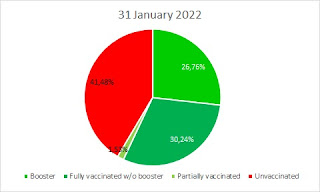
The customary month-end report of the sluggish pace of vaccinations in Poland.

1. Vaccine uptake in age groups

2. Vaccination status in the entire population of Poland

Given that the vaccination programme has nearly come to a standstill, is there any point in reporting its progress monthly anymore?

Tuesday, 1 March 2022
For that day, MOCOS forecast predicted that 7-day average of new infection would decline below 10,000. In practice, it reaches almost 14,000.

Wednesday, 2 March 2022
The 7-day average number of new deaths falls below 200. Hope the trend continues.

Thursday, 3 March 2022
The number of officially registered deaths caused by COVID-19 worldwide hits 6,000,000. I suppose a million more people die by 28 July 2022.

Friday, 4 March 2022
While the war is the only topic hitting the headlines, the second anniversary of first infection reported in Poland passes unnoticed. A year ago it was the topic of the day.

Saturday, 5 March 2022
On 3 February 2022 I predicted on that day the total number of reported cases in Poland would reach 6,000,000. Fortunately, I got it wrong, by 265,959. Now I bet the six million figure will be hit on 1 April 2022 (the first anniversary of the alpha wave peak last spring).
The number of hospitalisations on account of COVID-19 in Poland declines below 10,000, for the first time since 7 November 2021. Good news!

Sunday, 6 March 2022
As everybody is focused on the war in Ukraine, the pandemic is no longer a headline topic, but the virus does not let up during the warfare. Large gatherings might be conducive to spreading the virus.

Monday, 7 March 2022
After a noticeable decline in several countries in the second half of February, infections have picked up in many countries, but in some, such as the Netherlands or Austria, the incline is quite steep.

Tuesday, 8 March 2022
New infections in Poland rise week-on-week (by 1.3%) for the first time since nearly six weeks. With hindsight it will turn out it is just a one-off event, but the pace of decline gets very slow.

Wednesday, 9 March 2022
Torwar hall in Warsaw, being one of the biggest refugee shelters in Warsaw, becomes a hotbed of COVID-19, but as volunteers claim, this is just the peak of the iceberg, since people staying there are afflicted by several other diseases, which combined with the virus might get deadly. I fear a humanitarian disaster.

Thursday, 10 March 2022
In Austria the recent uptick send the level of new infections (7-day average) to all-time high. Too early to forget about COVID-19. We need to keep an eye on hospital admissions and deaths.

Friday, 11 March 2022
For me 11 March 2020, the day my employer ordered everyone to work from home and countrywide school closure was announced, marked the beginning of the pandemic. The second anniversary is barely noticed because of the war. Two years ago nobody expected it to last so long. Same might be with the warfare.

Saturday, 12 March 2022
The positivity rate has declined to around 15% - 18% in recent days, which is half of the figure witnessed in late January and early February, which implies new inflections have fallen by some 90% since the peak. Reassuringly?

Sunday, 6 March 2022

Wartime memories – first ten days

For some time the concept of this blog has been to save moment for posterity, therefore I have resolved to take down some notes on how the first ten days of Putin’s invasion looked from my perspective. It is not going to be a coverage of the military conflict which can be found in the media anyway. It will be just a personal record of my thoughts, musings and observations, so that one day I can revisit it and bring days the memories of dismal days which hopefully become the history soon, with a fortunate outcome.


Day 1 – Thursday, 24 February 2022

My phone shut down before 3 a.m. I deliberately have not left it on a charger overnight. I decide to charge it up in the morning. I get up at 5:30 a.m., eat a small breakfast and before setting off to the swimming pool, I connect the charger and switch the phone on. I check the recent posts on Twitter. I know it has begun.

After swimming I want to take a shower. For no apparent reason it does not flow. My skin stinks with chlorine, but I head home. Warsaw carries on.

Back home I learn the worst-case scenario of full-scale invasion has materialised.

A hard day at work begins. Nobody calls off business as usual due to the cruel attack on the Poland’s neighbour. Never in my lifetime has the warfare been so close to where I live. I find it hard to focus on work, like all the workmates. As we talk, it turns out most of us were hoping Putin would hold his horses. It was naïve, he is a ruthless psychopath, ready to scorch the earth to bring in his visions. Analogies between Germany after WW1 and Russia after the fall of the Soviet Union are so vivid.

As the sunset draws, panic-mongers begin to queue up to petrol stations. Those idiots firstly send money to Putin, secondly contribute to self-fulfilling prophecy that petrol stations might run out of fuel.

As the evening comes up, I feel exhausted. Partly because of tough 10 hours at work, partly because I fear how the story unfolds. The tsar is unpredictable.


Day 2 – Friday, 25 February 2022

With the invasion it became clear that accounts which used to spread pro-pandemic and anti-vaccine disinformation have now become pro-kremlin and ant-Ukrainian overt trolls.

The VPN in my company notebook keeps disconnecting itself for the second day in a row. A coincidence?

In the evening I team up with my mates from Szlachetna Paczka. I devise a plan of setting up “starter kits” for refugee families which would settle down locally. My mates immediately agree to join, so I let the mayor of Ursynów know about our initiative. He promises to keep us informed.


Day 3 – Saturday, 26 February 2022

In the morning I walk to the Lidl shop next door and buy two bags of hygiene materials and cosmetics (Rexona and Dove away from my basket), pack the stuff into a cardboard box and drop it to a local collection point. I ask to hand it over to the Ukrainian side of the borders, where it would be more necessary than in Poland.

If I could, I would send them weapons! But more and more countries declare such form of support to Ukraine, which is reassuring.

The spurt of Poles rushing to help Ukraine is spirit-lifting, but will it be long-lasting? It will be a marathon, not a sprint.

When I think of sanctions levied to Russia by the civilised world, I believe the main reason for some countries’ reluctance towards them is the cost of financial isolation. Yes, we have to pay the price for keeping Russia at bay, but the lost profits now are a good investment is the payoff is the absence of Russian tanks in the territory of Poland.

Americans urge their citizens to leave Belarus immediately. They are in the know again.

I pop by to some petrol stations and learn temporary shortages of fuel are a fact. Not only those who panic are to blame for it. Several people take trips in their private cars to the Ukrainian border and fuel up their vehicles in advance, thus boosting demand for fuel (and sending money partly to Putin’s pocket). The aid should be better co-ordinated, I believe.


Day 4 – Sunday, 27 February 2022

In the morning my father and I drop my mum off to the cardiac hospital in Anin for a planned treatment (ablation) for a few days. I realise she is stressed-out, not only by the planned surgery, but also since she knows she will be sorry for Ukrainian personnel working there. Admittedly, the willingness to keep company to my mother dragged me away from the involvement in aid to Ukrainians this weekend. But given the social response, I do not need to feel guilty.

In the fourth day of war, Ukraine is doing definitely better than expected, with Ukrainians proving not only bravery, but also shrewdness.

After a few days of silence, Putin threatens to use nuclear weapons. In his paranoia, he is capable of turning large swathes of land into nuclear deserts.

Freezing Russian central bank’s assets will be more painful than exclusion of most of the country’s commercial banks from SWIFT payment system. I fear how markets react tomorrow.


Day 5 – Monday, 28 February 2022

In a conversation with my workmates I strongly posit the only way out would be to kill Putin. Easier said than done. He is protected too well to make an assassination doable for a foreign intelligence agent, but Putin will not be alive for long. Irate oligarchs or infuriated military officer might be the ones to liquidate him.

My Facebook account gets restricted on account of posting a derogatory film mocking at Putin. The blockade is imposed by an algorithm, hence I file a complaint. Thus I become a passive user of the platform.

At work there is no major turmoil. For many years lending to companies involved in doing business in Russia was an excessive risk to my employer. Today the restraint pays off.

Boycotting goods with bar codes starting from “4 60”? Noble, yet you will find few of them in the shops, as Russia manufactures little. If you want to spite Putin, turn off the radiator in your dwelling and walk, cycle or take public transport whenever possible. Besides, time to boycott Polish companies which carry on doing business in Russia.

This is the first day of actual carnage of civilians in that war. Shelling residential estates in Kharkiv and shooting civilians on the city’s streets bear out Russians are barbarians. This is genocide.

Besides, conceivably the premises near the Polish-Ukrainian border might be attacked by Russian aircrafts.


Day 6 – Tuesday, 1 March 2022

Putin has done what no man has not done for decades. He messed with nearly everybody across the world and brought so many united against him.

My Facebook account gets unlocked after a verification by a human.

There is evidence Russia used vacuum bombs in Ukraine, so far not against civilians. Such weapons are prohibited by conventions and kill even people hiding in shelters.

Russian trolls work at full blast in the Polish Internet to sling muck at refugees from Ukraine. Poland must not fall victim of disinformation!


Day 7 – Wednesday, 2 March 2022

I learn with antidepressants I still take, though in lower doses, I cannot be a blood donor, while blood is what Ukrainian hospital need to rescue the injured soldiers.

My mother’s ablation is called off or rather put off until Friday. She is stressed-out and it also affects me. Her health is a yet another reason for concern to me.

In the neighbourhood I spot three cars on UA number plates. Glad somebody has played host to them. I admire people who let Ukrainians stay at their homes. I am afraid that would be beyond my comfort zone. Besides, such accommodation might last months.


Day 8 – Thursday, 3 March 2022

A week into the war, most people have shaken off the shock and are slowly coming to terms with the new reality, meaning the war is waged just across the border. With time indifference will grow.

I no longer take it for granted the war does not spill into Poland. The membership into NATO might scare off Russia, but the attach on the Treaty will bring the world on the brink of the nuclear war. I sadly have very little impact on the course of events, hence I convince myself not to worry in advance.

Three cars on UA number plates parked outside my block of flats. Will there be many more? Or is it just a stopover?

Brent oil price reaches nearly 120 USD per barrel, while USD/PLN trades around 4.30. I see double-digit inflation coming to Poland and the threat of stagflation to the whole civilised world. The least civilised part of its will be back into the misery of late 1980s.


Day 9 – Friday, 4 March 2022

Wake up to the news Russian missiles nearly missed the biggest nuclear power plant in Europe. Given the lack of precision of the Russian obsolete and run-down military stuff, I suppose we were lucky to have averted a nuclear disaster. Have the invaders lost control or are they trying to blackmail the civilised world?

I somewhat fear the aggressor might attack the Polish-Ukrainian border and civilians aiding there. With the uncivilised enemy, everything is conceivable.

NATO keeps holding back from getting involved in the conflict. I believe the fear of WW3 is the key reason for their restraint. Hoping their words about getting prepared for the worst-case scenario are not just hollow declarations.

In the afternoon my mother has her ablation. Preliminarily doctors say the treatment is successful.


Day 10 – Saturday, 5 March 2022

So far over 700,000 (exact numbers vary depending on source) refugees from Ukraine crossed the border with Poland. Will they be able to returns to their homes and rebuild their country soon? Will Poles exhibit so much hospitality towards them as they do these days? Will European Union help Poland take the burden of allocating refugees across the member states? Are the just past the first wave of migrants? Is it just the beginning? So many questions remain unanswered.

Helping Ukrainians will be a marathon, not a sprint, while people who rush to aid are sadly likely to run out of energy and resources far too soon. I recall the beginnings of the pandemic, the spurt of responsibility and solidarity which gave way to fatigue and indifference several weeks later.

If this all is hopefully over, there will come the time to bring to account those who advocated Russia recently. The first to be cracked down on will be the deputies of Konfederusja, mentally ill Grzegorz Braun and eccentric nutter Janusz Korwin-Mikke. Support for the far-right party declined below 5%. Hope they won’t make it to the parliament in 2023.

Sunday, 27 February 2022

Pandemic diary – weeks 101 & 102

Monday, 14 February 2022
Omicron now accounts for more than 90% of sequences. To make stats less boring, time to come up with the distinction between BA.1 (current prevalent) and BA.2 (less than 5% of sequences these days) – more infectious and probably more deadly subvariant which already prevails in Denmark.

Tuesday, 15 February 2022
After the post-contact quarantine was lifted and less than a week before pupils return to classrooms, headmaster still do not know how to handle groups where one pupil or a teacher has been tested positive. Until recently, in such cases remote learning was compulsory. As of now, the regulations are unclear. In early March schools might become a hotbed of the virus again, as the wave has not burnt out naturally and the level of immunisation is not particularly high.

Wednesday, 16 February 2022
The 7-day average of new infections decreases below 30,000, after staying above such level for 22 days.

Thursday, 17 February 2022
75% of Warsaw’s residents fully vaccinated. The figure looks well, but with respect to curbing transmission, is useless. With respect to preventing severe course of the illness and death, vaccines still prove good, decreasing those risk by around 8 to 9 times in all age groups.

Friday, 18 February 2022
The 7-day average of new infections decreases below 25,000, after staying above such level for 27 days. The fifth wave declines as quickly as it inclined.
The 7-day average number of deaths peaks out at 251 in Poland; 4 fewer and exactly on the day predicted by MOCOS in the first week of February.

Saturday, 19 February 2022

In early February Denmark lifted all restrictions and opened up. Critics of that decision point at the record-high number of deaths in COVID-19 reports (higher than in January 2021, when the number of infections was 10 times lower, but prior to vaccine roll-out). But once you drill down the data, the surge is driven by deceases where COVID-19 was not the primary cause, but infection accompanied another disease. Looking at the chart below, I believe reporting should be amended and only if COVID-19 was the primary cause of the death, such death ought to be reported.

Sunday, 20 February 2022
Queen Elisabeth (aged 95) tested positive for COVID-19. The British queen has been triple-vaccinated (date of booster jab unknown) and is reported to have only mild symptoms. Hope she continues to feel well.

Monday, 21 February 2022
It seems that school closure on 27 January brought forward the peak in infection by one week. Nevertheless, if this wave does not burn out as it should naturally, I expect a rebound, or levelling off in early March, a few days after today’s school reopening.

Tuesday, 22 February 2022
In Iceland, more than 10% of population are active cases. Neither in Slovenia, nor in Denmark more than 10% were not isolated when inflections peak. Iceland is a quaint and only example of a country where infections have kept rising for the recent two months. The well-vaccinated nation sees however, a single-digit number of critical cases (2 out of around 35,000 in total) and reports on average less than 1 death daily.

Wednesday, 23 February 2022
The 7-day average of new infections decreases below 20,000, after staying above since 20 January. It kept ascending for 13 days, but descended for 21 days.
The Polish prime minister announces all restrictions, except for isolation, quarantine for flatmates and mask-wearing indoors obligation will be lifted as of 1 March.

Thursday, 24 February 2022
Ukraine reports 25,789 new coronavirus cases and 276 new deaths. This is the last COVID-19 report from the country.

Friday, 25 February 2022
Worth looking at South Africa, the first country which experienced a surge of infections caused by omicron. New cases (7-day average) peaked there on 17 December 2021 at 23,437, but unlike in previous waves when deaths peaked out some two weeks after infections, this time deaths kept rising until 19 February 2022 when 7-day average of new deaths reached 233. Any explanation for that?

Saturday, 26 February 2022
R(t) in Poland bottoms out at 0.67. School opening will do its bit soon.

Sunday, 20 February 2022

Too Good To Go – application review

I am not really fond of installing and using applications in my smartphone. As I count, I use more or less frequently around a dozen of them, 40% of an average for a typical smartphone user in Poland. But from time to time out of curiosity I install a new one, usually prompted by a recommendation from another person.

The application mentioned in the post title was praised by one of my workmates during a business trip in September. Soon after hearing of it, I forgot about its existence and, truth be told, do not recall what refreshed my memory and made me try it out.

The idea behind the app is simple and commendable – it is meant to reduce food waste in shops and eateries. Produces saved from landing in a rubbish bin are sold for one-third of their regular price. Stuff from shops are near their expiry dates while restaurant food is not super-fresh and perfectly-looking to meet standards of an eatery, but surely edible.

If using the application was to be environment-friendly and cost-effective, if I lack a travelcard, I set the circle of 3 kilometres from home (i.e. a walking distance) to find places which wanted to get rid of some food. Each day I would find packages to be grabbed from Auchan Ursynów (PLN 8.49 – PLN 9.99), nearby BP stations (PLN 11.49), local Vegesushi restaurant (PLN 14.69), Costa Cofees (PLN 14.99). Some would wait hours for a buyer, other, such as packages from Blikle confectioneries (PLN 9.99) would be snatched within minutes or second.

The drawback of the application is that you reserve (and right away pay for) a pig in a poke. Some leftovers are guaranteed, but it is unpredictable what is left at the end of the day.

My first adventure was the regular food package from Auchan for PLN 9.99 on 10 February. I picked up a bag of food easily, but cannot say I was satisfied with its content. Inside I found a decent premium dry sausage (expiry date in 4 days), a cottage cheese (expiry date on the next day) and processed herring (expiry date on the same day) and this was the part which I ate. The remaining part of it (list on the receipt to the right) – too much of a whipped cream, yoghurt and other fat dairy products and a fat-made smoked beckon (all with expiry date on the pick-up day) sadly ended in the rubbish bin.

Admittedly, I have not saved the food properly, moreover I did not save money neither. What I consumed was worth PLN 10.29 at market prices, yet I while doing shopping would probably not buy all these products – fish I buy tinned or unprocessed to cook myself, cottage cheese would I buy, but less far, instead of a big premium sausage, I buy small packages of sliced meats. And look at the receipt from the application – the VAT receipt from Auchan contains 0% VAT for food, while the receipt from Too Good To Go included 23% VAT. Puzzling.

The second adventure was ordering a popular package from a nearby Blikle confectionery for PLN 9.99. I orderly picked it up on Friday (18 February) evening, brought it home, opened up and found a meringue cake. Again, it did not take my fancy, meringue is too sweet for me. Fortunately, I found a workmate who is fond of such sweets, bought a public transport 75-minute ticket for PLN 4.40 and took an underground train and a tram to drop it off to her place instead of committing it to the rubbish bin. All in all – PLN 14.39 spent, utility negative.

After the second experience, I do not feel like having a third attempt. The food is bought up anyway and does not go to waste. For somebody who, like me, plans shopping and strives not to waste food, the application is useless utility-wise and money-wise, but surely there might be people, especially large households, who might find the 67% discount attractive, provided they are luckier in terms of what the pig in a poke turns out to be.

I will not discourage you from using the app. It simply does not suit my needs, but someone else might find it a perfect tool for cutting their food shopping budget or saving the planet.

Sunday, 13 February 2022

Pandemic diary – weeks 99 & 100

Monday, 31 January 2022
The customary month-end report of the sluggish pace of vaccinations in Poland.

1. Vaccine uptake in age groups


2. Vaccination status in the entire population of Poland

Tuesday, 1 February 2022
Poland is the only country in the EU to have reported less than 1,000,000 test carried out per 1one million citizens since the beginning of the pandemic. Romania, the runner-up in the nefarious ranking has made 1,001,131 test per one million citizens, while Poland only 808,195. In comparison, Denmark has tested an average citizen more than 20 times.

Wednesday, 2 February 2022
The fifth wave reaches in Poland its surprisingly low peak at 49,078 (7-day average of new infections).
In Slovenia 1 in 89 citizens tested positive. Over 35% of the country’s population (2.08 million) have been officially infected since the onset of the pandemic.

Thursday, 3 February 2022
The number of confirmed COVID-19 cases in Poland crosses 5,000,000. The last million was reached within 43 days, 8 days later than I had predicted on 22 December 2021. Even if the optimistic scenario materialises and the wave begins to decline, I bet the decline will be slow and 6,000,000 will be hit on 5 March 2022 (i.e. within 30 days).

Friday, 4 February 2022
Newspapers inform about 250,000 Poles who have been given a referral to get tested, have not shown up at testing centres. Reasons might be manifold:
1) too long queues to testing centres,
2) they feel to bad to get to a centre,
3) the fact that seven-day quarantine is shorter than ten-day isolation (in fact ten days plus the time of waiting for test result and to get tested).
The system might have clogged up, as the reported capacity is 192,000 tests per day and actual number of tests conducted is near 180,000.

Saturday, 5 February 2022
Looking at the positivity rate in Poland we it has ranged from 26% to 34% since 20 January. The steady percentage of positive test results does not confirm the hypothesis that the testing system has reached the limits of its capacity. Although in fact it has.

Sunday, 6 February 2022
European countries that definitely have gone past the peak (date of the peak in 7-day average of new infections in brackets) of omicron wave are:
- the United Kingdom (5 January),
- Ireland (12 January),
- Italy (14 January),
- Spain (17 January),
- France (25 January),
- Sweden (27 January),
- Belgium (28 January),
- Portugal (29 January).

Monday, 7 February 2022
The Polish Ministry of Health brings in reporting of reinfections. A positive change triggers chaos in reporting and prompts questions whether until now reinfections had been properly reported. With hindsight it turns out they were.

Tuesday, 8 February 2022
Number of officially detected cases worldwide hits 400,000,000, 4 days earlier than I foresaw on 5 January 2022 (when it crossed 300,000,000 mark). I predict half a billion will be exceeded on 22 March 2022.
R(t), the reproduction number declines in Poland below 1.00x. The peak in reported new infections was reached one week before most mathematical models had predicted.

Wednesday, 9 February 2022
The Polish Minister of Health announces the pandemic draws to a close (on a day when nearly 47,000 new infections and over 300 deaths are reported). To accommodate to such scenario, the government:
- lifts quarantine of people who have contacted an infected person,
- shortens quarantine for flatmates of an infected person (takes effect on 11 February),
- shortens isolation from 10 to 7 days (takes effect on 15 February),
- brings forward the end of remote learning by one week – children are to return to schools on 21 February.
But the jaw-dropping announcement is scrapping the obligation to wear mask indoors once new infections decline. For me the very latter is a step too far. Are they going to call the election? Last time the virus was retreating before the election.

Thursday, 10 February 2022
The 7-day average of new infections decreases below 40,000, after staying above such level for 14 days.

Friday, 11 February 2022
With some delay I find an updated pandemic forecast by MOCOS. Those quants a month ago predicted nearly 150,000 reported infections daily and 700 deaths daily after the wave peaked. The new forecast says:
- 7-day average of new infections will decline below 10,000 on 1 March 2022,
- 7-day average of new deaths will peak at 255 on 18 February 2022.

Saturday, 12 February 2022
Bulgaria is the first country in the UE in which 0.50% of the population officially died from COVID-19. Disregarding the virus, reluctance towards vaccines and poor health service have contributed to the dismal statistics.

Sunday, 6 February 2022

Nadchodzi Trzecia Wojna Światowa – book review

Struggling to recall how I have learnt about the book, but beyond all doubt I immediately ordered it in the district library of Ursynów. To my surprise, the wait was not particularly long after a mere few weeks I was notified I could borrow it.

Th recently (autumn 2021) published volume is a transcript of extended conversations between Jacek Bartosiak (expert in international politics with focus on military issues) and Piotr Zychowicz (historian). The two men hold unbiased discussions in which they keep to themselves their private political views (the latter is a right-wing ardent anti-communist) and brush aside their prejudices. The outcome is a detailed, substantive analysis of superpowers in the contemporary world and how the spheres of influences might reshape in the coming decade.

The book rests on a paradigm that the era of post-history in which carnages of the First and the Second World Wars are not going to repeat, in which only local military conflicts are conceivable, but the highly developed countries enjoy peace, is drawing to a close. The authors claim something is about to give in less than a decade. They cite China’s ambitions to take over the dominant role from the United States as a major motive and dissect several other aspects as minor reasons potentially leading to a clash that could spill worldwide.

The script has prompted me to revise my views on armament spending, which for years I had considered mostly useless. My notion would have held true had there been no enemy to Poland, which most likely is a naïve claim. Modern, well-equipped and professionally-trained army with continuously updated contingency plans is like an insurance policy. A country pays the insurance premium to scare off enemies.

The authors are critical in their assessment of how Poland has handled its military policy over the last 30 years and cannot point at any government over that period that stood out positively. The unconstrained trust in the alliance with the United States, thoughtless armament spending just to stick to NATO’s requirements or for the sake of showing of earmarking a certain percentage of GDP for the military purposes, excessive purchases of aircrafts and other equipment from the United States to flatter the America – all that is slated by the experts.

Mr Bartosiak and Mr Zychowicz also take a look at the history of Poland around WW2, its subjugation to allies who turned their back on my country. The bitterly admit Poland should have focused more on its vested interests, rather than relying on allies and acting like a saviour of the world, sending its soldiers to shed blood for other nations. Drawing on those experiences, they insist Poland should curtail its dependence and reliance on NATO and be as self-supporting as it can, while staying united with Western Europe and strengthening this alliance wisely.

My read of the book coincided with Russia’s preparations to invade the Ukraine. I have pinned some hopes in good job of intelligences of several countries which foiled Mr Putin’s plans. Maybe it was naïve to think an action which everybody expects to happen is less likely, but the war should be about taking the enemy by surprise. Some experts claimed the invasion was unlikely during the Olympic Games, traditionally the time when warfare was on hold. They give an example of 2014 when the Crimea invasion occurred after the end of the event in Sochi. I suppose Mr Putin no longer gives a damn. Weather might play a bigger role. The north-eastern swathes of Ukraine are swampy and frozen ground would make it easier for heavy vehicles to move, so the time might be running out. On the other hand, some pundits say the positive temperature anomaly of 10 Celsius degrees might be conducive to Russians. Regardless of which version is right, it is disturbingly certain turbulent times are ahead.

Sunday, 30 January 2022

Pandemic diary – weeks 97 & 98

Monday, 17 January 2022
A week ago children returned to school and several people returned to work after holiday. I expect new cases to take off very soon.

Tuesday, 18 January 2022
The 7-day average of new infections increases above 15,000 again, after staying below such level for 24 days. New infections are now bound to soar, we will follow the path of other countries.
In France 1 in 141 citizens tested positive.

Wednesday, 19 January 2022
More than 30,000 new infections, up by 89% week-on-week, the highest number since early April 2021. The surge has started. I spend the day in the office and meet around 30 people…

Thursday, 20 January 2022
New cases up by 95% vs. last Thursday and nearly 3,000 new infections in the capital of Poland.
The 7-day average of new infections increases above 20,000, after staying below such level for 34 days.
In Israel 1 in 136 citizens tested positive.

Friday, 21 January 2022
New infections up by 128% week-on-week, with a record-breaking number of new infections. I see no point in informing about new records, since they will be reported several times a week.
In the evening I attend a party to celebrate the success of Szlachetna Paczka after which I will self-isolate. Putting the booster to the test…
1 in 133 citizens tested positive in Denmark.

Saturday, 22 January 2022
As I wake up into my self-isolation, I just see an increase in new by nearly 150% week-on-week. But the really ghastly piece of information is that the number will be going up until around 10 February 2022 and reported stats will be just the tip of the iceberg.
The 7-day average of new infections increases above 25,000, which means the fifth wave is already higher than the second and fourth one.

Sunday, 23 January 2022
The number of patients hospitalised hits its low at 13,491. Does not bode if it is the starting point for the Omicron wave. Just to remind you, the starting point for the Alpha wave were 11,962 beds occupied on 14 February 2021.
The fifth wave is already higher than the third one.
Positivity rate creeps above 30%.

Monday, 24 January 2022
New infections up by 179% week-on-week.
The 7-day average of new infections increases above 30,000. From now on hitting round number will be reported after each 10,000 more. 40,000 expected on Thursday in an optimistic scenario. In a pessimistic one – the day after tomorrow.

Tuesday, 25 January 2022
P1 system in which referrals for tests are issued clogged up yesterday and has not been lifted until today afternoon. What a mess!
My employer forbids coming to the office by the end of February.
Wronki is the first municipality in Poland where 80% of residents have had at least their first jab.
The decision to partly close schools is taken. Except for pupils up to the fourth year of the primary schools, remote learning will be in place by 27 February.
In France 1 in 131 citizens tested positive.

Wednesday, 26 January 2022
For this day:
- on 29 October 2021 I predicted new infections would hit 4,000,000,
- on 22 December 2021 I predicted new infections would hit 5,000,000.
The outturn of 4,637,776 came closer to the latter prediction. I missed it by 363,224 infections, but it will be caught up with within a week, I suppose.
In Slovenia 1 in 119 citizens tested positive.

Thursday, 27 January 2022
From today on, each individual is allowed to take a free-of-charge antigen rapid test in a pharmacy. In theory the opening lists of pharmacies has 64 such places across the country, therein 3 in Warsaw and around (1 pharmacy for 1,000,000 residents). In practice tests are not delivered to pharmacies anyway, so the efforts to boost testing are a flop.
The 7-day average of new infections increases above 40,000 – the optimistic scenario materializes.
The number of people quarantined in Poland exceeds 1,000,000 for the first time in history. To decrease the figure which has impact on absences in workplaces, the government has shortened the quarantine duration from 10 to 7 days, coming into effect on 24 January 2022 and not applying retroactively.. Add up more than half a million in isolation and you get 4% of Poland’s population stuck at homes.

Friday, 28 January 2022
I read the draft law of workplace testing which imposes potential financial penalties on employees who refuse to get tested. The law is ludicrous, but I am so underwhelmed by absurdities that I hold back from commenting on it.
In Denmark 1 in 116 citizens tested positive.

Saturday, 29 January 2022
In Warsaw as of today:
- new infections down by 13% week-on-week,
- tests carried out up by 17.5% week-on-week,
- positivity rate down by 7 p.p. from 27% to 20% week-on-week.
Hard to believe the capital has just gone past the peak. Albeit the general trend will be disrupted by school closures and school holidays just commencing.

Sunday, 23 January 2022

Behind the wheel in 2022

The most impressive flop of early 2022 is definitely the overwhelming mess subsequent to the rollout of the Nowy Ład. What goes on around the new tax legislation is a topic for a separate posting, yet today I refuse to have my nerves frayed by it. It is no secret I am not a beneficiary of it, yet I would agree to pay higher taxes, provided the tax law is simplified and tax proceeds and spent wisely. Sadly, neither the latter not the former holds true for Poland.

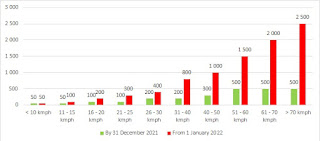
But wallets of motorists might be hit not only by higher taxes and other contributions, but also by fines for violations of the highway code. The penalty rates in Poland had not been revised since late 1990s and were laughably low in comparison to other countries. The fine rates for speeding, the most common offence on Polish roads have been revised upward, as shown on the chart. The lawmakers have turned out to be lenient for minor speeding, yet the higher the deviation of the actual speed from the limit, the more severity of the punishment increases. The point beyond speeding gets painfully expensive is 30 kmph. Besides, there is no flat fine for speeding above 50 kpmh, but fine amounts rise along with the scale of offence (or rather crime, given somebody driving 120 kmph in town where the speed limit is 50 kmph is already a criminal).

The upshot is that on the New Year’s Day Polish roads got similar to what I witness abroad. When venturing beyond the border of Poland I was always careful not to exceed speed limit, so that my holiday budgets were spared costly fines. Poles have been legendarily obedient abroad and careless in their homeland. Today it has changed for the majority of drivers, but I still see reckless idiots, usually in quite new premium-make oversized vehicles who do not give a damn about the higher fines. Nevertheless, the general tendency bears out a financial punishment serves best as a disincentive to commit offences.

Another change mentioned by some experts which should follow is the verification of speed limits on specific roads. I have no idea why the stretch of ul. Puławska along Wyścigi, with merely one intersection and no pedestrians crossing has lower speed limit (50 kmph) than the section between ul. Poleczki and the boundary of the city, where the speed limit is 60 kmph. I hold the view there are thoroughfares in Warsaw where speed limits could be increased by 10 or even 20 kmph, while traffic on minor roads should be calmed, as 50 kmph is far too much for several narrow streets.

Other pricing reshuffles which are taking place in early 2022 are:
- the increase in long-distance train ticket prices,
- the decrease in excise tax for fuel,
which given the effort to reduce carbon dioxide emissions, work the opposite way round than they should.

I have taken the trouble to compare a cost of a business trip taken in 11 days (planned yesterday for 2 February) for a six-hour workshop (which cannot be held online) in another bigger city (I have chosen 4 which have decent train connections to Warsaw – Poznań, Wrocław, Kraków and Gdańsk).

My assumptions:
- my destination is located 1 kilometre from a main train station so that I can walk there,
- start time of the workshop can be adjusted to match the train timetable,
- by car I drive door to door and pay a parking charge of 30 PLN in each city,
- I travel on my own,
- the cost of fuel is based on petrol price of 5.10 PLN per litre (envisaged after the excise tax cut) and the average consumption of petrol is 7.0 litres per 100 kilometres – this gives 0.357 PLN per kilometre,
- since I have no travelcard, I need to buy two 75-minute tickets each to get to W-wa Centralna Station,
- I travel in second class by train,
- on my way to Poznań I pay motorway charges, to Gdańsk I take S7 expressway,
- the cost of car journey increases by the cost of accelerated depreciation and higher upkeep costs on account of higher mileage – 0.10 PLN per kilometre
- journey time by car to each destination is calculated with Google Maps (mid-time for bracket) with 30 minutes added each way,
- I need to set off to the train station 55 minutes before train departure and return home 45 minutes after train arrival

Here come the results (cost and journey duration):

Poznań – still cheaper and faster by train

Wrocław – much cheaper by train, but slightly longer
Kraków – somewhat cheaper and faster by train

Gdańsk – markedly cheaper and faster by train.


I am positively surprised by the outcomes, especially with respect to the journey duration. But note with 2 passengers the journey by car gets cheaper. Is the proportion right?