Sunday, 26 January 2020

Greenwashing

Opening disclaimer: I write it as a driver and a car-owner.

The very term appearing in the title of the post has been coined more than a decade ago, yet I, shame to confess it, ran across it in early December 2019. Back then, while browsing LinkedIn I found a post by my employer’s fleet manager, in which he had boasted of handing over to staff another batch of hybrid Toyotas (to replace petrol-fuelled vehicles manufactured between 2015 and 2017).

Regardless of automobile’s industry’s efforts and despite countless marketing campaigns, there is no such thing an environment-friendly car. You will not circumvent laws of physics, hence the bigger a car, the more energy you need to set it in motion.

Don’t also think if you buy a hybrid or an electric car, you will save the planet. The graphic to the right from the European Parliament’s webpage (I trust if has not been bought off by a lobby of carmakers) dated March 2019 shows the total carbon dioxide emission during a vehicle’s lifetime (sadly, they do not define how the lifetime is calculated). The chart informs that in a country which fully relies on carbon in electricity generation (such as Poland), an electric car is all in all more harmful to the environment than a car with a traditional combustion engine.

If you believe a hybrid car is a remedy, I will let you down. Manufacturing and recycling (but not maintenance) of a car with batteries is more environment-detrimental than of a traditional vehicle. The energy to charge batteries is not delivered from outside, but is generated in a regular combustion engine, which apart from propelling the vehicle must work to charge batteries. This leads to efficiencies during in-town driving when the batteries support the traditional engine when a car accelerates, so a hybrid Corolla consumes between 5 and 6 litres of petrol per 100 kilometres in town. This is 30% less than my car would do, but the consumption figures are comparable to small city cars running on petrol only. The bigger problem is that you should use a car around town as little as possible. On a motorway, at the speed of 140 kmph, the hybrid Corolla consumes over 10 litres per 100 kilometres, some 25% more than my car. The car loses its edge where use of it is justifiable.

Plug-in hybrids and electric cars in Poland rely on electricity generated from coal (with PiS government doing little to accelerate switching into alternative energy sources). Abroad, with more environmental-friendly energy mix, the lifetime carbon footprint is lower than of a traditional vehicle, yet one needs to bear in mind the distribution of the footprint. At the exhaust pipes there are no fumes, but the batteries are produced and will be probably recycled (the problem will grow big in a decade of so when electric and hybrid cars produced today will begin to reach the end of their lives) in other countries where harm to the environment will be concentrated.

Modern traditional cars are not faultless. The automobile industry cares about its profits and passing more and more stringent emission tests. To comply with norms, it comes up with several tricks to declare possibly lowest carbon dioxide emission, the infamous Wieśwagen dieselgate scandal being the most glaring example. Particulate filters, found in every diesel engines manufactured over the last 2 decades, and in most petrol engines produced recently, do retain soot (then turning into ash) before it leaves an exhaust pipe, but as ash accumulates in a filter, it slowly clogs up. The process of self-cleaning the filter consists in burning out ash. A vehicle does it when its engine is warm, at revolutions above 2,000 rpm and at steady, rather high speed. Do you believe emission of harmful particles during the process of burning out ash remnants is low??? Do you believe the ash is burnt out during standardised WLTP measurements?

What can you do to reduce your carbon footprint? Drive less!

Start from reducing to those absolutely necessary around-town journeys, where you can rely on public transport and there because of traffic density, emission per kilometre is the highest and time savings are the lowest.

Cut down (unless absolutely justified by your health) on short-distance trips. Firstly, a cold engine during first seconds after being started up emits multiple time more fumes than after it warms up. Secondly, a vehicle’s wear-and-tear disproportionally accelerates on short distances. Thirdly, walking or cycling is healthier!

If you need to go somewhere by car, try doing this when traffic is sparse. Vehicles cause less air contamination when they are driven at steady speed, without frequent stops and accelerations. Many such trips can be taken over the working week after 8 p.m. or on Saturday mornings when traffic jams are not a plague.

Change the style of driving. Eco-driving is safer and reduces emission by approximately 20% vs. normal driving and by 40% or more in comparison to aggressive (but not making a journey faster) driving. Do it wisely, i.e. do not use the highest gear at too low revolutions and do not upshift too early – this might save fuel in short-time, but will decrease the life or engine and other components.

Look after your car! Production and recycling stand for 20-25% of a vehicle’s lifetime carbon dioxide emission, so keeping your car in good condition as long as possible will be better to environment than replacing it with a new one whose exhaust-located footprint is slightly lower (carmakers will try to persuade this assertion is untrue).

Take passengers or become another driver’s passenger. A passenger car carrying 4 persons emits only 5% more carbon dioxide per passenger than a train (in Poland running on electricity produced from coal).

Closing disclaimer: I have written it all with a sense of sadness. I draw pleasure from driving. Behind the wheel I get relaxed and because I need to focus on driving all worries and kept far away from my mind. Yet I need to see further than the end of my nose and mind the future of the planet more than my personal whims.

Sunday, 19 January 2020

Bieguni - book review

Conspiracy theorists claim Nobel prizes are awarded to influence political choices. No matter how much truth those assertions contain, the recent Nobel prize in literature granted to the Polish writer, Olga Tokarczuk, has not been a gift to the ruling party four days ahead of the parliamentary election.

The most prestigious honour a writer can receive has sparked off interest in Mrs Tokarczuk’s books. Shelves in bookshops ran empty, publishing houses rushed to place orders to printing companies, e-queues in libraries got longer. This spurt has of course affected just part of the better educated part of the nation.

Before I set out to it (I had planned to wait out the period of the biggest demand), I received the best known book of the accoladed writer, Bieguni, as one of my birthday gifts.

It was one of 3 books I read during the nine-day-long Christmas break (three days off, nine days away from the office). I had envisaged a tough read, rather slow and requiring concentration to grasp, as Noble prize winners are not hailed as producers of literature for masses. Unexpectedly, the book with its natural flow and lightness was easy to follow, yet involved some mindfulness and ability of reading between the lines. Maybe for such reason minister Glinski could not make it to back cover of any of Mrs Tokarczuk’s books despite trying (not) hard (enough).

The book has no unified plot, yet it is a jumble of several threads (in such respect akin to a blog devoid of posting dates), drifting around a leitmotiv of travel. Characters and sub-plots are sets in different epochs and venues, come from different walks of life, some refer to actual events, some are purely fictional. The only element that brings them together is involvement in some sort of motion. The very title might be somewhat misleading, since the tribe of Bieguni does not appear even once on the pages of the book, yet their belief that motion can ward off evil serves as inspiration for the entire work.

The writer contrasts herself (she travelled as lot and visited places on several continents during her life) with her parents (who holidayed once a year, planned their journeys carefully and found them stressful). I find such contrast in people around. There are ones who cannot stay in one place for a long period, if they tried, they would suffocate (travelling is a sense of their life) and there are others who prefer to stay in one place and just visit occasionally some holiday or business destinations.

I belong the to the latter group. The settled lifestyle I have chosen, being attached to the place I feel is home gives me feelings of comfort and security. I do travel from time to time, my trips are longer or shorter, but all taken not to search for something new, but to visit new places and then return home. I could not live today here, tomorrow there, in a month somewhere else, unlike other people could not live chained to one location.

The reflections upon the book reminded me of an article on people who had not ventured beyond Warsaw for the last two decades, published in Gazeta Wyborcza several years ago, today available free of charge. From a perspective of somebody who travels around Poland several times a year and visited 8 countries over the last 3 years, a fascinating read.

Sunday, 12 January 2020

Cooking workshop

Frankly speaking, I am not fond of pottering about in the kitchen. I have learnt to do several basic and few more sophisticated meals after moving out from my parents, yet unless a lust for cooking comes over me (what happens once in a blue moon) I confine to a repertoire of simple and tested lunch sets, which I strive to broaden anyway. I cook lunches to take them to work for 3 reasons. Firstly, I lack time to eat out (it takes an hour, far too long given my dreadful workload). Secondly, I detest packaged lunches sold by people roaming around office buildings (such food contains lots of preservatives and other abhorrent chemistry). Thirdly, this sends a signal to the surrounding world I am self-sufficient and can take care of myself.

A voucher to a workshop in a Spanish cuisine was one of my birthday gifts and has proven to be the most inspiring one. Shortly after obtaining it I signed up for the first possible Saturday workshop, held yesterday.

The venue in which the workshop was run smacked of post-industrial climate. Located in the southern, least prime part of Mordor, not easily reachable by public transport, mixes climate of socialist factory district with modernity. Fortunately, I was there for just one afternoon.

Most participants also had received vouchers as gifts. Out of 16 people, 7 were two families that came together, on top some couples (including two gays) and some singles. Seems that trend of bestowing your relatives and friends with experiences rather than material stuff intensifies. A sign of times. If you wish to make such gift to somebody, a good idea is to hand it to your near and dear person or pass the hat round to decrease the cost per person, since experiences do not rank among inexpensive gifts.

Such workshop is one of such forms of meet-ups where people come, interact and go. I have just noticed all the friendships I have made in life are with people whom I had met repeatably, i.e. mostly at school or at work. I attended several courses and though relationships with some people met there lasted longer than those courses, none of them has survived until today.

The teacher was a seasoned cook, communicative and eager to share her passion with participants, yet for no apparent reason underlining too often she did not eat meat, but had to deal with it during the workshop (the Spanish cuisine is meat-rich). I wonder why she hadn’t given it up or just stuck to the vegan version…

The duration of the workshop turned out to be nearly five hours. For somebody not really fond of cooking and spending in the kitchen just as much time as absolutely necessary, this was a bit tiresome, though fun. Such form of pastime activity is about fun, experiments, learning and tasting something new. My homework to be done is to cook what I have learnt to my friends who sponsored my attendance.

Truth be told, I am not a fan of the Spanish cuisine. Some of the ingredients I like (olives), some I dislike (their meat), yet their dishes seem too stodgy (my stomach gently reminds me of it today), not to mention their nutrition habits over the day which totally do not square with mine (I consume a satiating breakfast, thnn fill up with a lunch and then eat little or nothing in the evening, to wake up longing for another huge breakfast.

Sunday, 5 January 2020

POW - early 2020 update

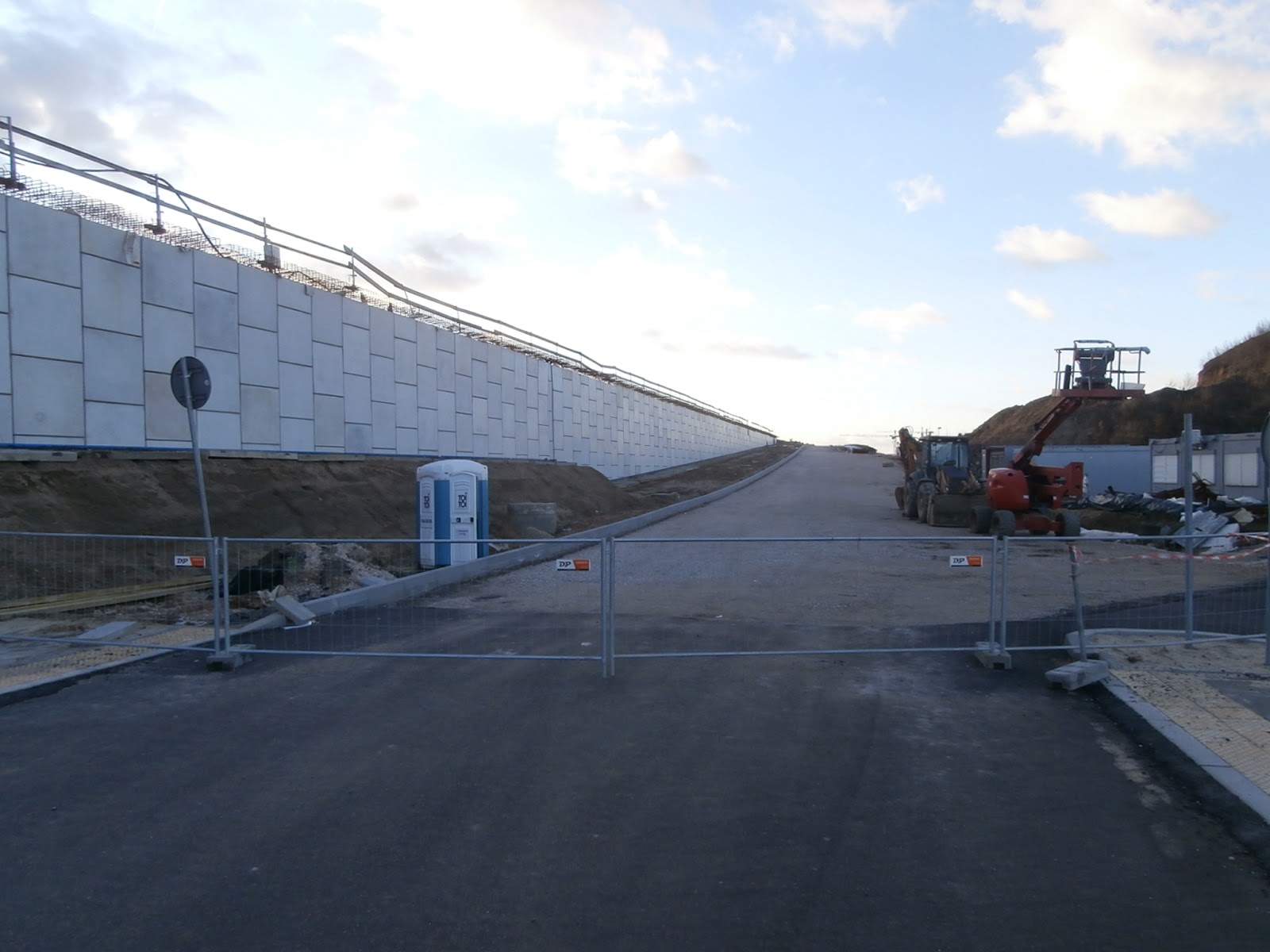
Eight months after the recent major photo round-up and nearly three months after posting most recent snaps, time to spend most of a short, a yet bright day to catch up with progress of works on POW construction site west of Vistula.

The weather looked out perfect as seen from a warm interior. In fact, temperature today creeped barely above zero, while outside, unless you took shelter from the chilly wind, it felt like almost -10C. Fortunately, I have not decided to put up for sale my thermal long johns and vest, purchased before the trip beyond the polar circle and today they proved useful, albeit I felt kind of overheated when marching briskly through areas shielded from wind and lit by sunrays.

The morning part of the trip commenced around 10 a.m., after I returned from the swimming pool. Having donned the thermal underwear (and regular outerwear) I jumped into 504 bus, rode 3 stops, alit it and rambled towards the southern end of ul. Indiry Gandhi. At the corner of ul. Pileckiego and ul. Indiry Gandhi I passed what 2 weeks ago had most probably been a Christmas-tree stall. Today the sellers were long gone, unsold trees remained. I wondered whether they had been chopped down legally. Felt sorry for the trees, unlike plastic substitutes, they would not decompose after 400 years, yet each year too few Xmas trees are sold in pots and then replanted.

Having mused about trees, I reached the spot were a new intersection of ul. Indiry Gandhi and ul. Płaskowieckiej should be built. The construction crews so far were focusing on re-laying underground installations. Without the intersection, junction Ursynów Zachód will be rendered useless.

I crossed ul. Płaskowickiej and scrambled up an earth mound in the shrubs. The viaduct in the distance on the afore-mentioned junction will carry eastbound traffic onto Ursynów and should bring relief to ever-clogged ul. Puławska. I had decided not to drive several kilometres to capture the sight of S2 roads slipping into the tunnels from the current end of the road. Not worth burning so much fuel for one photo.

Ul. Płaskowickiej will need to be broadened ahead of the link with the expressway; works on it have commenced, for no apparent reason bringing the westbound lanes close to windows of blocks built here in 2006-2007 when plans of the POW had been publicly available. No need to feel regret for dwellers.

I turned around and snapped the pavement and the cycling path along ul. Płaskowickiej behind the construction site fence. These are first elements of the pre-construction landscape restored. Although the very road is to be opened in late 2021, system of roads in Ursynów is to be back in pre-construction shape in August 2020.

The photo to the right has been taken from a pavement by ul. Pileckiego, south of ul. Płaskowickiej. One can spot the southern lanes of ul. Płaskowickiej (turned into a single carriageway 2 years ago) and original ul. Pileckiego rebuilt. The land above the POW tunnel is to be developed into a park, with lots of greenery and amenities to locals.

East of ul. Stryjeńskich there was little to boast about, at least above the ground. Nevertheless, I could not resist to snap the construction site fence next to intersection of ul. Płaskowickiej and al. KEN. It instantly brought to mind… the Berlin wall. Ursynów indeed has been divided by that construction for a while and once it is finished I will need to get accustomed to Ursynów not blotted by metal fences, mud and building machinery.

Ursynów Wschód junction, as observed from the top of the Warsaw escarpment is not an easy object to be photographed. Still I couldn’t make out where the roads carrying the traffic east from Ursynów would run. Progress since mid-October also hard to be estimated. The last morning snap, time to walk off to a bus stop by ul. Rosoła, hop on 179 bus which zigzags through Ursynów and return home.

After a lunch and a moment of rest, time to inspect developments in Wilanów. Przyczółkowa junction seems quite advanced. Yellow footbridge still lacks balustrades. Red viaducts in the distance carry two three-land roads over ul. Przyczółkowa. Konstancin-bound traffic already on target lanes, drivers heading north still need to slow down on temporary detour.

A quirky shot, taken as I was standing on cycling path running parallel to ul. Przyczółkowa, looking west at the slip road towards Ursynów, Łódź, Poznań, Berlin, Lisbon… Tarmac has not been laid, progress of works on the viaducts unknown…

Then on to ul. Wał Zawadowski. Had cycled here several times, today I first ventured there by car and felt like an intruder (despite having not violated any rules). The bridge is also not an easy object for the camera…

The pictures do not show progress on northern bridge is lower than on the southern one, whose construction had commenced earlier. Some time ago the delay on that section was said to be the longest. Today I can bet the entire Southern Bypass of Warsaw is opened in 4Q2021 and I am quite optimistic due to forecasts of mild winter continuing in January and February 2020.

Later I drove to see the viaduct on ul. Syta. One of drawbacks of taking such trips by car is a difficulty in finding a place to park the vehicle. The photo was taken through an opened window, while I stopped and turned the emergency light on. In the distance, the bridge(s) over Vistula.

The last pic, taken in the same location, half an hour before the sunset Looking west towards Ursynów, future roads clearly visible. The very viaduct seems nearly completed. I wonder whether it shares the fate of its peer on ul. Poloneza which infuriated local residents for months between actual completion and opening for traffic.

The progress is anyway best illustrated on films shot by drones, which can be found in the relevant thread of Skyscrapercity forum.

Sunday, 29 December 2019

2019 - end-year musings

As the end of the year draws near, high time for summaries and reflections spurred by the recent months.

The first quarter of the year was marked by refurbishment and furnishing the flat. Nine months after moving in, I feel well this is my place on earth. The drawback of such positive vibes associated with the dwelling will be the unease to move out of there one day.

The major event in the second quarter were exacerbating problems with the lumbar spine which ended up with a fortnight spent on intensive recovery, which, along with continuous exercising, have proven to help me pull through.

In the third quarter I had to face up to a tough challenge at work. The task was stressful, time-consuming and though worth being described on the blog, for the sake of confidentiality, I have held back on it. It was one of those things that could have killed me, but eventually have made me stronger.

In the fourth quarter I set out to fulfil my dream from last year and decided to commit much of my money, spare time and courage to help those worse off. It has paid back with good energy and has become made me yearn for more.

The entire year was marked by my growing awareness of the climate change, its severe implications and mankind’s impact on the global warming. After the hottest June since records began and after the warmest fourth quarter of the year since records began (October being the third warmest, November the second warmest and December on track to be the third warmest), one witnesses figures backing the climate change.

Every individual has responsibility to slow down this process, and just like in elections in which every vote counts, any (positive) change matters. In contemplating how one can influence the global warming I distinguish some key areas.

Firstly, how one heats one’s household. Here much needs to be done and is being done of the levels of central and local governments. The authorities need to support financially (with a carrot) those who need to replace their smog-generating incinerators with civilised furnaces running on natural gas, but also have to crack down (with a stick) on those who keep on burning rubbish and whatever cheap stuff to heat their houses.

Secondly, how one travels. The biggest detriment is caused by short-distance flying, which I have committed to shun as much as possible (though I may happen to repeat it, if I am forced to keep company to one of senior executives who do not stoop so low to take a train). The second biggest damage to air pollution is caused by short-distance car trips around town. I have nearly completely given up on driving below 10 kilometres (such is the distance to my parents’ house) and if I drive around town, my destinations are difficult to be reached by public transport (door-to-door journey several times longer) or when something heavy lands in my boot. Public transport and bicycle are a solution in over 90% of circumstances.

Thirdly, by one’s choices as a consumer. Here the 5R rule applies. Think before you buy an item and consider whether you really need it. Once you buy something, take care of it and use for as long as possible. Replace when an item wears down, not when your get bored of it and hanker after something brand new. Cut down on use of disposable items. Be sensitive to how stuff is packaged. I can proudly say my one-person household produces these day one 35-litre bag of litter per 3 days. Besides, I get along with life without material whims.

Fourthly, what one eats. Next year will be the time on cutting back on meat consumption, though with no intension of becoming a vegetarian.

Fifthly, be aware with making choices and mind the greenwashing. The best example of greenwashing observed by me in 2019 was my own employer, taking pride in replacing its entire fleet with hybrid Toyotas (each to be replaced by a brand-new one after mere two years of 60,000 kilometres). I have driven those cars and travelled on board of them as a passenger around town and I am more than disillusioned. Brushing driving impressions (I honestly dislike it) aside, I am deeply dissatisfied with its economics. Fuel consumption (I am writing now about hybrid Corolla sedan with 1.8 engine) of around 5 – 6 litres per 100 km in town (as much as a frugal, small petrol-run car would do and compares to my car with would consume 8 litres per 100 km) and above litres per 100 km on motorway (tempomat set at 140 kmph) which is far more than my car, which would gulp also around 8 litres at such speed, has little to do with stopping smog!

The hybrid vehicles are good for people who drive a lot around town as part of their profession (taxi drivers, couriers delivering parcels or whatever else, cable TV guys, etc). Other car users should rather be encouraged not to use cars around town rather than switching into cars which have their batteries charged from fume-producing engines. After doing a research I would not buy a hybrid car with my driving profile. Firstly, they have no advantage (to put it bluntly, perform inferiorly) in long-distance trips (2/3 of my yearly mileage), secondly they do not endure well frequent periods of sitting idle for a few days (my car generally sits in the garage over the working week).

Summing up, next year I see myself following the guidelines helping me preserve the planet, yet reasonably, without going into extremes, meaning not giving up on effects of technological progress at any price.

Sunday, 22 December 2019

Wintry Christmas? No such luck!


Each single advertisement and each (with some exceptions) film whose plot plays out in Christmas period is set in a scenery of bright, snowy, often sunny winter. This has little do with actual weather…

But shapes our expectations…

 …which hardly stand confrontation with the reality.

 I have taken the trouble to find out how many of Christmas Eves between 1951 and 2019 (69 years, with firm forecasts of late autumnal weather I can fairly add this year’s Christmas Eve to the sample) when reliable and precise weather measurements have been taken and are publicly available were wintery. I define winter (hereinafter proper winter) as day-time high below 0C and at least 1 centimetre of snow lying on the ground. Out of 68 Christmas Eves, only on 13 (1953, 1956, 1961, 1962, 1963, 1964, 1969, 1970, 1986, 1990, 2001, 2002, 2003), i.e. less than one in five Christmas Eves one could enjoy proper winter in Warsaw.

I have also collected detailed data for my lifetime and have broken them down into 4 categories, taking into account combinations of two features of winter conditions: sub-zero temperature and snow. I define:
- snowy as at least 1 centimetre of snow lying on the ground,
- frosty as day-time high below 0C,
- thaw and frost-free as day-time high equal to or higher than 0C,
- melting snow as at least centimetre of snow lying on the ground, but disappearing on account of positive temperature,
- without snow and snow-free as no snow falling or lying on the ground or sleet or snow falling, yet melting instantly or soon after reaching the ground.

Snowy and frosty (i.e. proper winter): 1990, 2001, 2002, 2003.

Thaw, melting snow: 2010, 2012.

Frosty, without snow: 1992, 1994, 1996, 1998, 1999, 2000, 2007.

Frost-free, snow-free: 1987, 1988, 1989, 1991, 1993, 1995, 1997, 2004, 2005, 2006, 2008, 2009, 2011, 2013, 2014, 2015, 2016, 2017, 2018 and 2019.

In my lifetime, 4 out of 33 Christmas Eves brought proper winter, the last one was witnessed 16 years ago (and was third subsequent one).

Interestingly, in my childhood quite common were frosty (frequently with double-digit negative temperatures) yet snow-free Christmas Eves.

In 2010 and 2012 the weather was particularly cruel, as Christmas thaws were just interludes in cold and snowy Decembers.

This year’s December is the seventh warmer-than average December in a row. Until today there was no snow, nor sleet in Warsaw, nor a day with maximum temperature below 0C, so my annual winter timeline has not been launched. The coming days are to bring colder and gloomier weather, with rain showers, typical for late autumn. Some of long-term forecasts hint at odds of a sleet or melting snow in the last days of December, yet I believe we will wait for the onset of proper winter until January.

Sunday, 15 December 2019

In a rush

A pile-up of work-related emergency (end-year period far busier and abundant in tribulations than usual), pre-Christmas, birthday-related (guests paying a visit today) and manifold other hustle holds me back from writing. Keep yourselves warm!

Sunday, 8 December 2019

Szlachetna Paczka

Abroad, especially in the Anglo-saxon circle, giving donations to charity is one of methods of underlining one’s social status. There is something hypocritic about it and it seems helping the disadvantaged in a secondary goal. Nevertheless, despite its roots and drivers, the system of transfers from the richer part of the society to foundations and other organisations taking care of those not better off does function.

In Poland this is still in the making; few people engage in charity, though many I know do it without boasting of it. Still a wealthy Pole is usually a child of not necessarily wealthy parents and most likely a grandchild of not wealthy grandparents. Thus Poles are focused on feathering their own nests, according to my observation, revel in lavish, reckless consumerism (recent blekfrajdej being a glaring example of what I detest).

I believe once you a reach a certain status of comfortable affluence (i.e. you have bought yourself all stuff you need to have your basic needs met and have put aside money for a rainy duty, it is your duty not just to be a decent citizen to pay taxes and share your income via official redistribution system, but also to share your wealth voluntarily. I am ashamed I have realised it quite late, i.e. after buying my dreamt-up flat from money scrimped and saved over eight years spent in a corporation. Currently, I with no desire to move to a posher property, nor planning purchase of a new car, no prospects of raising a family in near future, I can put aside, not holding myself back from spending money on whatever infrequent whims I have, a five-digit or six-digit amount of PLN (depending on how generous a yearly bonus is) for no specific purpose. I feel no temptation to splurge this money foolishly, but I have felt a strong desire to share it without who cannot even dream of affluence I have.

Last year, while being in the middle of the time-consuming flat refurbishment, I donated a rather small amount of money to Szlachetna Paczka. This year, apart other activities, I have decided to sacrifice my time and buy “components” of the gift package and raise money for the initiative via facebook. I have joined a team run by my friend within a company she works for (a Polish subsidiary of a multinational FMCG distributor). The group of 110 was preparing gift packages for 7 families from Płońsk region. A sizeable venture, with 3 core co-ordinators, and several line co-ordinators, including me, responsible for collecting sorted stuff for one of families and packaging). The very process of collecting the package from a heap of stuff accumulated for 7 families is an exercise in logistics. It took four hours of physical work yesterday, but all in all has eventually come out smoothly.

Today my friend, her husband, their friend and his daughter and I oversaw packing gift boxes to a lorry and we drove to Płońsk. Out of 7 families 4 had agreed to meet representatives of the donors, therein I visited 2: a lonely middle-aged man, who has slid into poverty after his wife’s death out of passiveness and a marriage bringing up five children. The very experience is still to fresh to put it in words; my musings on the way back to Warsaw was that the poverty does not creak / shriek as the Polish saying bieda aż piszczy goes. It either screams or stays silent. I have resolved to support Szlachetna Paczka with my money and time. Very few people who take it up later give it up and I will not be in the minority.

Sunday, 1 December 2019

What’s wrong with the average

November 2019, with mean temperature of +6.3C has gone down in the history as the warmest November in Warsaw after WW2 and second-warmest since records began, after November 1926 when temperature averaged out whopping +7.5C and ahead of November 1928 with average temperature of +6.2C.

For the sake of statistics, since the recent month will not become a part of the tenth edition of the renowned winter timeline:
- month-time high: +16.5C on 4 November 2019 (almost 3 degrees below last year’s record of November heat)
- month-time low: –4.7C on 1 November 2019 (was a frosty night, followed by nearly 3 weeks of above-average warmth),
- the warmest day: 4 November 2019 (daily average of +13.5C, typical late September’s weather, though windy),
- the coldest day: 23 November 2019 (daily average of –0.2C, technically a one-day thermal winter).

Also for the record, several trees, including birches, poplars, maples and willows have not shed their all leaves.

If you look at the graph showing average temperatures of Novembers in Warsaw in 21st century against long-term average, you can see only 4 out of 19 Novembers were below the average, therein 3 less than 1 Celsius degree below it. For the sake of clarity, in Polish climatology, the average temperature is based on recent finished full three decades, hence the frame of 1981-2010 currently serves as basis for what could be considered “normal”.

Another graph compares mean temperatures of specific months in 2019 against long-term average. As it turns out , May was the only month this year with temperature below average (by 0.5C degree), while January and July were just above the average (respectively by 0.1C and 0.2C degree). 2019 is bound to go down as the warmest year in Poland since records began…

…And will beat the record set by 2018, when only February and March brought below-average temperatures, while other months were substantially warmer than historically, including especially two spring months the warmest since records began: April 2018 (mean temperature of +13.6C, beating the record of +13.5C from April 1918) and May 2018 (mean temperature of +18.2C, above May 1937 when temperature averaged out +17.8C).

While CEE countries experienced a balmy late autumn, the Western part of Europe was shivering (for around two weeks temperature in Warsaw was constantly higher than in Madrid), Venice was plagued by the most horrible flood since decades, snow fell in mountain areas of North Africa and northern Scandinavia experienced the heaviest early-November snow (nearly one metre) since 1922. The bill for our warmth was paid in other parts of the planet; unsurprisingly, since the global warming exacerbates imbalances in the atmosphere and conceivably in a year or two we might be hit by an onslaught of winter in mid-November.

I also wondered how switching to a refreshed long-term average in 2021, i.e. replacing 1981-2010 with 1991-2020 timeframe would impact “normal” mean temperatures and here comes the comparison (with averages based on 1991-2019 data). The green spots referring to the right axis show the temperature increase. Sadly, the biggest warming is observed in summer months (June and August) when heat is the hardest to withstand and through energy-consuming use of cooling systems intensifies the process of warming. Besides, many colder months have become on average milder, i.e. November, February and December. Interestingly, average temperature of October would rise by merely 0.1 degree and this is despite the string of 3 warm Octobers since 2017.

While around autumn the oncoming winter was predicted to be the mildest ever, in the recent (issued a week ago or so) long-term forecast of the Polish Met Office only December 2019 is to be warm. Polish forecasters predict January 2020 and February 2020 will bring proper winter, including snow and double-digit frosts, while mean temperature of March 2020 will be close to long-term average.